A High-Performance Software Platform Developed In-House and Tested on Offshore Demonstrators
The first two phases in the creation of the digital twin, carried out in parallel, involved developing a digital model of a floating wind turbine and specifying and then deploying sensors on a machine at sea and in operation.
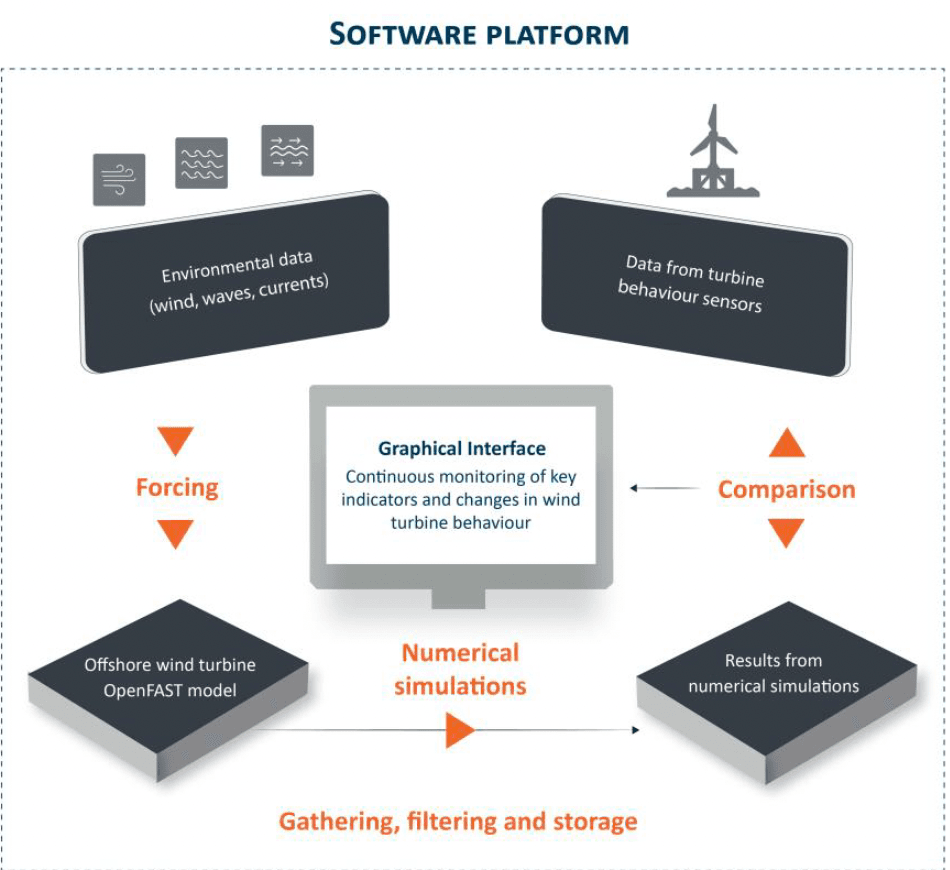
To enable the data collected at sea to be coupled and analyzed with the data from the numerical simulations, a software platform has been fully developed by France Energies Marines. It forms the core of the digital twin developed for this project. This platform gathers and filters the data, as well as forces the numerical model with environmental data (wind, waves, currents) to run the simulations. It also handles data storage and features a graphical control interface for monitoring key indicators and the continuous evolution of the wind turbine’s behavior.
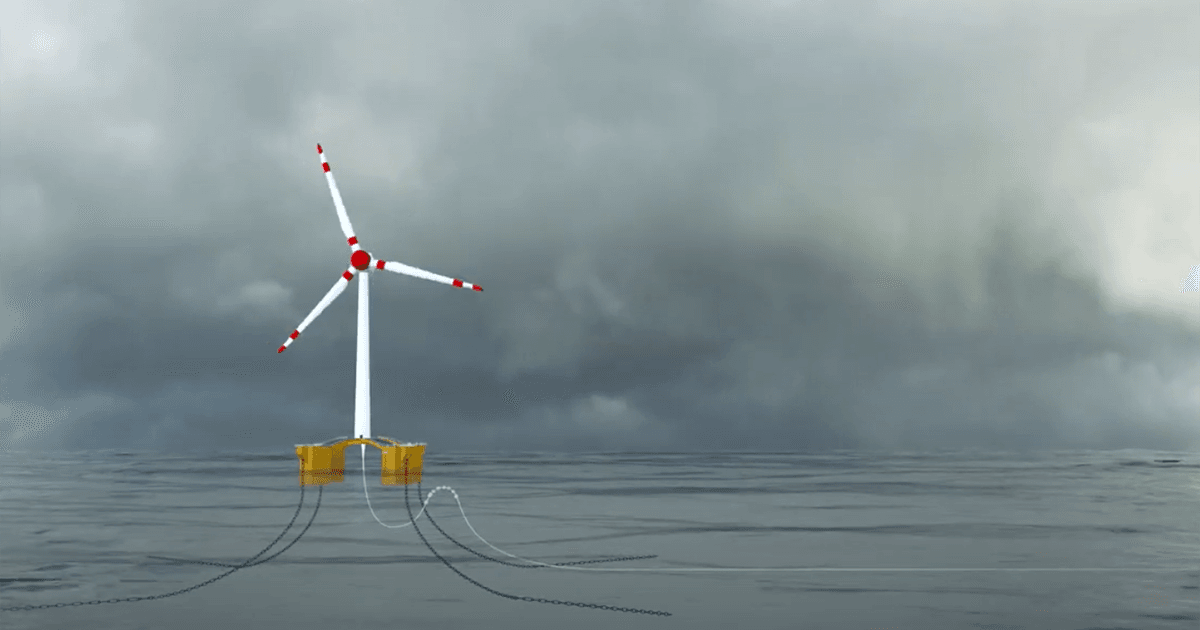
This platform has been deployed and tested on two floating offshore wind turbines: Zefyros (North Sea, off Norway) and DemoSATH (Bay of Biscay, off Spain). Its modularity allows it to be coupled with various numerical modeling tools available on the market, such as OpenFAST, SIMATM, and DeepLinesTM.
Open License Tools for Use by the Sector
Four types of digital tools have been developed as part of DIONYSOS, for use by the sector. They are available under an open license, documented and accessible on France Energies Marines’ GitLab software forge.
- Simuoptuna is a tool for optimizing the parameters intrinsic to the numerical models involved in the modeling a floating offshore wind turbine. By forcing the global numerical model with in situ data, it becomes possible to predict key parameters that have not been measured but which are crucial to the reliability and efficiency of the wind turbine, such as mooring lines tension, electricity production, or the bending moment at the blades. Having a digital model calibrated with real data also makes it possible to generate virtual sensors that offer more accurate monitoring of the fatigue life of critical components.
- Torchydra, which offers models and tutorials for organizing the repository of deep learning models.
- Zefyros OpenFAST, which is the OpenFAST numerical model of the Zefyros wind turbine, was validated with measurements on the offshore system.
- TwinViews is a graphical interface for comparing simulations from Zefyros OpenFAST with in situ measurements and includes an advanced graphical visualization system.
Better Detection and Categorization of Behavioral Anomalies of Floating Wind Turbines
The results from the digital twin were analyzed using a model-based method, in which the model is deliberately faulted to simulate abnormal behavior, which is then categorized (e.g., mooring displacement). The dataset generated in this way can be applied to real data to identify and classify any anomalies. This will enable floating wind farm operators to optimize the maintenance operations required to return the wind farm to normal operation.
In parallel with this work, a deep learning method was used to train a neural network to recognize abnormal behavior in data from in situ measurements, compared with a reference system of situations defined as normal. Compared with a conventional engineering method, the results obtained show greater reliability in predicting anomalies. This method is also perfectly suited to companies that develop sensors and want to improve the performance of their detection algorithms.