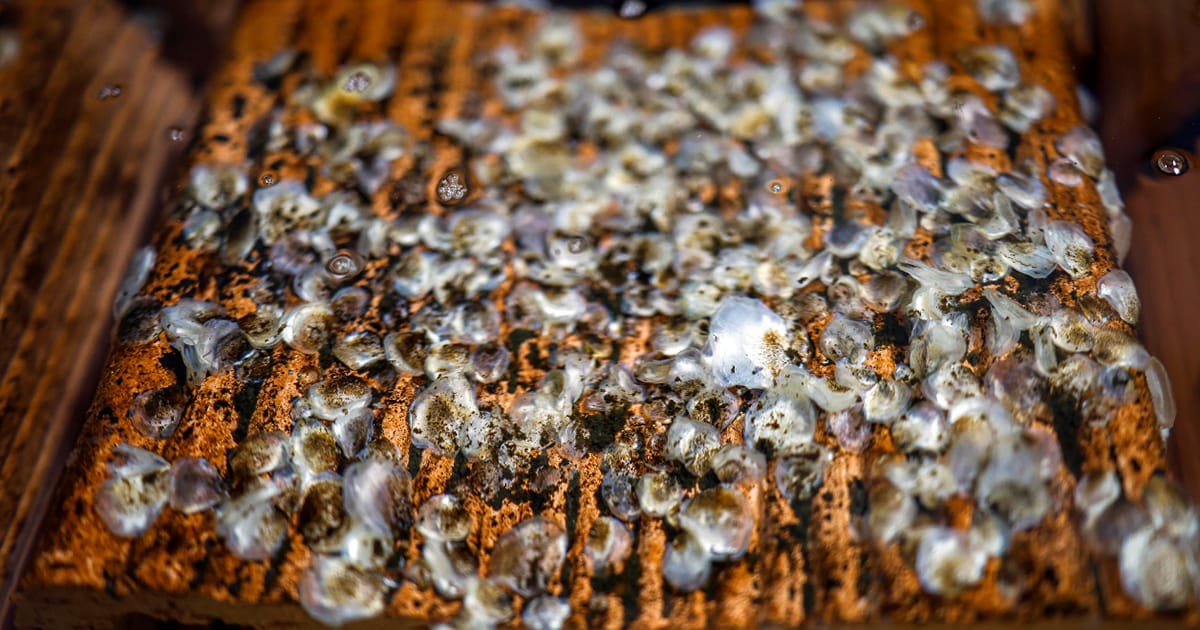
BELREEFS is a collaboration between Jan De Nul, the Institute of Natural Sciences, Shells & Valves, and Mantis Consulting. They installed more than two hundred thousand young oysters on the seabed of the North Sea. Before 1900, European flat oyster beds (Ostrea edulis) were found everywhere in the North Sea. Overfishing and human activity on the seabed have caused them to disappear almost entirely. A persistent parasite also wiped out the last flat oysters in the 20th century.
However, they are extremely valuable habitats. Flat oysters are also known as ecosystem engineers because they form reefs that serve as shelter and food sources for many other species. In this way, they support diverse fish species and enhance biodiversity. They also provide us with all kinds of other ecosystem services. They purify the water and capture (excess) nitrogen. Closer to the coast, they also stabilize the seabed, which makes us more resilient to the effects of climate change.
Minister of Justice and North Sea Affairs Annelies Verlinden: “The North Sea is not only an important economic driver, but also a rich and unique natural environment that we must protect very well. Through this collaboration between government, science, and industry, we are taking an important step towards nature restoration today. Releasing young oysters into our sea is more than symbolic—it is an investment in biodiversity and climate resilience. With projects such as BELREEFS, we are working purposefully towards our ambition: to restore at least 20% of the North Sea to a healthy ecological state by 2030.”
Biodegradable, Hard Material
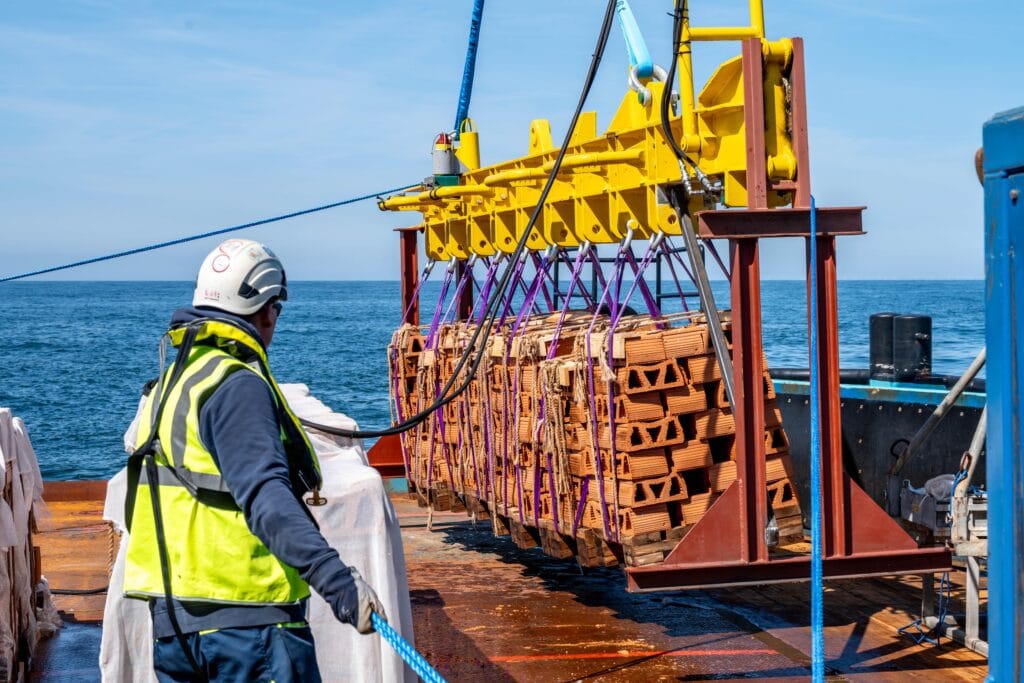
After more than a year of preparation, the oysters were lowered into the water from an installation vessel, attached to what is known as reef substrate. The project team studied various biodegradable materials that could serve as reef substrate and ultimately opted for baked clay bricks. Oyster larvae were sown on these bricks and cultivated for several weeks. This was done partly in a nursery in the Netherlands, but in Ostend, the team is also developing techniques to do this locally, close to the ship’s departure point.
Old Shipwreck
The oysters were introduced on a gravel bed thirty kilometers from the coast, around the legally protected shipwreck Kilmore, at a depth of 30 meters. The project team chose this location with care. They mapped out the locations with the most suitable seabed and environmental conditions to maximize the chances of survival. Natural protection against damage and currents, and optimal conditions for installation, are also important parameters. They also consulted with the fishing industry via the Redercentrale (Shipping Association) to determine the best location for the oyster reef.
Intensive Monitoring
After installation, an intensive monitoring program will be carried out to track the development of the reef and its effect on biodiversity. The monitoring of the habitat will assess the ecological impact and provide crucial insights for the scientifically substantiated management of the restoration area, as well as for the further development of future upscaling plans.
European Law for Nature Restoration
The BELREEFS restoration project is one of the federal measures resulting from European directives to improve the environmental status of our seas. The project is supported by the LIFE project Belgium for Biodiversity, which aims to strengthen biodiversity in Belgium.
Merel Oeyen, Policy Officer at the Marine Environment Department (FPS Public Health): “The new European Nature Restoration Regulation requires member states to draw up a nature restoration plan setting out how damaged nature—including in the sea—can be restored. The restoration of oyster beds is one of the priorities for marine nature restoration in Belgium. We expect more than 30,000 oyster larvae to grow into adult oysters. The survivors will reproduce, expand the reef, and attract other marine species. This will create a self-sustaining ecosystem without further human intervention.”
Applications of Unique Know-How
The knowledge and techniques developed during BELREEFS have broader applications in active nature restoration—for example, in Natura 2000 areas—but also in the nature-inclusive design of offshore infrastructure for renewable energy. Jan De Nul can also apply these techniques to the many wind farms and submarine cables that it helps to install.
Vicky Stratigaki, Marine engineer and project coordinator BELREEFS at Jan De Nul: “In our various marine construction projects, we often work with rocks, gravel, and other hard materials. For example, to protect the foundations of wind turbines or submarine cables from currents, waves, anchors, and fishing nets. We are constantly looking for new and efficient ways to integrate nature restoration into our core activities. With BELREEFS, we are laying the foundations for a large-scale restoration of oyster reefs in the North Sea and beyond. We are also doing this through projects such as the Princess Elisabeth Island and Reefcovery, in which we are working towards the further upscaling of active oyster reef restoration and focusing on the integration of oysters into marine infrastructure.”
BELREEFS is a collaboration between Jan De Nul, the Institute of Natural Sciences, Shells & Valves, and Mantis Consulting, and is being carried out on behalf of the Federal Public Service Health, Food Chain Safety and Environment as part of action T4.8 of the LIFE B4B project (101069526).
The oysters were cultivated in collaboration with the Dutch Stichting Zeeschelp and Oyster Heaven (Mother Reef). For all our projects, we collaborate with NORA experts and adhere to the guidelines of the Native Oyster Restoration Alliance, an international organization. This ensures that we work with the best available knowledge, advanced technologies, and leading experience.