
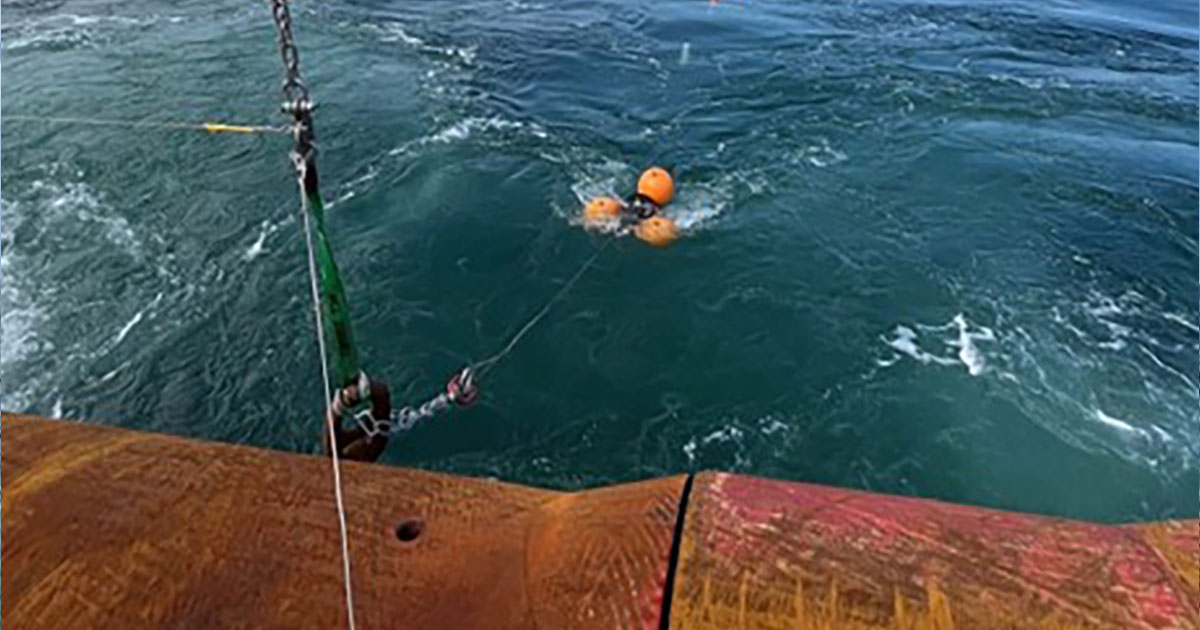
Commissioned by the Department for Environment, Food and Rural Affairs (Defra), the pilot study is being delivered by Seiche as lead contractor, working alongside partners SAMS Enterprise, SMRU Consulting, and TNO. The study commenced during piling operations at RWE’s Sofia Offshore Wind Farm and continued at ScottishPower Renewables’ East Anglia THREE Offshore Wind Farm, both of which have adopted noise reduction measures during construction in 2025 and 2026.
This pilot study follows a desk-based feasibility study undertaken by Seiche and Tetra Tech RPS Energy, which evaluated realistic noise limit thresholds and designed the program to test these scenarios in real-world settings.
Using a combination of autonomous underwater recording units (ARUs) and porpoise click detectors (F-PODs), the study will:
- Assess the effectiveness of various noise abatement technologies under real conditions.
- Evaluate how achievable the proposed decibel limits are in practice.
- Improve scientific understanding of marine mammal disturbance, both with and without noise abatement systems (NAS).
- Document operational experiences with NAS deployment in English and Welsh waters
- Utilize results to inform future policy and implementation.
Field monitoring is now complete at Sofia Offshore Wind Farm, where a seabed array of passive acoustic monitoring devices was deployed in April 2025 to collect data during the installation of up to ten monopile foundations using a big bubble curtain (BBC) system. The Sofia monitoring program also complements a wider effort led by SMRU Consulting to monitor porpoise responses during concurrent piling at Dogger Bank C Offshore Wind Farm, being developed and constructed by SSE Renewables. Together, these efforts will build on a larger body of work carried out in the North Sea to help refine our understanding of porpoise responses to piling activity, including effective deterrence ranges (EDRs).
At East Anglia THREE, further data has been gathered during a six-month deployment which began in May 2025, focusing on piling operations using in-line hammer noise reduction technology supplied by MENCK. This builds on an ongoing long-term monitoring program within the southern North Sea Special Area of Conservation (SAC) for harbor porpoise, also led by Seiche and SAMS Enterprise. The aim is to develop a more nuanced dose-response relationship between underwater noise and porpoise behavior across all phases of offshore wind development, from pre-construction and UXO clearance through to turbine operation.
Seiche and its partners bring unmatched expertise in underwater acoustic monitoring, marine mammal assessment, and offshore wind development. With a track record that includes more than 2,000,000 operational days at sea and strong relationships with industry and regulators, the consortium will deliver key results underpinned by cutting-edge science and contribute key confidence to our growing knowledge towards the management of future offshore developments.
The pilot study forms part of the Offshore Wind Evidence and Change program, led by The Crown Estate in partnership with the Department for Energy Security and Net Zero and the Department for Environment, Food & Rural Affairs. The Offshore Wind Evidence and Change program is an ambitious, strategic research and data-led program. Its aim is to facilitate the sustainable and coordinated expansion of offshore wind to help meet the UK’s commitments to low-carbon energy transition whilst supporting clean, healthy, productive, and biologically diverse seas.
Roy Wyatt, CEO of Seiche Water Technology Group, said: “We’re proud to lead this vital pilot program in collaboration with some of the most respected marine science organizations. This clearly demonstrates what can be achieved when we work together. As the offshore wind industry expands, it is essential that noise management measures are both practical and underpinned by sound science. This work will provide the robust evidence base needed to support future policy and help protect marine life in our seas.”