An array of Sonardyne’s Fetch instruments will provide the precise and stable underwater positioning that the 3,000 m deep Pacific Ocean Neutrino Experiment (P-ONE) needs to accurately detect and analyze high-energy neutrinos.
P-ONE—a multi-national, multi-institute scientific collaborative project—will help scientists to unlock insights into extreme cosmic phenomena like black holes and supernovae.
The next-generation cosmic neutrino telescope will be built off the coast of British Columbia, Canada, leveraging Ocean Networks Canada’s existing world-class advanced deep-sea infrastructure.
Alongside exploring the universe, P-ONE will also deliver vital data for oceanography, climate science, and tectonic research, advancing both astrophysics and marine technology.
Simon Fraser University (SFU), in British Columbia, is one of the collaborators on the P-ONE project and is the coordinator of the array’s acoustic positioning.
Professor Matthias Danninger, principal investigator at SFU, said, “The P-ONE collaboration’s goal is to create a unique observational facility, as part of a global effort to improve our understanding of high-energy and ultra-high-energy cosmic neutrinos, their sources, and their role in astro and particle physics.
“The positioning system is critical to its success. Critically, we need to know precisely where our detector is in the absolute geo-reference frame and also where each component is relative to each other at any time, as, although anchored, the ocean currents will move the detector lines constantly.
“With Sonardyne’s Fetch system, we’ll achieve the precision we need and continuous monitoring to maintain alignment, safeguarding data integrity and enabling P-ONE to unlock insights into extreme cosmic phenomena.”
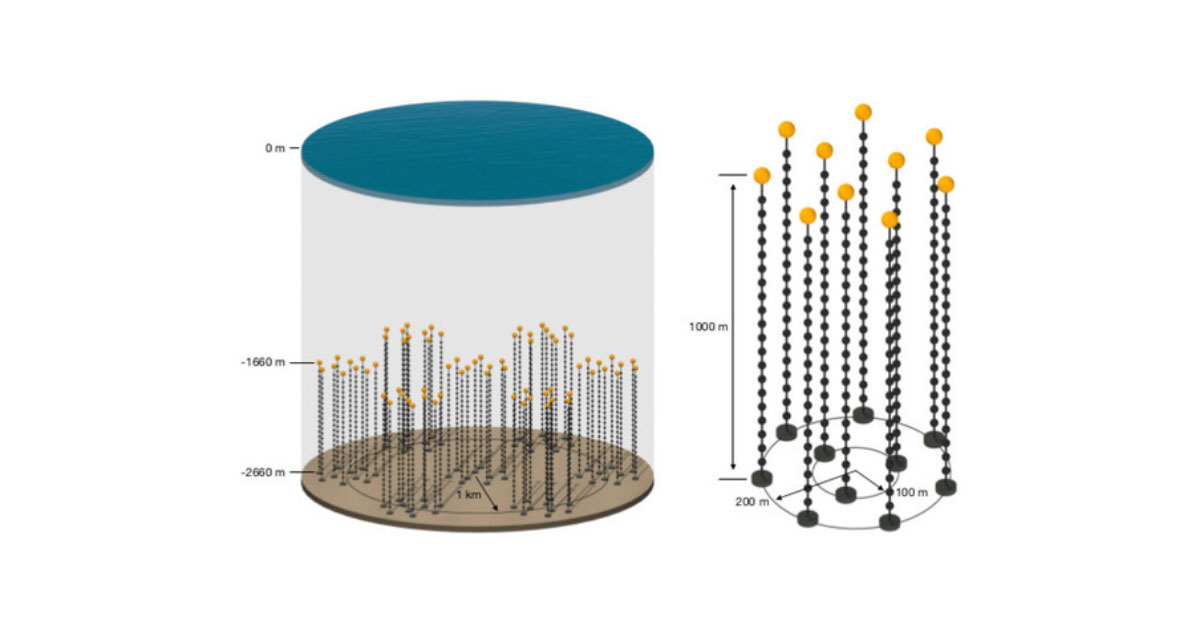
The P-ONE detector will involve the anchoring of a three-dimensional array of thousands of advanced optical sensors, creating a vast detection grid. These will detect the faint light (Cherenkov radiation) created when high-energy neutrinos interact with water molecules.
The P-One collaboration’s goal is to build a full detector array that would cover multiple square kilometers. The initial pilot array – and a potential future full array—will be connected into ONC’s existing cabled infrastructure, which spans thousands of kilometers in the Cascadia Basin.
Thanks to the ONC infrastructure, P-ONE has readily available power and data transmission capabilities, enabling real-time monitoring and analysis.
“We’re incredibly proud that our Fetch technology is playing a pivotal role in the P-ONE project, supporting international, collaborative science,” said Michelle Barnett, Ocean Science Business Development Manager/Kim Swords, Sales Manager, Sonardyne.
“By ensuring precise sensor positioning and stability, we will be enabling pioneering discoveries in cosmic phenomena and demonstrating how innovative underwater technology can advance global scientific research.”
Designed as a long-life autonomous seabed node, Fetch can operate for up to 10 years, making it ideal for extended deep-sea monitoring campaigns.
Its adaptable design allows for a range of sensors to be integrated, supporting everything from seabed deformation studies to broader ocean science.
With a robust, deep-rated housing and seamless integration into Sonardyne’s positioning ecosystem, Fetch is a pivotal tool for advancing research in the deep sea.