Backed by $7.5 million in seed funding, the system enables UAVs to operate from vessels as small as 10 meters and decks of any size, without any hardware or software modifications to the UAV. WaiV’s patent-pending catch-lock-release landing mechanism, combined with AI-driven predictive algorithms, enables safe and precise drone recovery even while vessels are in motion on the open sea.
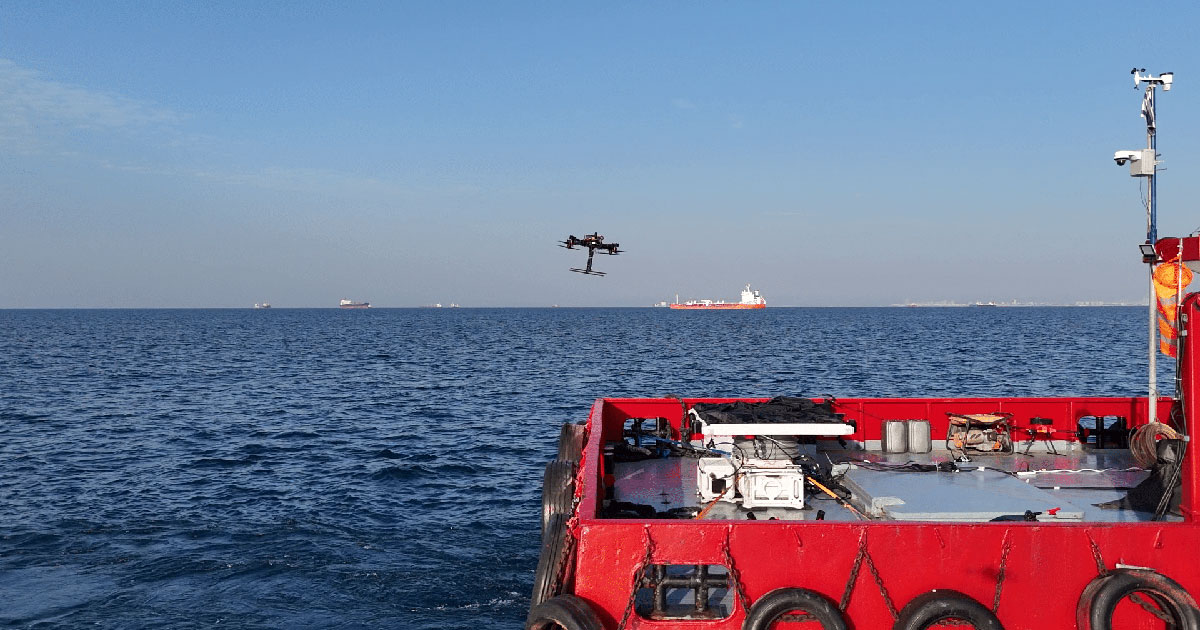
While airborne drones have become increasingly capable on land, operating them at sea introduces a different set of challenges. Offshore, the landing surface is in constant motion, shifting unpredictably with stochastic wave patterns that make a vessel deck far less stable than anything on land. Instead of a UAV approaching a fixed landing pad on shore, the drone must adapt to a surface that is constantly moving (six degrees of freedom) and may also be salt-covered and slippery upon contact. Until now, existing solutions have been limited to calm waters or lab conditions, leaving offshore operators hesitant to deploy UAVs, especially from smaller vessels.
WaiV Robotics VTOL landing at sea. (Video credit: WaiV Robotics)
As the first to solve fully autonomous UAV landings at sea, WaiV’s approach centers on the infrastructure needed to support reliable UAV operations with a landing platform designed to operate independently of human input under difficult sea conditions. Designed to support the full mission cycle from takeoff through recovery and landing, the system includes:
- Stabilized landing infrastructure: Through AI-controlled software and specialized algorithms, a gyro-stabilized platform effectively “takes over the sticks,” guiding the drone via its remote control and eliminating the need for an expert pilot during landing.
- Impact absorption and secure capture: The landing pad absorbs impact on contact, while a locking mechanism secures the UAV’s skids to prevent bounce, slide, or roll-off in high-sea conditions.
- Broad VTOL UAV compatibility: Designed to support any type of VTOL UAV, including multicopter, fixed-wing, and helicopter platforms, regardless of the manufacturer.
Designed to scale across a range of operational needs, the platform supports UAVs up to 15 kg, with plans to accommodate smaller aircraft carriers as small as 3kg and larger carriers weighing 100–300 kg. The system supports WaiV Robotics’ goal of making UAVs a viable option for offshore fleets that have traditionally faced deployment constraints.
“For drones to become a reliable part of offshore operations, the missing piece isn’t the aircraft, it’s the infrastructure around it,” said Johnny Carni, Founder and CEO of WaiV Robotics. “Our system was designed to remove traditional deployment constraints, allowing fleets to operate as mobile launch and recovery hubs that ensure reliable UAV operations. Without a dependable way to launch and recover at sea, large-scale deployment simply doesn’t work. Our goal is to remove that constraint and make drone operations viable from virtually any vessel.”