“Neptun Deep is a strategic project for Romania and for the energy security of the region, involving investments of around EUR 4 billion and an estimated annual production of around 8 billion cubic meters of natural gas. In 2026, we will make significant progress here in Romania: installing the offshore pipeline, subsea equipment, and the production platform. All activities are carried out to the highest safety and quality standards, with the objective of starting production in 2027,” said Christina Verchere, CEO of OMV Petrom.
“The installation work planned for this year involves mobilizing a fleet of approximately 50 vessels—up to 10 of which are involved in the pipeline installation work. These are world-class vessels specialized in subsea installations, including some of the largest offshore units in the world. The integration of maritime, subsea, and onshore operations is essential to delivering the project safely and within an ambitious timeframe,” said Cristian Hubati, the OMV Petrom Executive Board member responsible for Exploration and Production.
“The main gas pipeline installation kick-off represents an essential milestone in the development of Neptun Deep project. The existing partnership demonstrates efficient cooperation for delivering such a complex project, with a key role in energy security. The completion of the investment and start of commercial production from the natural gas fields, with first gas delivery in 2027, will strengthen Romania’s position by an energy resilience advantage at national and regional level,” stated SNGN ROMGAZ SA CEO Răzvan Popescu.
“Within Neptun Deep project, the main gas pipeline will be part of the gas production infrastructure. During this year, the project is transitioning from a global to a local execution dimension, with a large mobilization of resources for the installation and connection of subsea equipment in the Black Sea. We are determined to successfully complete this project, conduct the offshore operations safely, through the joint efforts of the project teams and contractors involved in the Neptun Deep project,” stated SNGN ROMGAZ SA Deputy CEO Aristotel Jude.
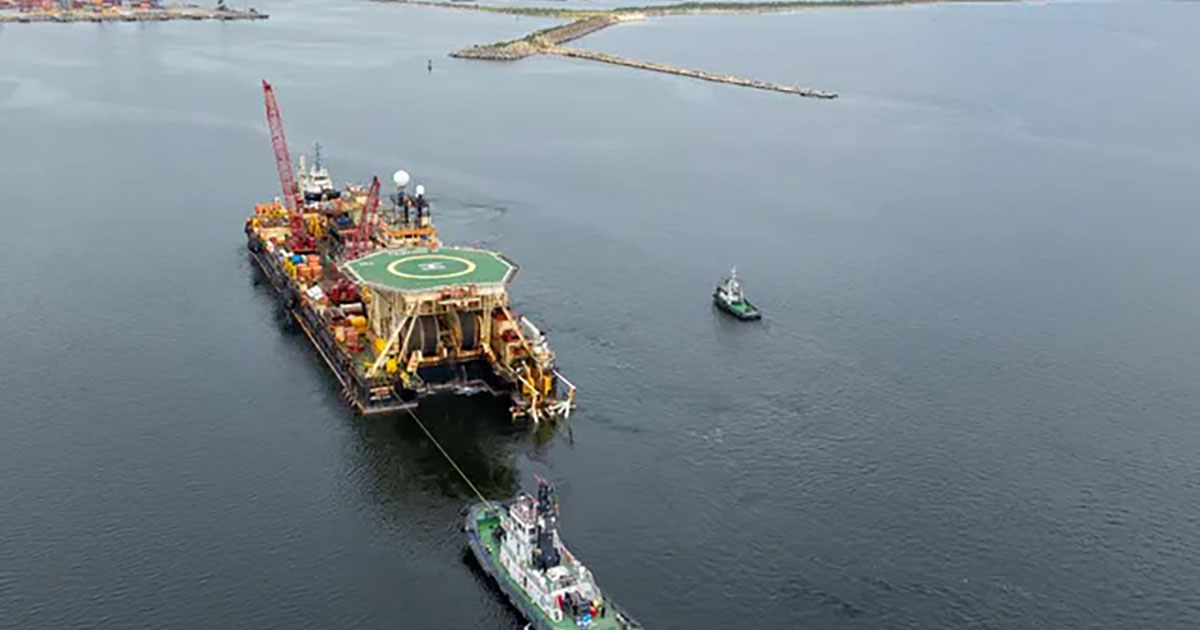
The first vessel in the fleet required for the Neptun Deep project has arrived in Romania: Castoro 10 will install the first section of the pipeline in the coastal area. The connection will be made via the microtunnel already constructed in Tuzla, a technology that enhances work safety and minimizes environmental impact.
The 160-km pipeline—a key component of the offshore infrastructure
The pipeline installation phase is a key component of the project. The pipeline will stretch over approximately 160 km, built from thousands of steel pipe segments with a diameter of 30” (76 cm).
The pipeline will transport natural gas from the offshore production platform to shore, where it will be metered and delivered to the National Transmission System.
The Neptun Deep infrastructure includes the offshore production platform, three subsea systems, 10 production wells—four already drilled on Pelican South and six underway on Domino—as well as the onshore gas metering and control station at Tuzla.
Pipeline installation vessels operate as miniature assembly lines. The pipeline joints are aligned, welded together, tested, and coated on board before being lowered in a continuous string to the seabed. This system enables rigorous quality control at each step and high operational efficiency even in offshore conditions.
Key vessels involved in the installation activities:
- Castoro 10—a specialized pipe-lay vessel for nearshore installation, over 160 meters in length
- Castorone—one of the largest and most powerful offshore pipelayers globally, approximately 330 meters in length
- JSD 6000—one of the most advanced multipurpose deep‑water pipelaying and heavy‑lift vessels currently in service. It will carry out the installation of the subsea infrastructure in the deep‑water area, ensuring the connection of the wells to the production platform.
These vessels will be supported by supply vessels, tugboats, barges, and ROV-operated units, ensuring efficient and safe offshore operations.