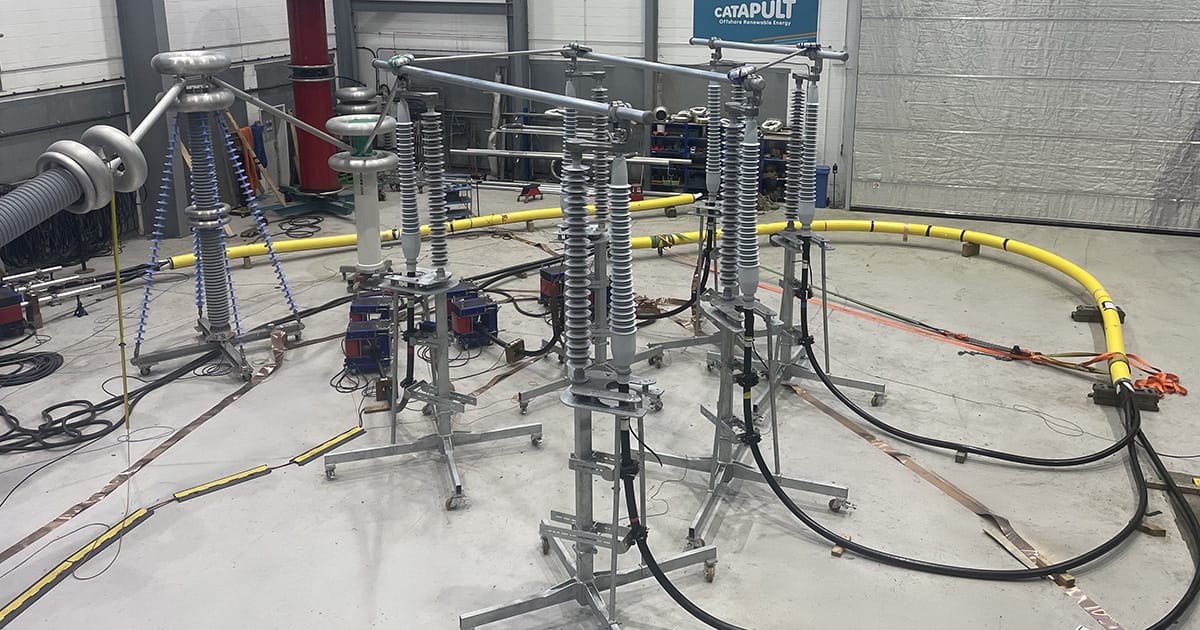
JDR’s static cable development and testing were supported by a Development Grant from the Offshore Wind Growth Partnership and produced in collaboration with a leading materials supplier, with extensive testing performed at Offshore Renewable Energy Catapult. JDR will manufacture the innovative 132 kV cables at their upgraded Hartlepool facility as well as in their new high-voltage cable manufacturing facility in Cambois, near Blyth, Northumberland.
To facilitate the installation of next-generation offshore wind turbines at 20 MW and above, as well as accommodate increasing distances from shore and greater water depths, the industry requires significantly higher voltage cables. By doubling the voltage of the industry-standard 66 kV array cable, JDR’s technology will allow increased transmission between turbines at higher capacity—a vital factor in continuing to reduce the cost of offshore wind and assist in reducing the impact of clean energy prices for consumers.
The successful type test qualification of the fixed foundation 132 kV static cable technology is further supported by the successful completion of JDR’s second high-voltage cable development under the Department of Energy Security and Net-Zero’s Floating Offshore Wind Demonstration Program. The AHEAD (Advanced High-Voltage Export and Array Dynamic) cable project, supported by £1.6 million in grant funding, has demonstrated the viability of 132 kV dynamic cables for floating wind applications. A full testing program has been successfully completed, including over 1.5 million tension-bending cycles, thereby validating the reliability of the advanced cable design when subjected to the dynamic motion it will endure in offshore floating applications.
Joe Cole, Technology Manager – Power Cables at JDR, commented: “We pride ourselves on providing solutions to the energy sector ahead of time, and with our 132 kV technology, we will do exactly that. Dynamic cables for floating wind and advanced 132 kV cable technologies are critical for the progressive deployment of both fixed and floating offshore wind, enabling developers to not only deploy larger turbines but also to site floating offshore wind in deeper waters, further offshore. It’s an exciting time for the industry, and we are right at the forefront by developing, validating, and delivering new solutions for the benefit of the offshore energy industry and electricity consumers.”
As part of its broader strategy to drive innovation in high-voltage subsea technology, JDR is contributing its technical findings to the international standards body CIGRE, helping to inform the evolution of safety standards for higher-voltage applications. In addition, the company is actively involved in the Carbon Trust’s Offshore Wind Accelerator High Voltage Array Systems project, which supports the development and qualification of 132 kV cable technology within the UK. These efforts align closely with the UK Government’s commitment to advancing floating offshore wind, as reflected in the £31.6 million grant funding awarded by the Department for Energy Security and Net Zero through the Net Zero Innovation Portfolio, aimed at accelerating the demonstration of innovative technologies in this sector.