Interestingly, they have also emphasized the idea of “breaking from traditions”—whether by expanding beyond traditional academic pathways or ensuring that students gain expertise beyond traditional maritime operations. Success in the Blue Economy workforce increasingly requires a mix of technical knowledge, problem-solving skills, and hands-on experience, all of which can be gained through nontraditional learning models.
MATE ROV COMPETITION
While after 23 years one might consider it a “tradition,” since its inception the MATE ROV Competition has embraced this non-traditional philosophy, engaging students in real-world challenges that integrate scientific, engineering, and technical skills with critical thinking, collaboration, entrepreneurship, and innovation. Developed in partnership with the MTS ROV Committee, the program originally served as a workforce development pipeline for the offshore oil and gas industry but has evolved to address a broad range of industry sectors.
Competition challenges now reflect the growing demands of the blue economy workforce. Missions simulate ROVs’ roles in marine renewable energy, such as offshore wind farms, floating solar panel arrays, and tidal turbines. Recent partnerships with oceanographic research institutions have introduced new challenges, like designing and building vertical profiling floats equipped with sensors to collect, transmit, and image data.
FIRST-HAND PRACTICAL EXPERIENCE
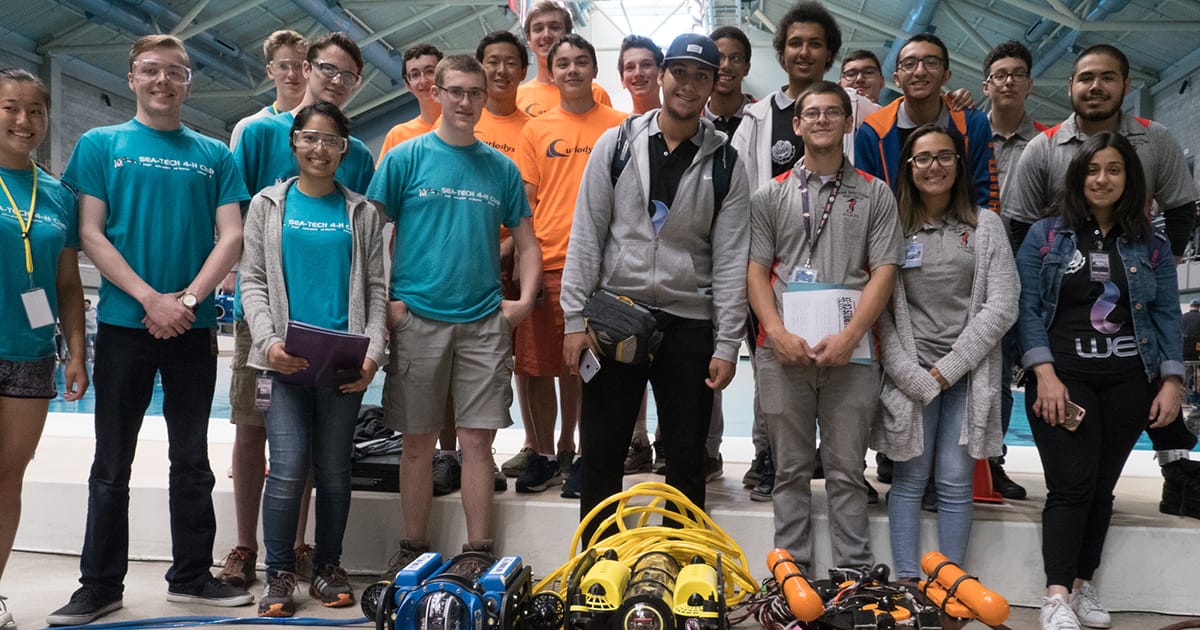
Regardless of the scenario, the mission tasks are designed to simulate the high-performance workplace and to allow students to experience first-hand the practical applications of their academic learning—be it from a traditional classroom setting, afterschool robotics club, senior capstone project, or intense, week-long marine technology workshop, like those offered by MTS.
And it was with the MATE ROV Competition’s integration into MTS in 2023 that we furthered one of the program’s founding tenets: to increase students’ awareness of career opportunities within the blue sector while helping them build their networks and find jobs. It’s been said that “they can’t be what they can’t see;” attend a MATE competition event and you will see students engaging with professionals from the field, learning about the work they do, and starting to envision and plan their own career paths.
INSPIRING FUTURE GENERATIONS
Now entering its 23rd season, the MATE ROV Competition has grown from one event to a network of 45 “regional” programs that take place across the country and around the world. The competition has entrained thousands of students from K-12 through community college and 4-year university into the workforce pipeline, ultimately growing a global community of learners, inspired by the ocean, innovating and collaborating to address societal challenges.
Circling back to my colleagues’ previous spotlights, I appreciate the closing comments of one in particular; that our “focus must remain on creating accessible education pathways.” Keeping the MATE ROV Competition accessible to a broad range of student learners remains a priority and guiding principle of this workforce development program, reinforcing the principle of “equality of opportunity.” Attracting, engaging, and retaining the full scope and spectrum of individuals is key to fostering creativity, driving innovation, and ensuring the sustainable growth of the Blue Economy.
This spotllight appeared in ON&T Magazine’s 2025 April Edition, Offshore Energy Transition, to read more access the magazine here.