From Argo to OneArgo
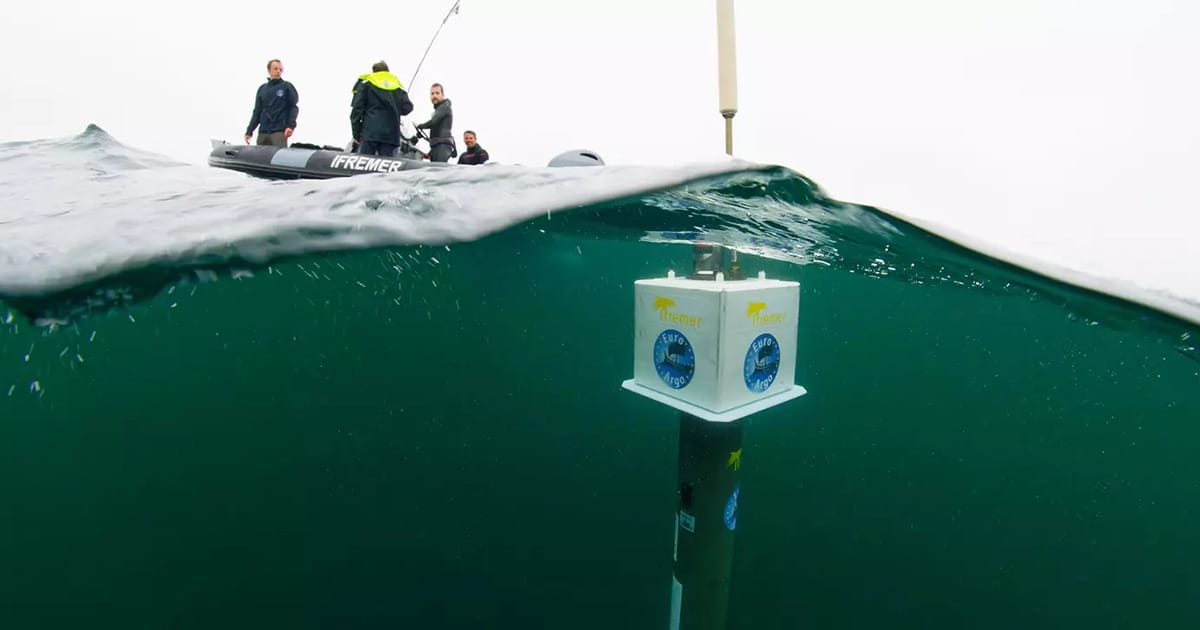
Launched in the early 2000s, the international Argo program has revolutionized our ability to observe and understand the ocean in real time, thanks to a global network of 4,000 autonomous floats deployed across all oceans. Deployed from ships, these autonomous underwater instruments drift with ocean currents for up to six years, measuring ocean temperature and salinity from the surface down to 2,000 meters. They take the “pulse” of the ocean. The data collected are then transmitted by satellite to the scientific community, providing a vital resource for ocean monitoring and research.
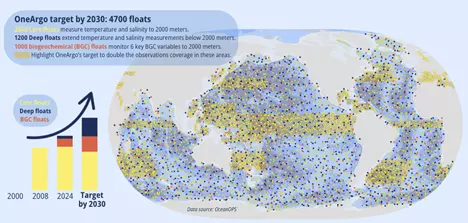
By 2030, the program aims to expand its observational capabilities, enabling comprehensive monitoring of the global ocean—from surface to seabed—and broadening the range of physical and chemical parameters it monitors. Argo becomes OneArgo—a global, full-depth, and multidisciplinary ocean observing system.
Among the 4,700 profiling floats targeted in the OneArgo array, 1,200 will have deep-ocean measurement capabilities down to 6,000 m (Deep floats), and 1,000 will monitor key biogeochemical parameters (BGC floats), such as pH, oxygen content, chlorophyll, light, suspended particles, and nitrate concentrations. Implementation of OneArgo is already underway, with 500 BGC floats and 200 Deep floats currently operational.
The data, openly and freely accessible, provide tangible benefits to society. They support informed and evidence-based decision-making in a wide range of domains—maritime safety, weather and climate forecasting, sustainable management of marine resources, ecosystem resilience, and adaptation to extreme events. With climate change and human activities in general exerting increasing pressure on our environment and lifestyles, this information is more crucial than ever.
Securing Sustainable Funding
Through this publication, the international community speaks with one voice: it is vital to ensure the long-term sustainability of the Argo program and to fully implement its OneArgo expansion by 2030. This ambitious evolution provides society and policymakers with the foresight needed to respond effectively to the climate and environmental challenges—deeply interconnected with the ocean—that we collectively face. In the context of rapid changes in the Earth system driven by human activities, maintaining and strengthening our ability to understand and monitor the ocean is essential. It is a prerequisite for developing the best adaptation strategies and for safeguarding ocean health and biodiversity, food security, the maritime economy, and human well-being.
Today, the entire Argo value chain—manufacturers, research institutes, operators, and scientists—is fully mobilized to meet the OneArgo challenge over the next five years. The goal is to build on the expertise gained to sustain the existing network while evolving it towards a more comprehensive and integrated coverage. The stakes are clear: preserve the services provided by Argo and ensure the continuity of long-term observational records, which are essential for monitoring climate change. Yet, despite its recognized scientific and societal value, OneArgo currently receives only partial and short-term research-based funding.
Faced with the uncertainties of international funding, OneArgo’s realization requires, more than ever, sustained and significantly increased investment. This means breaking with the logic of project-based funding in favor of an institutionalized, long-term model—like meteorological observation systems, which have long been supported by stable public and private funding.
To read the article, visit: https://www.frontiersin.org/journals/marine-science/articles/10.3389/fmars.2025.1593904/full