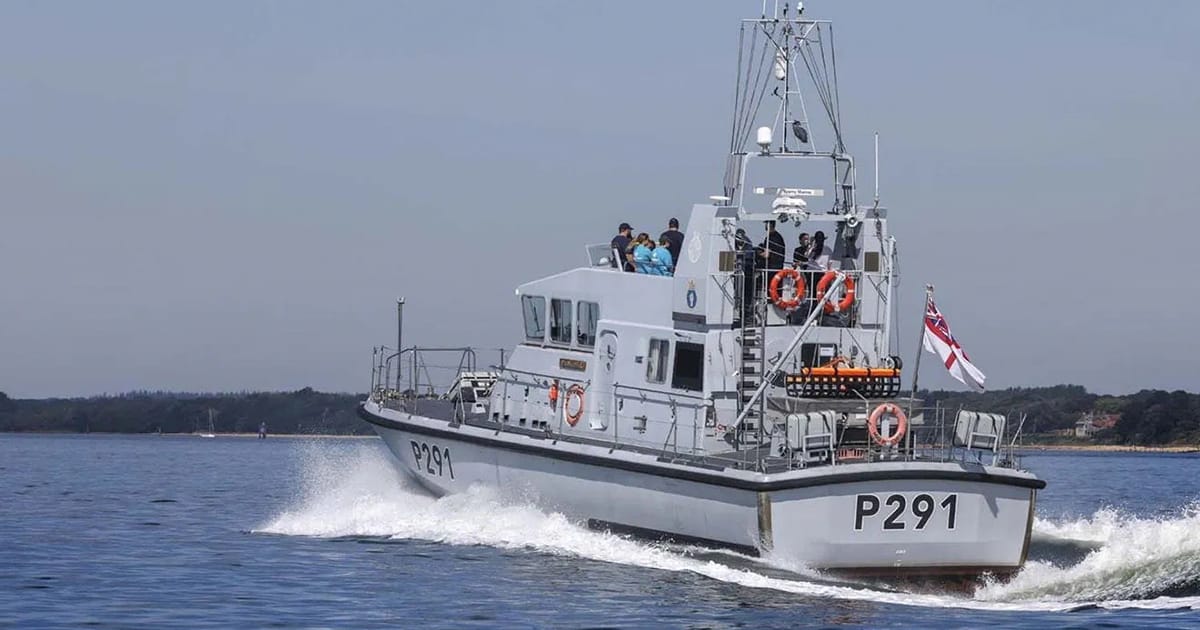
Quantum sensing specialists Aquark Technologies have been working with the P2000 HMS Puncher of the Navy’s Coastal Forces Squadron to test their atomic clock system AQlock.
The system functioned non-stop onboard Puncher in the Solent, marking an important milestone for Position, Navigation, and Timing technology and a step forward in reducing reliance on satellites.
The navy’s Disruptive Capabilities and Technologies Office and the Ministry of Defence’s Defence Science and Technology Laboratory (Dstl) supported Aquark’s latest trial—the first of its kind testing the stability of the AQlock operating in open waters.
The AQlock is the UK’s first industrially designed and built cold atom-based clock. It works by transferring atoms that have been cooled to near absolute zero to a conventional oscillator to reduce long-term drift, allowing real-time and highly precise data on the clock’s position.
The technology is underpinned by the supermolasses trap, a unique method of trapping atoms pioneered by Aquark that makes the technology highly robust, portable, and more affordable—ultimately meaning it can be transferred onto a ship such as HMS Puncher.
By demonstrating its ability to continuously operate aboard a Royal Navy vessel in rough offshore conditions, the company is now closing in on its goal of improving conventional Position, Navigation and Timing, and reducing global reliance on Global Navigation Satellite System for military operations, infrastructure, telecommunications, finance, transportation, and many other sectors.
“The Royal Navy remains committed to exploring disruptive technologies that offer the potential for significant operational advantage,” commented Chester Butterworth, Head of Strategy at the Royal Navy’s Disruptive Capabilities and Technologies Office.
Chester Butterworth, Head of Strategy at the Royal Navy’s Disruptive Capabilities and Technologies Office, said: “The Royal Navy remains committed to exploring disruptive technologies that offer the potential for significant operational advantage.
“The outcome of this trial aligns with the UK’s sovereign capability goals and paves the way for future innovation that will enable the Royal Navy to leverage best-in-class technologies.
“The capabilities of Aquark’s system to improve existing Position, Navigation, and Timing methods, outside of the laboratory and in harsh, remote environments, is a milestone achieved by very few systems to date.”
Commander Carla Higgins, Commanding Officer Coastal Forces Squadron, added: “The Coastal Forces Squadron is delighted to have taken part in trialing this unique technology.
“P2000 Inshore Patrol Vessels are an ideal platform to provide the challenging at-sea conditions required to put systems to the test.
“The team in HMS Pursuer appreciates the exposure to such new equipment and the opportunity to learn about the technology which will contribute to the UK’s capabilities of the future.”
The AQlock was developed with support from a Small Business Research Initiative (SBRI) grant from Innovate UK.