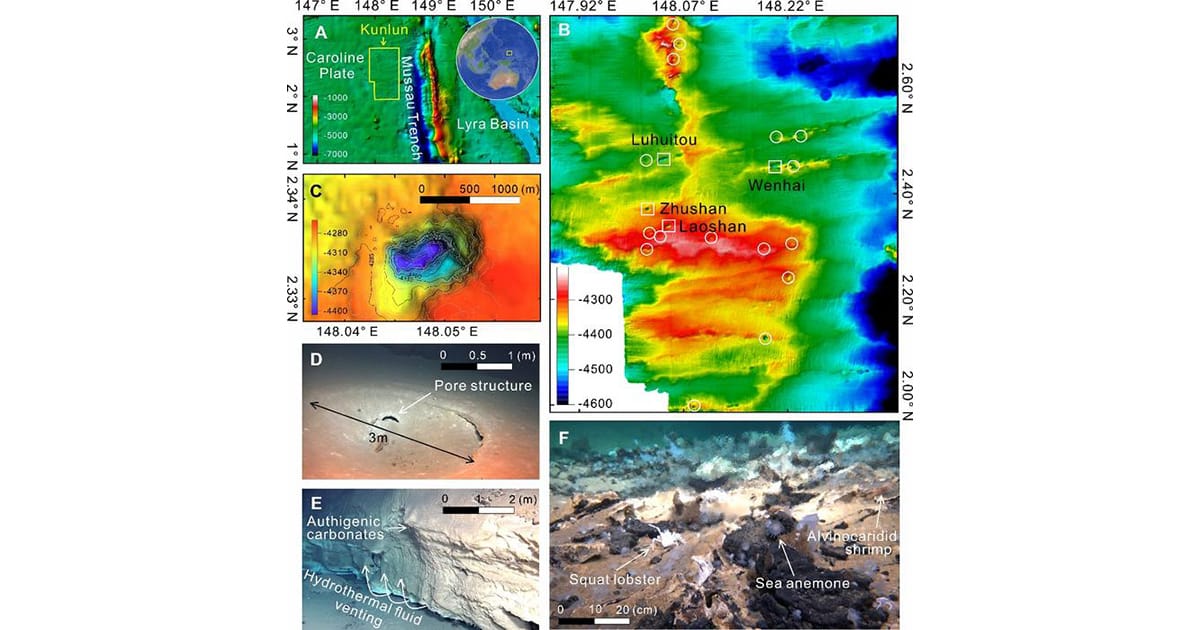
The Kunlun hydrothermal field—a tectonically active site roughly 80 kilometers west of the Mussau Trench on the Caroline Plate—comprises 20 large seafloor depressions (some exceeding one kilometer in diameter) clustered together like a pipe swarm, a group of vertical or steeply inclined cylindrical rock structures that funnel liquid or gas from Earth’s interior. The system was explored using the crewed submersible Fendouzhe. In situ investigations revealed abundant hydrogen-rich fluids and extensive carbonate formations, all located below the carbonate compensation depth.
The findings were published in Science Advances.
“The Kunlun system stands out for its exceptionally high hydrogen flux, scale, and unique geological setting,” said Prof. SUN Weidong, the study’s corresponding author. “It shows that serpentinization-driven hydrogen generation can occur far from mid-ocean ridges, challenging long-held assumptions.”
Deploying advanced seafloor Raman spectroscopy, the team measured molecular hydrogen concentrations of 5.9–6.8 mmol/kg in diffuse hydrothermal fluids. Although the fluids themselves are moderately warm (under 40°C), geochemical markers indicate much higher subsurface temperatures—sufficient to drive dolomite formation—pointing to intense fluid–rock interactions deep beneath the seafloor.
Based on discharge area mapping and flow velocity analysis, the Kunlun field’s annual hydrogen flux is estimated at 4.8 × 1,011 mol/year, representing at least 5% of the global abiotic hydrogen output from all submarine sources—a notable contribution for a single system.
Geological features—including steep-walled craters resembling kimberlite pipes, explosive breccia deposits, and layered carbonate structures—suggest the hydrothermal activity has followed a staged evolution: gas-driven eruptions first, followed by prolonged hydrothermal circulation and mineral deposition.
“What’s particularly intriguing is its ecological potential,” Prof. SUN said. “We observed diverse deep-sea life thriving here—shrimp, squat lobsters, anemones, and tubeworms—species that may depend on hydrogen-fueled chemosynthesis.”
This discovery provides a natural laboratory for studying links between hydrogen emissions and the emergence of primitive life. Alkaline, hydrogen-rich fluids like those at Kunlun are thought to mirror early Earth’s chemical environment.
The Kunlun hydrothermal system not only expands our knowledge of deep-sea hydrogen processes but also opens new avenues for identifying untapped submarine hydrogen resources, the researchers noted.