Ocean alkalinity enhancement (OAE), particularly through approaches like alkaline mineral addition, has the potential to remove several billion tons of CO2 with a credible path to under $100 per ton. Frontier has supported the deployment of alkaline materials across a range of environments to help clarify the efficacy, scalability, and safety of each approach: on land, in freshwater systems like rivers and wastewater treatment, and now in a coastal environment with Planetary.
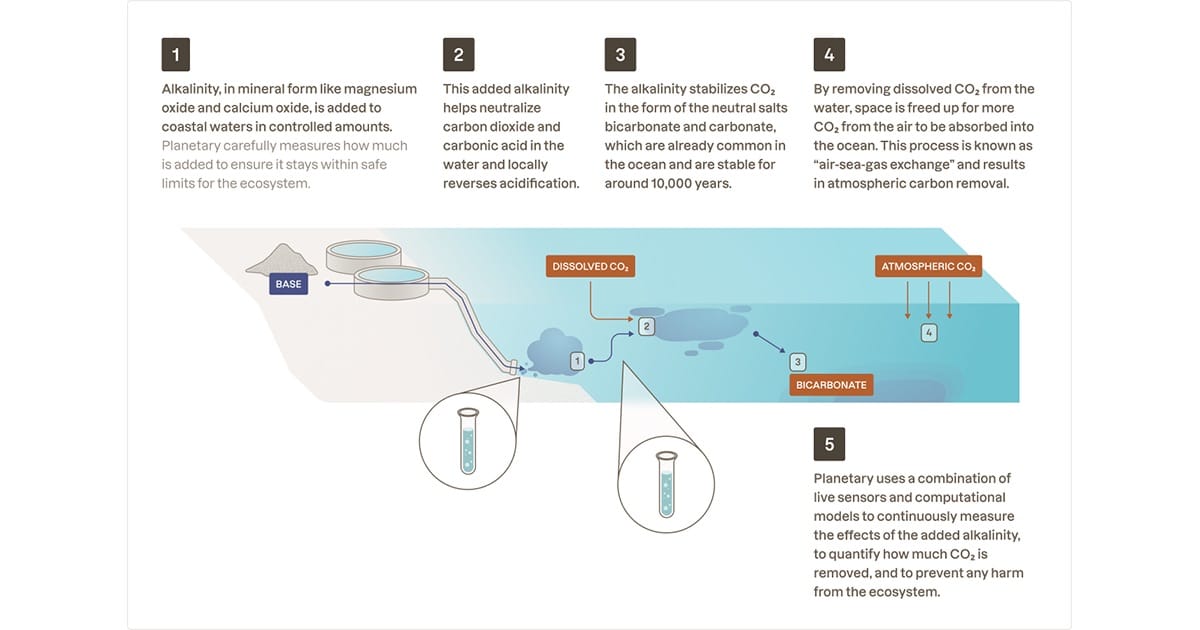
Planetary’s process involves careful addition of dissolved alkaline minerals, such as calcium oxide (CaO) or magnesium oxide (MgO), into coastal surface waters. This process boosts the ocean’s natural ability to draw down carbon by converting dissolved CO2 into stable bicarbonate ions, which are durably stored in the ocean for over 10,000 years. They use existing coastal facilities—like power plant cooling water outfalls—to ensure quick and effective integration without the need for massive new infrastructure investment. Unlike biological approaches, OAE works through the ocean’s chemical buffering system, avoiding disruption to biological carbon cycling and food webs.
The case for Planetary’s approach to OAE
Planetary’s approach to carbon removal is compelling for several reasons:
- It has a path to <$100/ ton and gigaton-scale removal. OAE, including through alkaline mineral addition, offers a path to extremely low-cost carbon removal, with the potential to remove billions of tons of CO2 annually at a price of $50–160/ ton. Planetary’s path to lower cost is contingent on 1) switching to lower-cost alkaline feedstocks and 2) co-locating facilities near these feedstock sources to cut transportation costs.
- Environmental monitoring is baked in at every step of the process. The team manages the end-to-end process with rigorous safety controls: 1) they conduct extensive screening of feedstocks to detect and avoid harmful contaminants, 2) they use a network of sensors to monitor the discharge water and surrounding ecosystems in real-time, and 3) they have established a “stop trigger” plan to immediately halt dosing if any measurement exceeds permitted safety thresholds.
- Planetary’s MRV sets a high bar for measuring open-system pathways. Measuring carbon removal in the ocean is challenging because its efficacy depends on the alkaline materials dissolving in the water. Planetary dissolves the alkaline minerals before releasing them in the ocean. This removes the uncertainty around where and at what time point the material dissolves to do its job. Planetary then uses sensors and validated computational models to measure the effects of the added alkalinity, including on air-sea gas exchange.
- It delivers co-benefits for ocean ecosystems. By locally raising pH and carbonate saturation levels, Planetary’s OAE approach helps counteract the local effects of ocean acidification. This improves conditions for marine calcifiers like oysters, shrimp, lobsters, and crabs, benefiting not only the aquaculture and fishing industries but also natural ecosystems. Planetary is conducting research to quantify these benefits in partnership with academic institutions (Dalhousie University) and local communities (First Nations, environmental groups, municipal leaders, and fisheries).
- The team will make project findings publicly available: This offtake includes binding commitments to share data in line with FAIR data principles and the Carbon to Sea data protocol.
Frontier has facilitated purchases on behalf of its Founding Members, Stripe, Google, Shopify, and McKinsey Sustainability, as well as members Autodesk, H&M Group, and Workday. Additionally, Aledade, Canva, Match Group, Samsara, SKIMS, Skyscanner, Wise, and Zendesk have participated via Watershed’s partnership with Frontier.
Mike Kelland, CEO, Planetary: “This offtake with Frontier buyers allows us to demonstrate that ocean alkalinity enhancement can safely and effectively remove CO2 beyond small-scale trials. This approach could be the cheapest and most scalable carbon removal solution. We’re eager to show how it can be rolled out responsibly.”
Hannah Bebbington, Head of Deployment, Frontier: “Ocean alkalinity enhancement can remove CO2 from the atmosphere extremely cheaply and efficiently. But expanding it beyond small-scale trials calls for ironclad measurement and safety protocols, alongside addressing community concerns. Planetary is taking on these challenges head-on with a rigorous MRV approach and thoughtful community engagement at its Tufts Cove site. This is the right project and team to pave the way forward for this promising pathway.”
Christopher Googoo, Chief Operating Officer, Ulnooweg and Executive Director, Ulnooweg Indigenous Communities Foundation: “Ulnooweg is proud to have worked with Planetary Technologies on the Joint Learning Opportunity initiative. Through this collaboration, we have explored how innovative ocean alkalinity enhancement projects, like the one at Tufts Cove, can inform and support Indigenous-led conservation priorities, including oyster restoration in Prince Edward Island. The Lennox Island First Nation embraced the opportunity to collaborate, sparking increased interest from young innovators, while the project dovetailed with the First Nations’ environmental blueprint. This multi-year offtake agreement is an exciting step forward, demonstrating how cutting-edge climate solutions can create opportunities for knowledge sharing, environmental stewardship, and sustainable benefits for our communities and future generations.”
Jim Hepworth, CEO of Business Development and Social Enterprises, The Confederacy of Mainland Mi’kmaq: “As Mi’kmaw people, our responsibility to the ocean and environment is rooted in generations of knowledge and care. We’re encouraged to see innovative climate solutions, like those being developed by Planetary, approached with attention to both science and community. Our ongoing conversations with them reflect a broader recognition that Indigenous voices are vital to the future of environmental innovation. We congratulate Planetary and wish them continued success as they take this important initiative forward.”