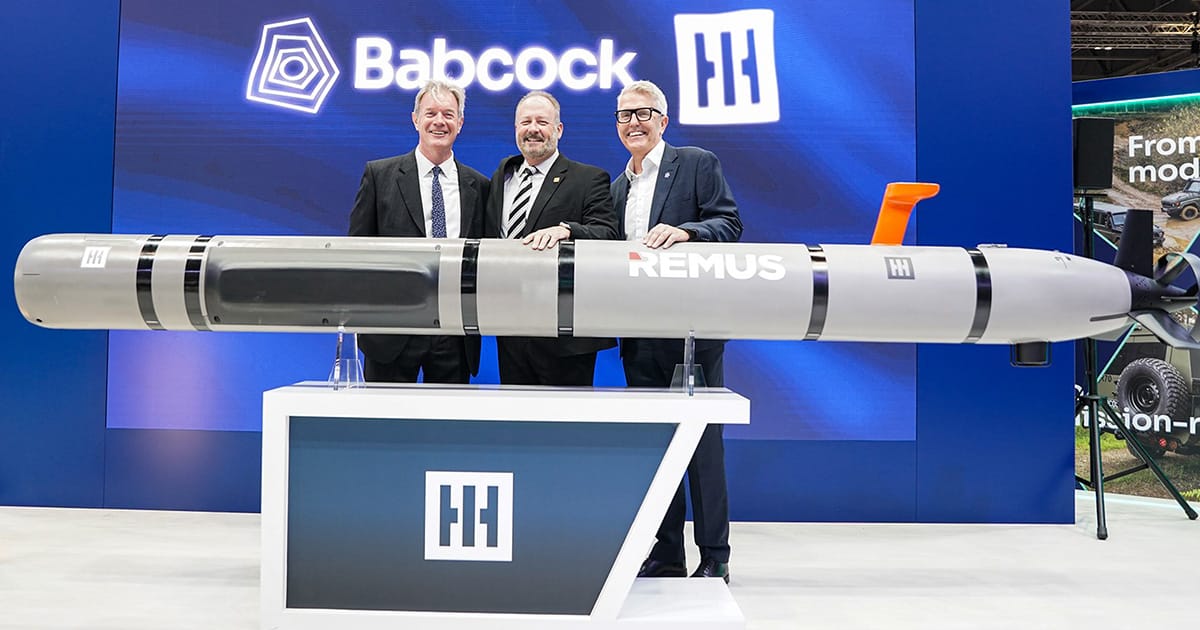
As UUVs become increasingly vital to future undersea operations, the partners seek to work together with HII to jointly pursue future opportunities within the unmanned space. This joint initiative builds on our strategic partnership started in 2023, and the US Navy’s first successful forward-deployed UUV launch and recovery via torpedo tube, using an HII REMUS. Babcock’s WHLS are currently in service with the submarine fleets of the United Kingdom, Canada, Australia, Spain, and South Korea.
Sir Nick Hine, Babcock, Chief Executive Marine, said: “Partnering with HII, we’re combining over a century of expertise in surface and sub-surface systems to further explore marine technologies and strengthen defense capabilities—this is just the beginning of future collaborations across marine programs.”
Chris Kastner, HII, President and Chief Executive Officer, said: “This partnership demonstrates the promise of pairing Babcock’s handling and launch system technology with the capabilities of HII’s REMUS UUVs to strengthen the undersea advantage of our allies. I am proud of HII’s leadership in advancing autonomous maritime manned-unmanned teaming operations and excited about the opportunities this collaboration will unlock.”
Babcock has been responsible for the design, manufacture, and support of submarine WHLS for the Royal Navy and overseas customers for more than 50 years. Together with HII’s autonomous REMUS, together with HII, Babcock can offer customers more capability through the integration of the latest UUV technology into existing and new build platforms.
The US Navy’s milestone operation underscores a broader transformation in undersea warfare: the growing demand for integrated manned-autonomous operations that extend reach, enhance stealth, and reduce operational risk. HII and Babcock’s collaboration positions both companies and their allied navy customers to lead this transformation.
To date, HII has sold more than 700 REMUS vehicles to over 30 countries, including 14 NATO members. Notably, more than 90% of REMUS units delivered in the past 23 years remain in service, demonstrating platform durability and lifecycle value – critical in defense acquisition decision-making.