FOWT platforms face multi-directional forces from wind, waves, and currents. When exposed to currents, periodic vortex shedding can trigger vortex-induced motion (VIM), amplifying fatigue loads, increasing mooring tension, and reducing power generation stability. While previous experiments reported that column geometry and structural layout affect VIM behavior, the influence of flow direction and complex platform components such as pontoons and cross braces remains insufficiently understood. Due to these challenges, deeper investigation into the vortex-structure interaction under varying incidence angles is needed.
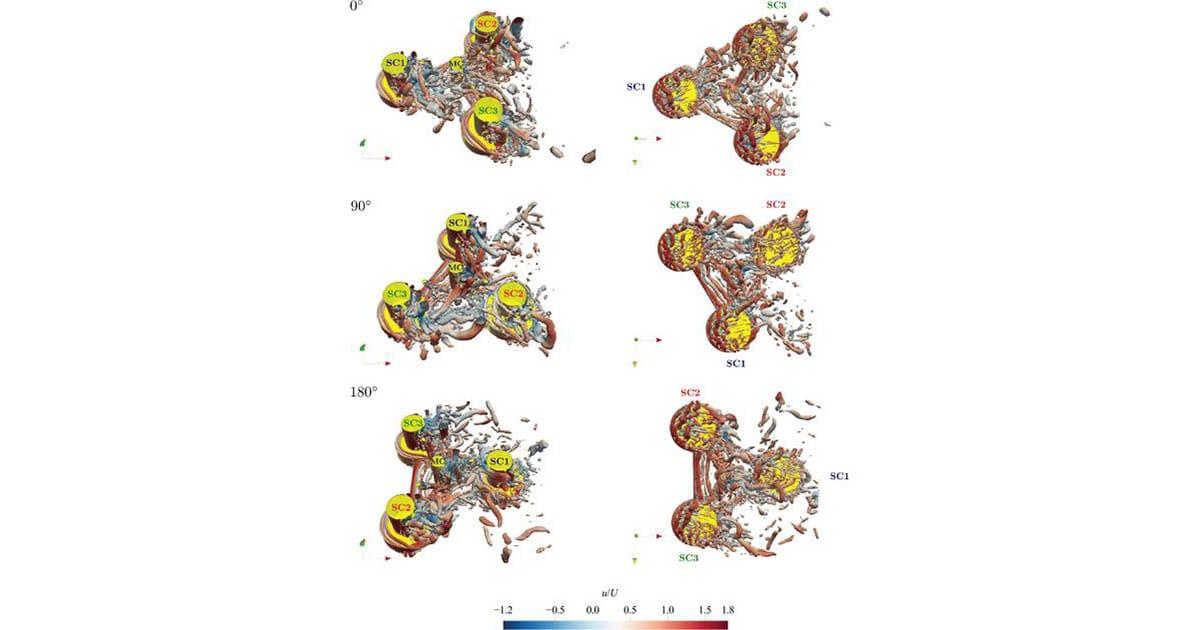
A research team from Tsinghua University Shenzhen International Graduate School, Ocean University of China, SGIDI Engineering Consulting Group, and University of Strathclyde has published a new study in Ocean (2025), investigating how ocean current direction governs VIM behavior of a DeepCWind semi-submersible floating platform. Using large-eddy simulation (LES) coupled with structural dynamic equations, the team analyzed response amplitudes, wake dynamics, hydrodynamic coefficients, and motion trajectories across three flow incidence angles. The work reveals how the vortex patterns evolve with the incidence angle, offering guidance for platform design and safety evaluations.
The researchers simulated VIM using a 1:72.72 scaled DeepCWind platform model with surge, sway, and yaw motion. Flow incidence angles of 0°, 90°, and 180° were tested at reduced velocities VR = 3–15. A pronounced lock-in region appeared at VR = 6–10, in which cross-flow vibration was the strongest. When θ = 0°, sway amplitude peaked at Ay/D ≈ 0.52, exceeding the other angles, with figure-eight motion trajectories indicating strong vortex-response coupling. In contrast, θ = 90° and 180° showed weaker VIM due to wake interference between upstream and downstream columns, forming raindrop-like trajectories. At high VR (>11), yaw oscillation increased gradually, reaching ~3.5° when θ = 0°, suggesting yaw-induced fatigue risk at elevated current speeds.
Hydrodynamic analysis revealed that pontoons and cross braces significantly damp VIM by breaking vortex streets and generating symmetric counter-vortices behind braces, creating restoring moments. Added mass coefficient sign reversals at VR ≈ 5–6 marked lock-in onset, while excitation coefficients indicated energy transfer from fluid to structure for θ = 0° and 180°, but damping for θ = 90°.
“Our results demonstrate that flow incidence angle plays a decisive role in VIM and yaw development,” the authors stated. “By visualizing 3D vortex structures and quantifying response amplitudes, we show how structural components, not just column arrangement, alter wake dynamics and energy transfer. Understanding these mechanisms is essential for designing next-generation FOWT platforms capable of stable operation under strong currents.”
This study provides a scientific basis for optimizing the layout of semi-submersible FOWT platforms, improving fatigue resistance, and enhancing operational stability in deep-sea wind farms. By identifying lock-in regions and wake-induced yaw conditions, designers can refine column arrangement, pontoon geometry, and mooring strategy to suppress VIM. The findings also support future development of VIM prediction models and control strategies for large-scale turbine deployment in variable ocean currents. As offshore wind expands globally, such hydrodynamic insights offer practical tools for reducing mechanical stress, lowering maintenance costs, and increasing power output reliability.