For anyone not familiar with the Ocean Sonics story, give us a brief background to the company…
Our founding principles and mission are to build best-in-class ocean-listening tools that simplify life for people working in and studying our oceans. We design and manufacture smart digital hydrophones that are simple to set up, deploy, and collect data; that are highly accurate; and are reliable for prolonged deployments in some of the harshest environments imaginable.
Our products are used in every ocean because we maintain a relentless focus on our users and their experience.
Over the past 14 years, we have grown and diversified our offerings and our markets. We have customers using our products ranging from single-user researchers in shallow (or extreme deep) water to environmental monitoring clients with multi-hydrophone arrays to submersible manufacturers deploying autonomous surveillance platforms to monitor critical underwater infrastructure.
We are also incredibly fortunate to have a robust and growing network of distributors around the globe. Whether an enduser client is in Australia, France, Brazil, India, Japan, the US, or further afield, we have a distributor that is ready, able, and willing to assist them.
Today, Ocean Sonics is entering another growth phase; our clients’ continuous support reaffirms our belief that we are creating amazing tools that enable them to complete their work as efficiently as possible.
The icListen smart hydrophone is closing in on 15 years in the field; what have been the key learnings along the way?
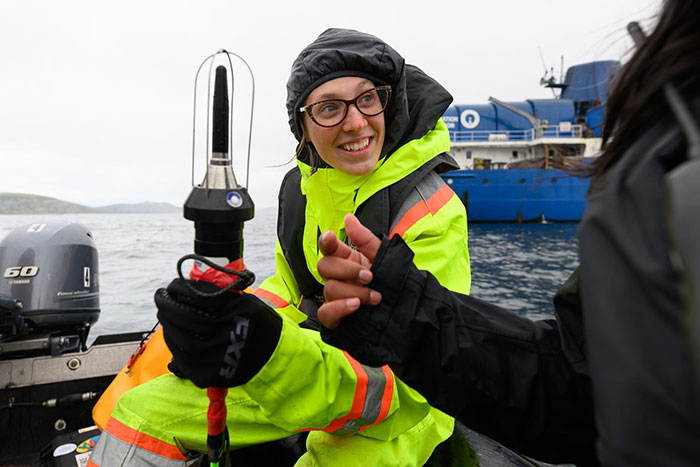
Our flagship product, the icListen smart digital hydrophone, may be nearing the 15-year mark in the field, but today’s icListen is more advanced than its predecessors. We take enormous pride in our team’s commitment to continuous and incremental improvement and innovation within existing product lines. Quite often, we get great ideas from our client base, based on their use of our product.
In fact, the icListen is not one single product. It is now a family of products that has evolved to include products with extended low-frequency capability, high intensity capability, and depth ratings of up to 6,000 meters. Many of these additional capabilities are a result of conversations with those in the field who use our products daily.
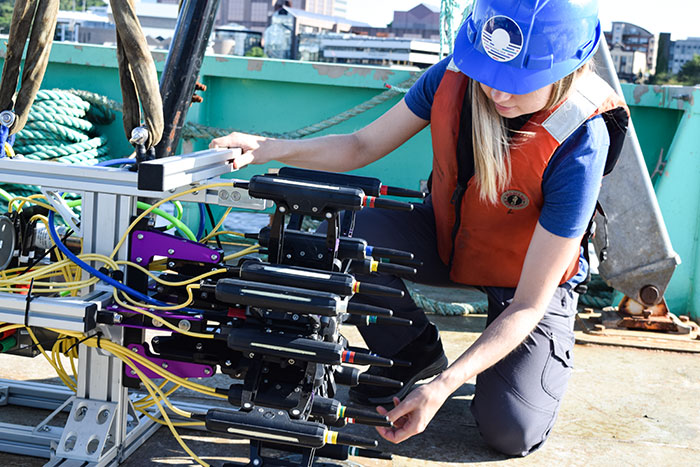
One key learning is that users will always find new ways to use our products, and that many recent deployments are featuring larger and more complex acoustic arrays.
It has already been a busy year for Ocean Sonics. Tell us about the recent product launches in 2026…
At Oceanology International 2026 in March, we launched the latest smart digital hydrophone, the icListen Kayak. The feedback we received was overwhelmingly positive.
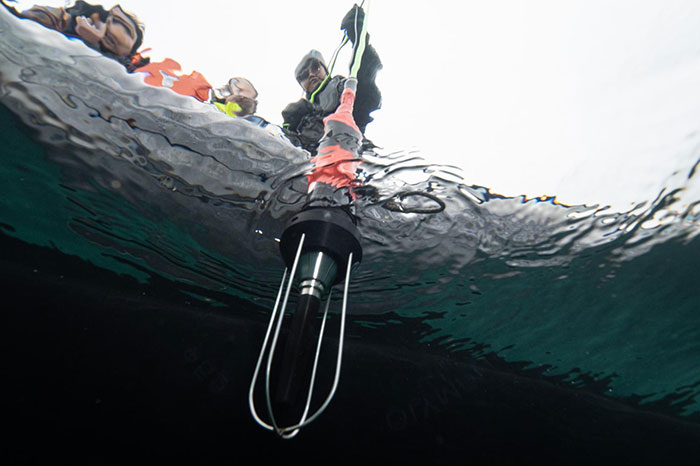
This new product is designed with scalability in mind to allow our users to unleash their creativity and build larger if and more complex acoustic arrays. The icListen Kayak will have the same underlying principles of simplicity, accuracy, and reliability built into its design as the current icListen, and will expand upon those with the scalability to create arrays of up to 100 icListen Kayaks.
A smaller form factor (the diameter is roughly 50% the size of the icListen), and a lower power requirement make the product ideal for a variety of applications and arrays. We will be bringing the icListen Kayak to market later in 2026 once full field trials are completed.
We also showcased our newest plug-ins to our Lucy II software, Coda, and Impact. These two plug-ins are specific application-built addons that enhance Lucy II’s functionality.
The CODA Plugin automatically detects harbor porpoise clicks, groups them into click trains, and classifies activity into interpretable categories such as Orientation and Foraging based on click timing and click rate (CPS).
Impact is designed to assist those working in the marine construction environment. It will quantify sound exposure with core metrics such as Peak, Peak-to-Peak, and cumulative sound exposure level (SEL). It can generate a downloadable comma-separated value file (CSV) Impulse and Sound Exposure logs that make underwater sound exposure traceable, reportable, and easy to communicate, with less turnaround time and less rework.
What real-world challenges are these systems designed to address?
Our clients and our distributors have always been encouraged to share their real-world examples of the requirements and the challenges they face with us. What we have heard frequently of late is the desire to connect more and more hydrophones into a single array.
The icListen Kayak is purpose-built for this need, designed with scalability top of mind. We have reimagined what is possible with a smaller form factor, reduced power requirement, and the potential to connect up to 100 in a single array.
Whether the requirement is to monitor critical underwater infrastructure across a large area in real time, or to deploy a four-channel vertical line array to capture marine mammal communications, the icListen Kayak is ideally designed for these applications.
Offshore construction, specifically in the marine renewable energy sector, is an area we are seeing much more of. Our users are able to streamline their regulatory reporting requirements with the Impact plug-in, meaning construction can be more efficient, and administrative tasks are greatly reduced.
How do you see the world of underwater monitoring and data collection evolving over the next 5 years?
From a business outlook perspective, we are seeing trends emerge in the past 18–24 months that will continue for a few more years. As the manufacturer of dual-use products, we benefit from having the capability of servicing several different market segments.
There will be a continued need to monitor critical underwater infrastructure. This is not solely driven by government or defense sector requirements; we have had commercial organizations connect with us on this topic as well.
As offshore construction expands, there will be an increase in the need for noise monitoring and event logging capabilities. Ongoing regulations will create the need for documentation about the sound levels, complete with timestamps and threshold adherence data. Human activity in our oceans should not disrupt marine life.
The next wave of data collection will be focused on the noise of shipping. Underwater Radiated Noise and the movement towards global standards for measurement and certification will drive the need for additional acoustic monitoring, data collection and storage.
This feature appeared in ON&T Magazine’s 2026 June Edition, Ocean Observation & Monitoring, to read more access the magazine here.