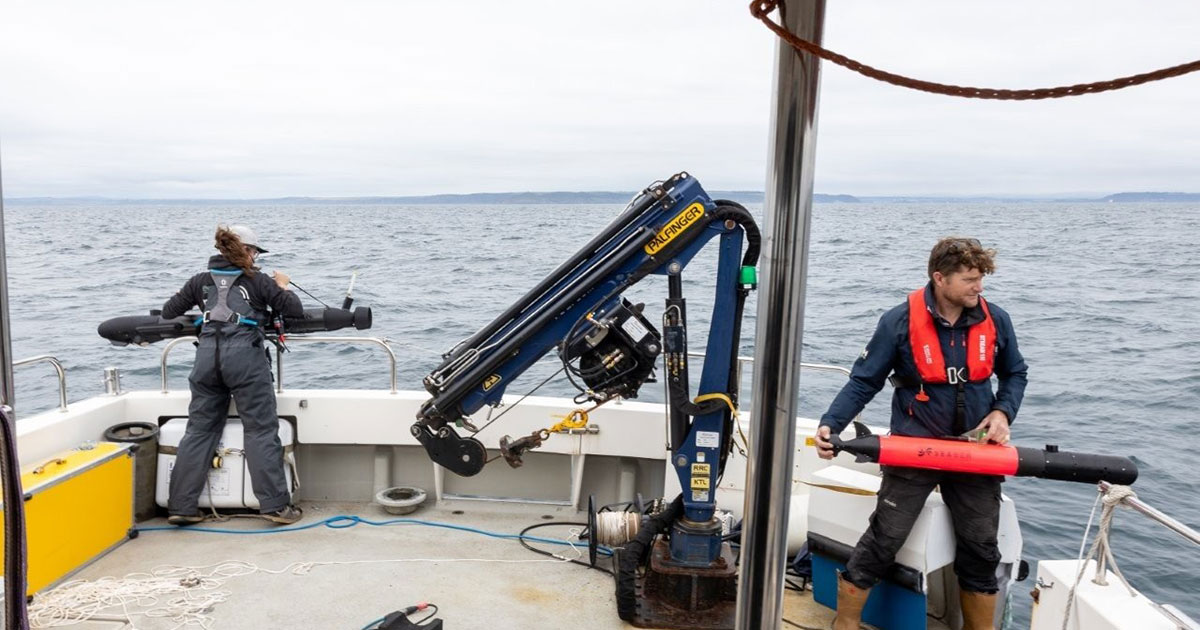
The Smart Sound Connect Subsurface (SSCS) project, part of Smart Sound Plymouth, led by the University of Plymouth, with Plymouth Marine Laboratory (PML), saw platforms from ACUA Ocean, ecoSUB Robotics, Seaber and Sonardyne working together above and below the surface.
The all-day collaborative demonstration enabled visitors from business, science, defense and national bodies to view the potential of the three-year, £1.2 million SSCS project.
Delivered by Sonardyne, the SSCS’ infrastructure extends Smart Sound Plymouth—already the UK’s premier marine autonomy testbed—and the Western Channel Observatory, through a seabed node array for absolute positioning and communications, alongside other intelligent sensors within a highly characterized environment.
Professor James Fishwick, Head of Innovation for Smart Sound Plymouth (at PML), said: “Smart Sound Plymouth is going from strength to strength. The addition of the subsurface network enables even greater integration between platforms and supports our state-of-the-art testing capabilities for autonomous vehicles and advanced technologies. It complements the high-speed military-encrypted network above the surface and helps provide a fully connected environment. This successful technology demonstration further reflects Plymouth’s place as a world-leading hub for marine autonomy.”
Dr. Lilian Lieber, Senior Research Fellow at the University of Plymouth, said: “SSCS provides a unique opportunity to test new ocean observing technologies. For me, its value lies in turning prototypes and field-tested technologies into trusted data streams, accelerating ocean observing towards autonomous sensing and near-real-time insight. This helps turn ocean data into actionable intelligence for climate resilience, early warning and preparedness, while the infrastructure itself enables technology innovation and stronger industry collaboration.”
A key element of SSCS is the seabed node array, which provides absolute positioning and communications using passive Ultra-Short BaseLine (USBL) technology for testing underwater systems in a real-world highly characterized testing environment.
During the demonstration, both the University of Plymouth’s Seaber autonomous underwater vehicle (AUV) and an ecoSUB AUV navigated simultaneously using only the seabed node array.
At the surface, a PIONEER uncrewed surface vessel (USV) from Plymouth-based ACUA Ocean tracked and controlled an AUV from Southampton-based ecoSUB using a Sonardyne Ranger 2 Gyro USBL positioning system on the USV.
The USV also wirelessly harvested data from a permanently deployed Sonardyne Origin 600 acoustic Doppler current profiler (ADCP) in the SSCS, which also transmits real-time data to shore—and a live internet feed as part of the Western Channel Observatory—via the long-running L4 oceanographic monitoring station.
In addition, marine software engineering firm Marine AI showed the ability to continue navigating, even when GNSS drops out, using Sonardyne’s SPRINT-Nav, based on trials in the SSCS earlier this year.
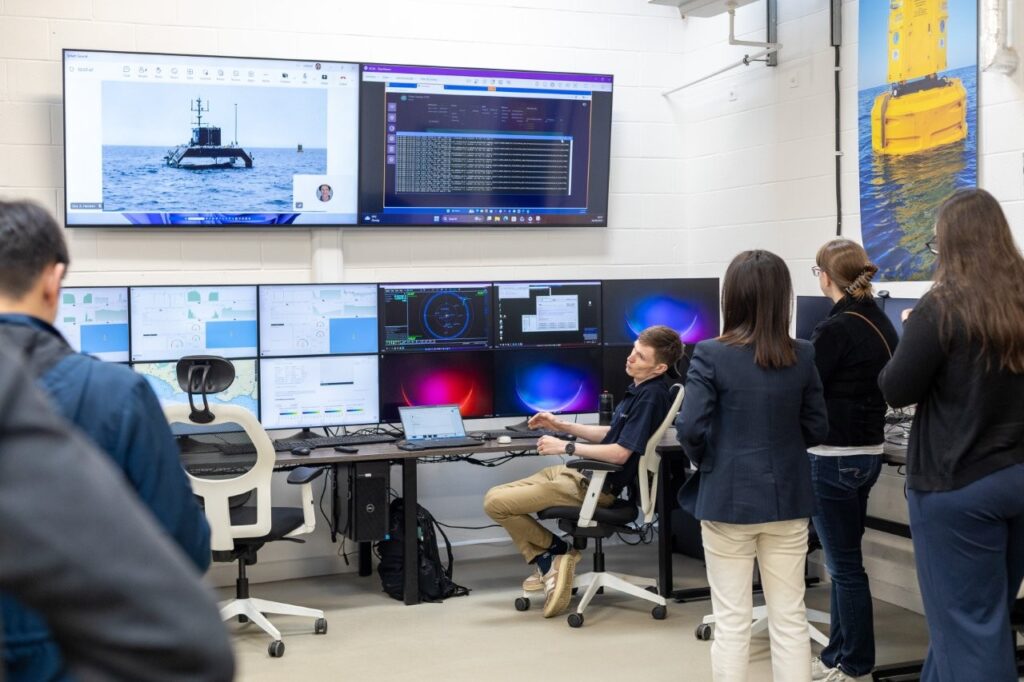
The demonstrations were viewed live by guests from the UK and overseas from within PML’s onshore remote operations center at its campus in Plymouth.
Geraint West, Business Development Advisor at Sonardyne, said, “This ability to test and accelerate marine autonomous system innovation in a known environment with the type of infrastructure we now have in the SSCS is a real boost not just for Plymouth.
“The demonstration had interest from around the UK and internationally, with visitors from North America and Asia and from a wide range of stakeholders, military, commercial, science and industry. It just shows the reputation Plymouth now has and continues to build for marine autonomy, thanks to the environment, ecosystem and collaboration we have in the city and in Plymouth Sound.”
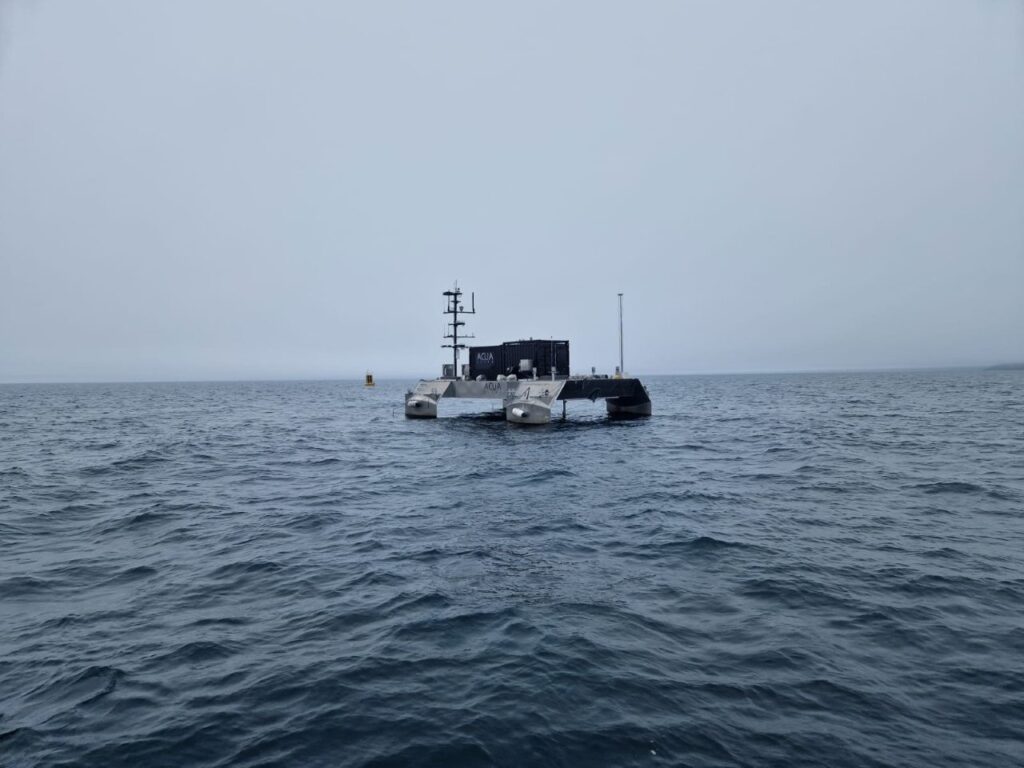
ACUA Ocean’s John Hunnibell, Chief Product Officer, said, “This demonstration provided an excellent opportunity to demonstrate the persistent mission utility and seagoing characteristics of our USV PIONEER as a ‘mothership’ for nested robotics, data harvesting and data transfer at sea.
“Specifically, we used this event to demonstrate that the USV PIONEER can deliver subsea monitoring and security for critical underwater infrastructure by teaming with multi-static seabed sensor nodes. It was also a great way to develop our relationships with capable, credible technical partners: Sonardyne, ecoSUB, PML and the University of Plymouth in Smart Sound Plymouth.”
Iain Vincent, Director & General Manager at ecoSUB Robotics said, “Smart Sound and the SSCS environment has already been an extremely useful resource for ecoSUB Robotics. Most recently we have collaborated with Sonardyne on the development of a subsea AUV launch and navigation solution.
“Smart Sound provided the perfect place to test this technology, with easy access to open water, vessels and subsea nodes, and an outgoing and helpful community who support activity.”
The Smart Sound Connect Subsurface team is currently seeking additional research and development partners to collaborate in further trials of the SSCS testing environment.
It encourages anyone interested in testing new subsea vehicle operations, underwater data telemetry, or any other use of the new infrastructure to contact Aaron Barrett, Lecturer in Autonomy at the University of Plymouth, to learn how they can get involved.