“This is important for Norway. Now that we have access to our own advanced mapping resources, we’re enhancing both the knowledge base and our ability to understand and manage deep sea areas in a responsible way,” said Hilde Braut, Assistant Director for New Industries. “We’re looking forward to receiving data of very high quality—and to further refining knowledge about Norwegian deep-sea areas!”
Extensive Historical Mapping
Deep sea areas have actually been mapped since the 1800s. In the early days, simple weights were used to measure water depth and give the first indications of subsea structures and seabed morphology. There have been substantial technological developments since then—which have also drastically expanded our understanding of the deep sea.
Today, this mapping is mainly achieved using ship-based multibeam echo sounders, which provide detailed overviews of the seabed. This data is supplemented with even more high-resolution surveys using AUVs.
Collecting Data at Depths of Up to 6,000 Meters
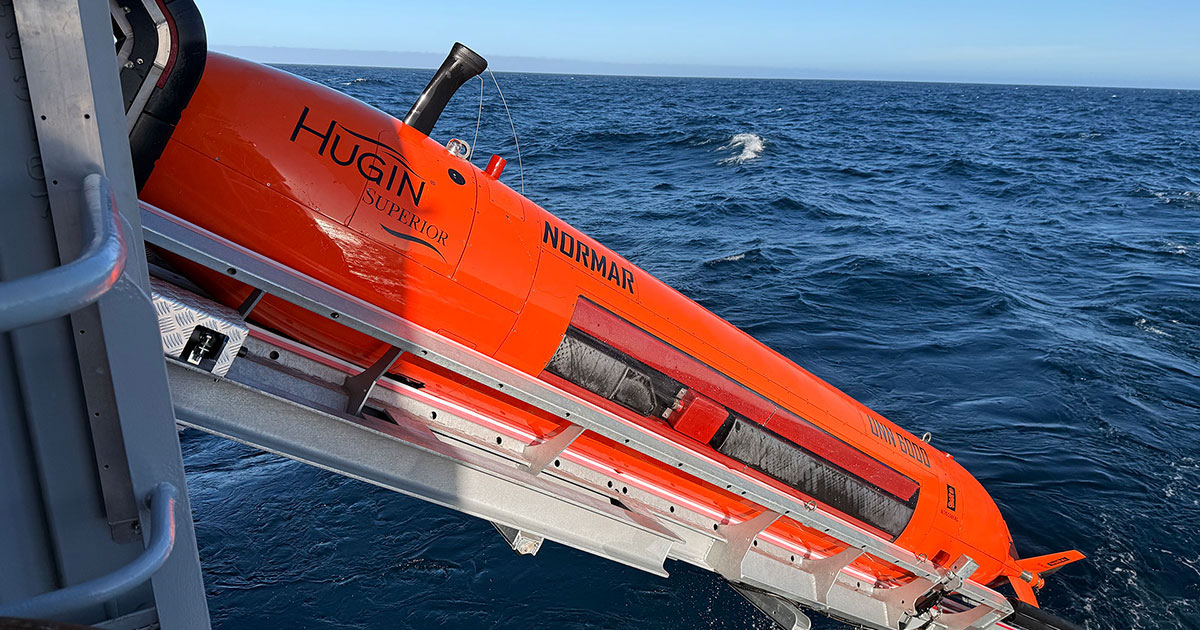
Until recently, this kind of advanced mapping was contracted out to private businesses. This will be changing soon. In 2025, the Ministry of Energy funded the procurement of a HUGIN Superior AUV through the Norwegian Offshore Directorate. This vehicle will be operated by the Norwegian Marine Data Centre (NORMAR), which is affiliated with the University of Bergen.
This advanced AUV can operate at depths of up to 6,000 meters, collecting high-resolution data about the seabed. The vehicle is capable of mapping structures and objects with very high precision using sonar—where sound waves are emitted and reflected back. In many ways, it operates like a bat underwater, orienting itself and gathering information using audio waves.
First Voyage of Newly-Christened Vessel
The AUV started its first expedition in early June. It was christened prior to departure in Bergen, in line with good maritime tradition. A number of representatives were present during this event, including representatives from the Norwegian Offshore Directorate, the Ministry of Energy, the Norwegian Institute of Marine Research and the Kongsberg Group.