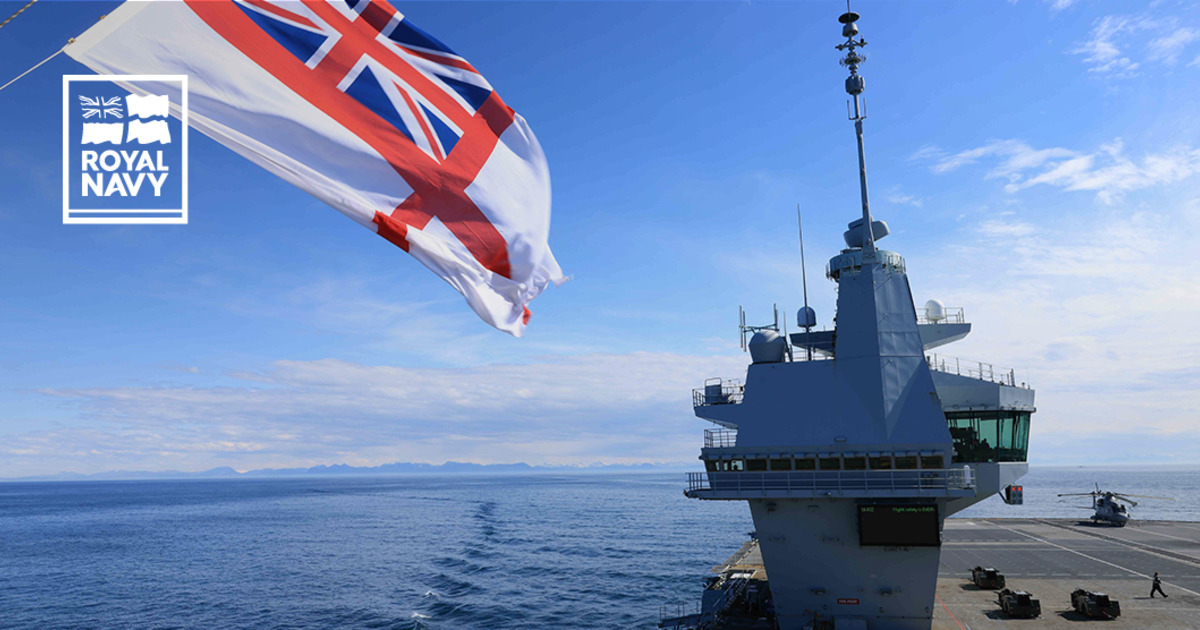
The UK Carrier Strike Group—led by flagship HMS Prince of Wales, supported by destroyer HMS Duncan, tanker RFA Tidespring and air wing of F-35B jets and rotary wing plus uncrewed autonomous systems—have completed the first part of their mission, Operation Firecrest, which will continue in the autumn in northern European waters.
HMS Prince of Wales and HMS Duncan are due to return to Portsmouth tomorrow to allow leave for personnel and maintenance for the ships before the second phase.
The first half of their mission concluded with Exercise Neptune Strike, which saw 10 NATO allies operate across air, sea, and land in the Atlantic.
Commodore Richard Hewitt, Commander of the UK Carrier Strike Group, said: “Over the past three months, we have proven the UK Carrier Strike Group capabilities over and over again, committing this capability to NATO and demonstrating our determination to defend NATO’s Northern Flank.
“We have shown how we can generate, sustain and when called upon, defend our NATO and JEF allies against unwanted threats in the High North and North Atlantic.
“Neptune Strike has been a successful finish, demonstrating our capability and supporting NATO deterrence across the Euro-Atlantic.”
The aim of Neptune Strike was to reinforce NATO’s 360-degree protection of Allied territory by demonstrating the ability of its personnel and equipment to work together as a potent, unified deterrent.
The exercise focused on the UK Carrier Strike Group delivering long-range air strikes with F-35B Lightning jets of 809 Naval Air Squadron, which made use of an RAF Voyager and an Italian 767 tanker to extend their range to conduct sorties not just over the North Atlantic, but as far as Poland.
The task group’s ships concentrated on surface and underwater actions, supported by the carrier air group’s Merlin and Wildcat helicopters and bolstered by frigate HMS Somerset and a French destroyer joining the Strike Group.
Commodore Donald Mackinnon, Assistant Chief of Staff of Operations at NATO Joint Force Command Norfolk (JFC Norfolk), added: “Neptune Strike 26-3 demonstrates NATO’s ability to integrate maritime, air, land, and multinational forces across one of the Alliance’s most strategically significant regions.
“Operating in the High North and North Atlantic strengthens our readiness, reinforces interoperability among Allies, and ensures we can command and synchronize multi-domain operations as required.
“Activities like this underscore JFC Norfolk’s commitment to enhancing collective defense, deterrence, and the security of the transatlantic region.”
Involvement in Neptune Strike not only brought the curtain down on the first part of the UK Carrier Strike Group’s Operation Firecrest deployment but reinforced the international flavor of the three-month mission to date.
The strike group has worked with 19 allies from NATO and the Joint Expeditionary Force since sailing in April, bolstering regional partnerships and strengthening the defense of the Euro-Atlantic.
A key element of Operation Firecrest involved the Carrier Strike Group delivering NATO’s Arctic Sentry enhanced Vigilance Activity.
The Carrier Strike Group also delivered NATO’s Air Policing mission to safeguard the skies of Iceland and the Arctic from incursions by Russian Aircraft—the first time this mission has been conducted by aircraft launched from the deck of a European aircraft carrier.
The deployment demonstrated capability across a range of naval warfare, from combined aviation operations alongside 18 NATO allies in Exercise Ramstein Flag to submarine hunting during another NATO exercise, Dynamic Mongoose, and an Anglo-Norwegian test of helicopter, missile, and fast-attack boat tactics in the confined waters of the fjords during the Joint Expeditionary Force’s Exercise Tamber Shield.
The group most recently visited Iceland, where they hosted the UK’s Defence Secretary and Iceland’s Foreign Minister and Defence Director before NATO’s Summit in Ankara. HMS Prince of Wales also visited Stavanger, Norway. HMS Duncan also had the chance to call on Bergen in Norway, Aarhus in Denmark, and her affiliated city of Dundee.