
As operators seek greater safety, security, and efficiency, the integration of advanced technologies is accelerating, setting the stage for a future defined by autonomy, connectivity, and smarter workflows.
DIGITAL ENGINEERING
The foundation of this transformation lies in digital engineering. Tools such as 3D modeling and digital twins enable precise design and simulation, reducing project risk and improving predictability. Mobile data capture systems complement these efforts by delivering real-time insights from offshore environments, allowing operators to make faster, data-driven decisions.
Alongside these digital capabilities, small robotic technologies and drones are expanding the reach of inspection and intervention tasks. These systems, combined with smart workflows, streamline operations and minimize downtime. The result is a more agile offshore environment; one where technology augments human expertise to deliver safer and more efficient outcomes.
REMOTE OPERATIONS
Increasingly, offshore operators are adopting approaches that move personnel supervising autonomous underwater vehicles (AUVs) and remotely operated vehicles (ROVs) from offshore vessels to onshore bases. This mode of remote operations reduces offshore personnel exposure, lowers costs, and enables global scalability while increasing access to remotely based experts.
To support this trend, Oceaneering has established a network of Onshore Remote Operations Centers (OROCs) in the US, UK, Brazil, and Norway. These centers oversee deployments of advanced systems, including the Freedom™ AUV and the Liberty™ Resident System. Each OROC shares core capabilities while specializing in certain technologies, such as AUV operations in Norway and USV control in the US Gulf Coast, which creates a collaborative global network of operators and assets.
The integration of satellite connectivity solutions is further extending the reach of remote operations. Recent testing has demonstrated the ability to maintain stable communications even in dynamic offshore environments, paving the way for operations in regions beyond traditional LTE coverage.
EXPANDING CAPABILITIES
The Freedom™ AUV represents a major step forward in subsea autonomy. Developed through collaboration with leading operators, Freedom combines the versatility of a work-class ROV with the range and maneuverability of an AUV. Introduced commercially in 2023 after nearly a decade of development, Freedom has already demonstrated its value in challenging environments such as the North Sea, where it has conducted pipeline inspections for major operators.
Unlike traditional AUVs that require multiple passes to collect high-resolution data, Freedom achieves this in a single pass. Its advanced perception stack processes multiple data sources to maintain precise positioning relative to pipelines, while a multi-thruster design enables rapid, low-altitude flight and obstacle avoidance. These capabilities not only improve efficiency but also ensure complete data acquisition, even in areas with steep subsea terrain or strong currents.
Freedom’s development roadmap continues to evolve, with enhancements such as vertical and horizontal docking, payload-informed flight, and expanded autonomous behaviors. The technology is also being adapted for defense applications, leveraging its autonomy and perception capabilities for critical infrastructure protection.
Complementing Freedom is the Liberty™ Resident System, a modular, vehicle-agnostic docking station that is designed to support both ROV and AUV operations. Liberty enables long-term subsea residency, reducing vessel dependency and operational costs. In one deployment on the Norwegian Continental Shelf, Liberty accumulated nearly 21,000 operational hours and saved more than 850 vessel days. Recent additions to its capabilities include pipeline pigging and isolation, further expanding its role in inspection, intervention, and commissioning tasks.
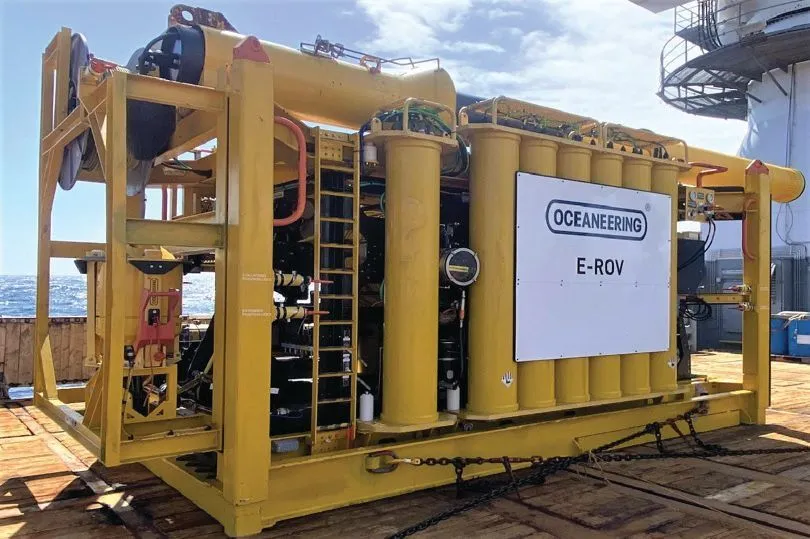
Liberty’s modular design allows seamless reconfiguration between tethered and autonomous operations, and integration with Freedom is on the development roadmap. Future versions will extend depth ratings to support operations in frontier regions such as Guyana, where deepwater capabilities are essential.
OPTIMIZING EFFICIENCY
Fleet management in offshore operations is evolving toward integrated multi-robot architectures that complement traditional vessels by executing tasks in parallel without increasing personnel requirements or extending project timelines. In this configuration, the primary vessel focuses on installation and intervention activities, while autonomous platforms, such as the DriX USV, perform high-resolution survey and mapping missions remotely, reducing vessel standby time and enhancing overall efficiency. Future developments will enable the Freedom AUV to collaborate with the DriX through advanced autonomy frameworks, supporting synchronized multi-vehicle missions. This integrated approach will optimize task allocation, mitigate operational risk, and lower lifecycle costs through remote supervision, intelligent coordination, and distributed autonomy.
Building on this foundation, Oceaneering’s vessel strategy prioritizes simultaneous operations (SIMOPs) to maximize productivity. By combining remote capabilities with vessel-based activities, operators can compress project schedules and improve resource utilization. This methodology not only delivers cost savings but also advances sustainability objectives by reducing vessel days and associated environmental impact.
Resident systems such as Liberty further extend these efficiencies by allowing vessels to depart after initial deployment, leaving subsea assets in place for commissioning or maintenance scopes. In decommissioning campaigns, Liberty has already proven its value, notably in projects like Equinor’s Veslefrikk field, where significant reductions in vessel time were achieved.
LOOKING AHEAD
The future points toward greater autonomy, enhanced connectivity, and integrated digital ecosystems but the ability to transform raw data into actionable insights will remain critical. Oceaneering’s acquisition of GDi has strengthened its digital capabilities through platforms such as Inform™ Asset Integrity Management Software and Vision™ 3D Data Visualization Software, which are designed to centralize integrity workflows and deliver engineering-grade asset views. Inform provides a governed source of truth for anomaly tracking and risk-based planning, ensuring compliance and operational accountability across complex assets.
Building on this foundation, Vision Subsea— a new cloud-based module within the Vision platform—consolidates inspection evidence into a single, measurable digital record, addressing common integrity challenges such as fragmented drawings and ROV-captured video files that lack spatial context.
These capabilities extend beyond visualization. By combining advanced scanning with Oceaneering’s engineering expertise, Vision supports life-extension planning and improves decision-making based on verifiable geometry rather than isolated frames. Together with Inform, it forms a digital ecosystem that connects topside and subsea data, enabling operators to see issues sooner, act faster, and maintain confidence in compliance programs.
The future of ocean technology is being shaped today through innovations in autonomy, remote operations, and digital integration. By combining advanced robotics with global connectivity and smart workflows, and by leveraging platforms like Inform and Vision for subsea insight, the industry is redefining what is possible offshore. These developments are not just incremental improvements; they are transformative steps toward a more efficient and sustainable ocean economy.
This feature appeared in ON&T Magazine’s 2026 January Special Edition, The Future of Ocean Technology Vol. 6, to read more access the magazine here.
