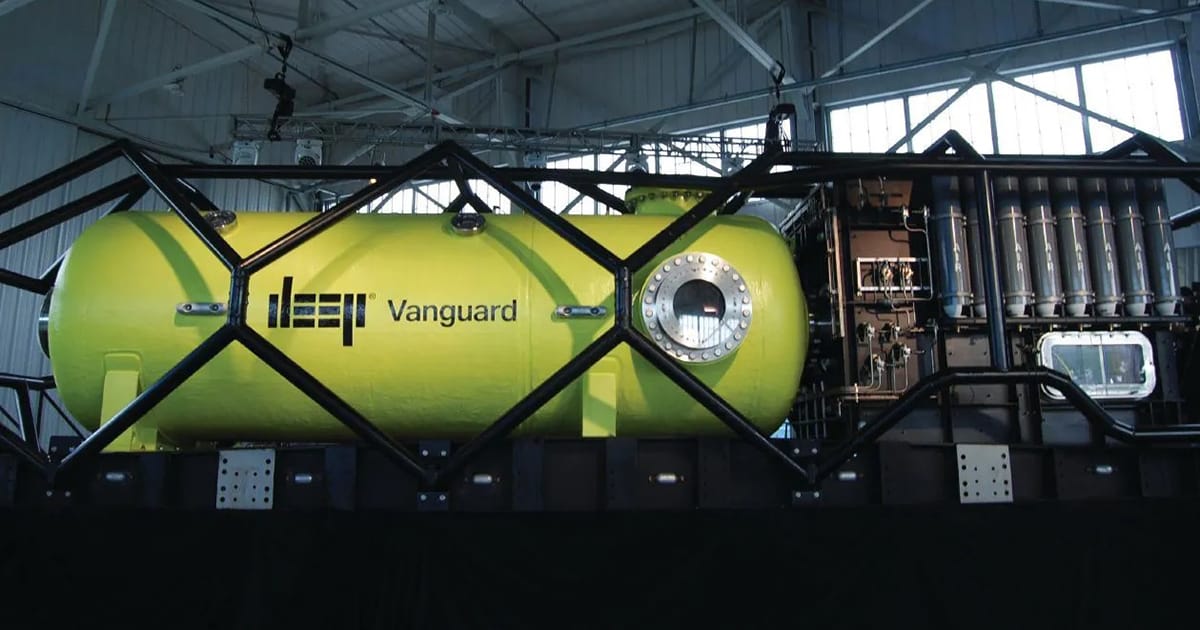
At ocean engineering company DEEP, I lead the team that designs and builds our subsea human habitats. We’re pioneering a new era of underwater living, beginning with the Vanguard habitat, which was recently unveiled in Miami, Florida.
But why focus on living underwater now?
A NEW ERA OF EXPLORATION
Most of our planet is water. You’ll often hear that 70% of the surface is water. But the ocean is a three-dimensional realm. Large regions of the ocean remain unexplored, for example the mesophotic zone or “twilight depth,” a vast but narrow band of seafloor hugging continental land and islands where light penetrates between 30 and 200 meters. This represents an area of ocean floor equal to the entire landmass of the United States and is particularly important to me because research suggests this zone may serve as a partial refuge for some coral species under thermal stress in shallower zones.
It’ll take people, technology, and uninterrupted time underwater, to truly understand and explore this critical area of the ocean. That’s where underwater habitats offer the perfect solution—the gift of time. It’s the difference of days and weeks at depth diving from underwater habitats versus minutes and hours bounce diving from the surface.
One of my childhood heroes was Jacques Cousteau. His Conshelf projects in the early 1960s proved that humans could live and work indefinitely on the ocean floor. Over 50 habitats were built and deployed in oceans all over the world in the following 15 years—a golden era for exploration with underwater habitats. But over time, the appetite to build these kinds of platforms under the sea dwindled. Why? I believe it’s because NASA captured the exploration narrative (and budgets), funding for man-in-the-sea programs dwindled, and oceanography turned toward remote sensing and satellite observation.
IF NOT NOW, WHEN?
Research organizations such as the IPCC and NOAA are showing climate change and degradation to marine ecosystems have reached a crisis point. We have an opportunity to help solve some of the planet’s most urgent challenges by sustaining a human presence underwater to learn, observe, and collect data. Now is a crucial time to build a new generation of subsea habitats.
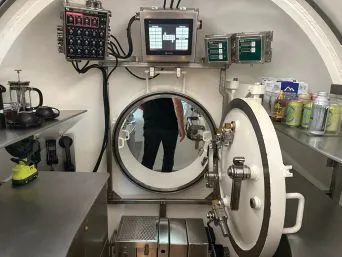
The golden era of subsea habitats was about proving that yes it could be done. Now it’s time to prove the how and why it must be done. DEEP’s vision to make humans aquatic starts a modern era of subsea habitation that will show how to do it sustainably and repeatedly. DEEP’s pilot habitat, Vanguard, will be the first modern underwater habitat to be deployed anywhere in the world for scientific research, the space analog experience, and advanced dive training.
VANGUARD: A NEW APPROACH
Vanguard allows crews of four to spend seven days or longer at depth, creating a platform for scientific research, conservation, and training. It offers days and weeks of bottom time for discovery and research under the ocean without the need to resurface. That extra time means more data, more discoveries, and more potential for the ocean to reveal its secrets.
The last habitat of this kind was built and launched almost 40 years ago. Just think about the advances in technology since then: the World Wide Web, satellite navigation, microelectronics, additive manufacturing, wearable health technology, and so on. All these advances can improve the design and use of habitats and, because the world is much more connected now, the research from subsea missions can be shared with the public more effectively.
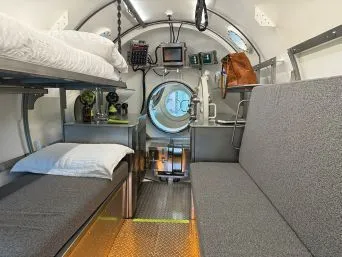
Vanguard is DEEP’s pilot subsea habitat. It’s a functioning prototype that we’ll use to learn from and to inform the design of the more advanced habitats that are on our roadmap for the future. As well as serving a range of customers, Vanguard will allow DEEP to fine tune its designs and operations for future habitats such as Sentinel, a larger, modular habitat deployable up to 200 meters deep.
Once operational, Vanguard will be the first underwater habitat to be classed by Det Norske Veritas (DNV), a leading authority in subsea standards, marking a milestone in safety.
MAKING SUBSEA HABITATION GLOBAL
DEEP’s Vanguard project is a starting point in a new era of subsea habitation.
This pilot habitat will allow DEEP to test real-world functionality and refine the systems that will eventually support a global network of subsea human habitats.
From science to industry applications, from training to conservation, DEEP envisions a world where humans have permanent access to the ocean, and the public at large are engaged with understanding and protecting it.
This feature appeared in ON&T Magazine’s 2026 January Special Edition, The Future of Ocean Technology Vol. 6, to read more access the magazine here.