
Compact USV Platform
OceanAlpha’s M40 USV Series comprises compact surface platforms designed to support survey and inspection tasks in coastal, nearshore, and restricted-water environments. As a technology platform, the vessel combines remote operation, route-following capability, and sensor payload integration. When equipped with MBES, a USV can follow planned survey lines, scan the seabed, and provide data that helps operators identify pipeline exposure, seabed change, or other conditions that may affect asset integrity. Remote control and monitoring also allow surveyors to supervise missions from shore or from a nearby control station.
Field-Proven Package
One example of the USV’s suitability for remote operations comes from a nearshore pipeline survey in Brunei. Malaysia-based geo-solutions provider HGIS deployed an OceanAlpha 5.5-m M40P USV to complete a remote inspection of subsea pipelines for a project with Brunei’s largest oil and gas producer. The USV was controlled and monitored from a station near the oil terminal, approximately 5 km from the pipelines under investigation. The platform acquired seabed data to support pipeline routing, construction, operation, and maintenance, while surveyors could focus more attention on data analysis and hazard identification.
A second case shows the value of USVs in restricted shallow-water inspection. In Hengqin, in the Chinese city of Zhuhai, a natural gas pipeline was located in water too shallow for crewed vessels to operate under the required safety protocols. OceanAlpha used an M40 USV carrying a MBES to scan the seabed. The survey identified seven exposed pipeline sections, with the longest continuous exposed section measuring 689 m and the total exposed length exceeding 1,200 m. The results gave the operator a clear reference for assessing the pipeline’s condition and planning maintenance.
These applications show how USVs can support the defense of critical underwater infrastructure in practical field conditions by helping operators detect conditions that may otherwise remain difficult to observe. Their value is not only in autonomy, but in access: reaching areas where conventional boats may be inefficient, restricted, or unsafe—quickly and efficiently.

As the range of available commercial USVs continues to expand, these examples serve as a reminder that uncrewed survey platforms are not a replacement for experienced campaign planning, quality control, or asset integrity assessment, but when deployed in the right context, USVs equipped with MBES can become an invaluable part of the subsea inspection toolkit for nearshore and restricted-water infrastructure.


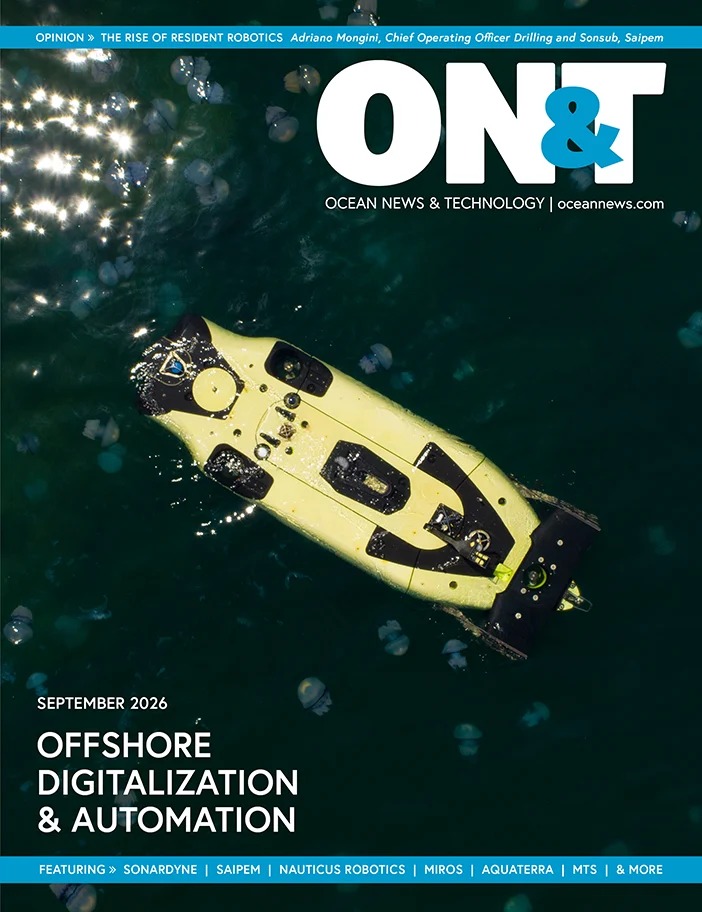
This spotlight appeared in ON&T Magazine’s 2026 August Edition, Defending Critical Underwater Infrastructure, to read more access the magazine here.