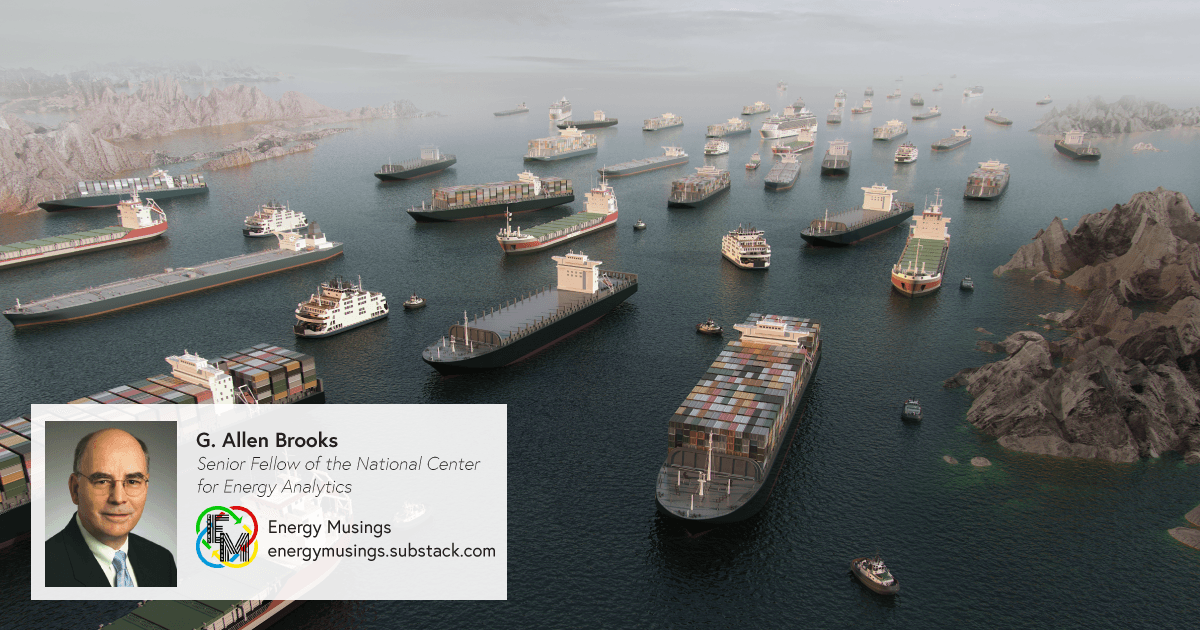

While tanker transits through the Strait of Hormuz fluctuate, more Middle East oil is reaching the global market. However, the workaround is limited by how much oil can be transferred ship-to-ship in the Gulf of Oman. Smaller tankers bring oil from the Persian Gulf to larger tankers, which haul it to global markets.
The key issue impacting oil prices is the lack of global refining capacity. A barrel of crude oil has little value until refiners turn it into petroleum products used in transport, industry, and consumer markets. Diesel fuel is the key global petroleum product in short supply. Around the world, transport markets must pay higher prices for the fuel needed for trucks, trains, and ships moving cargoes. Higher diesel costs are passed on to industry and consumers through higher intermediate and final product prices, pushing up global inflation. Central banks are fighting higher inflation by raising interest rates to choke off demand and slow global demand for diesel, creating further economic challenges.
Ukraine’s attacks on Russia’s refineries are contributing to the diesel shortage, as Russia has been a key provider of diesel fuel to the world market. In the US, refineries have been running at 96-98 percent utilization. This level will soon drop as they perform required maintenance and switch to different product outputs to meet seasonal demand shifts. This will squeeze fuel supplies, keeping pump prices elevated. Our accompanying chart on US diesel inventories shows them to be historically low. It explains why diesel pump prices are currently above $6.50 a gallon, more than 70 percent higher than before the start of the Iranian war.
Six months after the start of the Iranian war, the global oil crisis many anticipated is finally arriving. We are learning that the crisis is created not only by a shortage of crude oil, but, more importantly, by the lack of sufficient refining capacity. The former shortage is being alleviated, but the latter will persist well beyond the end of hostilities and the reopening of the Strait of Hormuz. Elevated oil prices will affect inflation and global economic growth. So far, neither has risen to levels that would bring the world to a halt.
Natural Gas
While the global LNG market struggles to overcome the supply shortage from the closure of the Strait of Hormuz, the US gas market is performing well, with storage levels above the five-year average. In contrast, Europe is gambling on a warm winter.
Only in September has the gas storage level dropped below the pace of 2025 weekly injections. We will watch to see if that trend continues, as it would suggest production is not growing as much as needed to support winter injections, current usage, and increased LNG exports. Importantly, parts of the US have continued to experience much higher-than-normal temperatures, which may explain the lower storage level as more gas has been used to generate electricity for air conditioning. Surprisingly, June-to-August gas prices are averaging 6 percent lower this year than in 2025.
In Europe, gas storage is only about 70 percent full, well below the seasonal 88 percent. The lower storage level is due to the elevated gas prices in Europe and for global LNG cargoes. Based on the last seven-day average injection rate, Europe storage will likely only reach 80 percent full, which is the European Union’s revised recommendation, down from its mandatory 90 percent level.
The lower capacity level requirement is a definite gamble that the upcoming winter will be warmer than recent winters. That gamble has allowed European buyers to avoid an aggressive price battle with Asian LNG buyers who have been willing to pay higher prices for cargoes.
Europe’s gas price recently reached €80 per megawatt-hour but quickly fell closer to €70 as prospects improved for a reopening of the Strait of Hormuz. That would allow Qatar to begin LNG exports. Qatar officials recently told attendees at a conference alongside the 81st UN General Assembly that it would begin shipments in a few weeks after the Strait’s reopening. It also said its massive capacity expansion will continue, although the first phase start-up is delayed to the first half of 2027. Qatar plans to expand its LNG capacity from 72 million tons per annum to 144 mtpa by 2030. A looming question is whether LNG buyers will become reluctant to sign long-term contracts, given the now-evident export risk.
US LNG exports have saved the global gas market. It will continue to bring additional export capacity online, consistent with its plan to more than double capacity by 2031. Interestingly, Qatar has capitalized on the US expansion. Its partnership with ExxonMobil began with the Qatar plant damaged by Iranian attacks that will take up to five years to repair. That damage has reduced Qatar’s LNG export capacity by 17 percent. But with ExxonMobil opening its new Golden Pass LNG export terminal in Louisiana, Qatar has benefited. It has been able to use its share of output to deliver gas to customers that received force majeure notices after Qatar closed its export facilities in February due to the war with Iran.
Natural gas remains a key energy source for reducing carbon emissions. That reality has become clearer recently. It will not change anytime soon. The world will use more gas in the future.
This feature appeared in ON&T Magazine’s 2026 October Edition, Navigation, Positioning & Communications, to read more access the magazine here.