1. Can you give us the quick background on Skana Robotics…
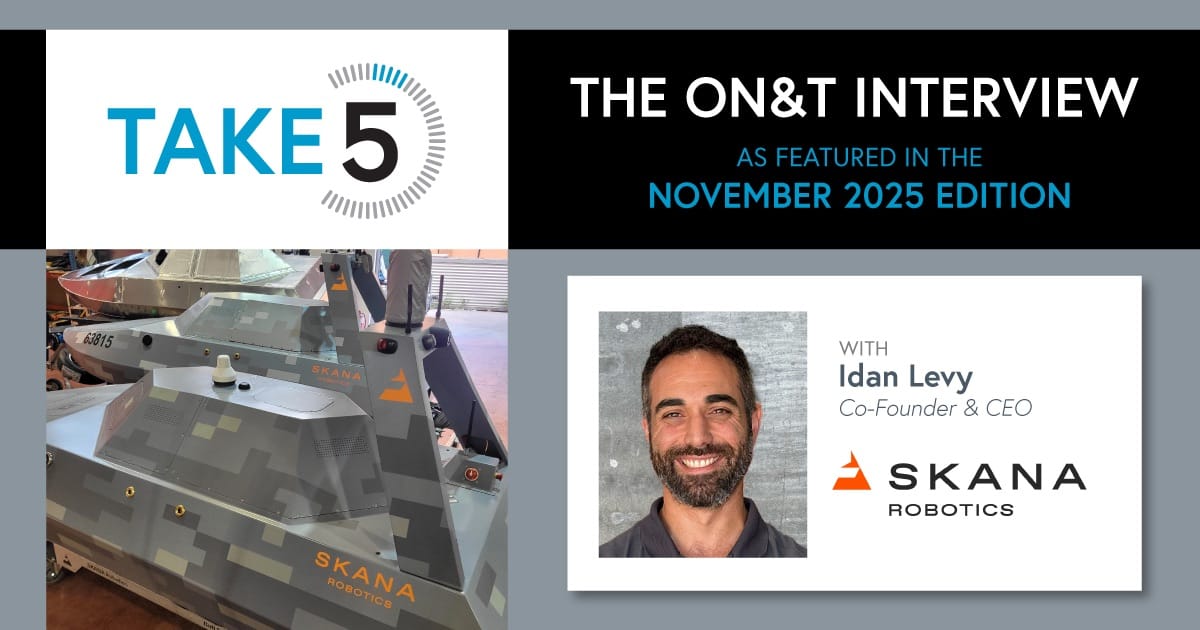
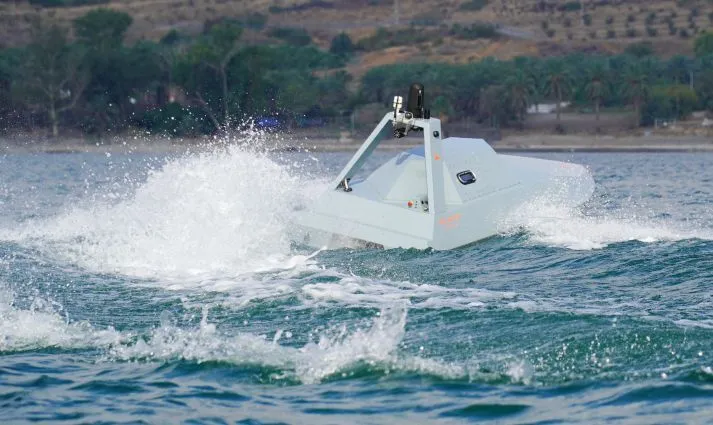
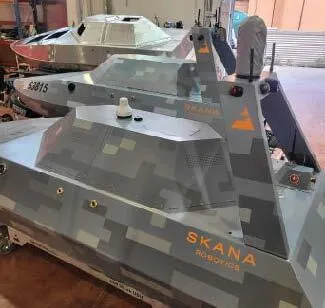
We are a vertically integrated company: we develop the software and autonomy stack, as well as the vessels themselves. Our first platforms that are already in sea trials are the Bull Shark ASV and Stingray AUV, both designed for rapid integration, modular payloads and sensors, and are designed and integrated at our facilities, made out of COTS.
We are in the final stages of integration of our Alligator, our Autonomous Amphibious Platform, which will start operational demonstration by the beginning of 2026. Also, by Q3 2026 we’ll be presenting our underwater docking stations for our Stingrays, which will be a force multiplier for underwater operations, enabling navies to operate autonomously in multiple areas at the same time, enabling continuous presence and maritime resilience.
2. Tell us about your own blueprint for maritime power…
We believe national resilience starts at sea. That’s why we are building the systems and the platforms to enable any fleet, of any allied navy, regardless of its size, to be ready for any type of mission, and to have the persistent presence and reach its operational goals in order to keep the countries safe. Resilience means the following fundamentals: Full domain coverage, self sustainability, flexibility, and adaptability.
At Skana, we view the maritime domain as a whole-of-domain stack composed of multiple interconnected layers: surface, subsurface, littoral, and the technological layer above them. This unified approach enables interconnected vessels operating above and below the water to leverage the unique advantages of each domain, delivering operational effects that neither layer could achieve independently. It creates a cohesive maritime network capable of executing complex missions through coordinated autonomy.
Our ecosystem is built on the concept of Adaptable Autonomy, which ensures that a human operator remains in the loop whenever mission complexity requires it, in alignment with each navy’s CONOPS. This allows both tactical teams and fleet commanders to retain decision authority, while enabling the manned fleet to adopt a more standoff posture as unmanned assets extend operational reach, increase persistence, and assume risk.
Skana’s ecosystem is proven and modular: we have demonstrated the ability to design, build, and test a new vessel in under eight weeks, deploy it, and continuously upgrade its capabilities as it gains operational hours and data. Our assets are interoperable across domains, easily networked, and built to integrate seamlessly into existing naval structures and systems.
Our autonomous systems are designed to serve across a wide range of defense and security missions, especially in regions where navies face limited fleet size and coverage constraints including:
- Intelligence, Surveillance, and Reconnaissance (ISR)
- Critical maritime infrastructure
- Maritime domain awareness and security patrols
- Anomaly detection and persistent monitoring in low-access or high-risk areas
- Force protection, mine countermeasures, and logistics support
- Manned–unmanned teaming for extended reach, coordination, and situational-awareness
Because Skana’s platforms are size-, payload-, and force-structure–adaptable, navies can rapidly scale coverage, endurance, and mission density to match their operational needs.
Our unmanned assets act as the fleet’s “long arm and eye,” dramatically enhancing the range, persistence, and responsiveness of naval forces while reducing cost, risk, and manpower requirements.
By integrating adaptable autonomy, modular design, and cross-domain orchestration, Skana’s blueprint delivers a true force multiplier—transforming how navies project power, maintain situational dominance, and adapt to the evolving challenges of modern maritime operations.
3. Could you share more information about the software governing these missions?
Skana’s operations are governed by two integrated software layers: SeaSphere—the fleet-level mission and resource management system; and Vera—the vessel-level Edge OS for execution and autonomy. Together they form a unified command framework that plans, allocates, and executes missions across all unmanned assets.
SeaSphere serves as the fleet’s central brain, managing resource allocation, mission planning, and real-time re-tasking. Integrated with existing C4I systems, it allows operators to define objectives and constraints, while enabling commanders to set autonomy levels for each mission—from supervised to fully independent modes. The system then automatically assigns assets across surface, subsurface, and amphibious domains.
Powered by data analytics and an advanced simulation environment, SeaSphere generates optimized mission plans aligned with each navy’s CONOPS, doctrine, and rules of engagement.
SeaSphere is the first system of its kind to combine resource allocation and mission planning for a robotic fleet, backed by data and powered by an advanced simulation environment. It delivers courses of action (COAs) to decision-makers in formats tailored to the mission at hand. From the outset, it is grounded in the operator’s CONOPS and mission constraints, ensuring that the recommended plans align with doctrine, risk tolerance, and rules of engagement—not just mathematical optimization.
Vera executes each vessel’s autonomy, managing navigation (including GNSS-degraded modes), perception, obstacle avoidance, system health, and payload control.
Built on ROS-2 interface, our systems are designed with an open architecture approach, allowing any autonomous asset, not only Skana’s, to seamlessly integrate into the robotic fleet. Once implemented, third-party vessels and payloads become part of the same coordinated SeaSphere/Vera ecosystem, enabling unified command, control, and mission execution across domains.
4. What level of scalability and development is Skana Robotics at right now?
Skana is in the scaling phase, transitioning to serial production. The Bull Shark ASV and Stingray AUV have been in ongoing sea trials for several months, while the Alligator (Amphibious) will enter trials within the next three months. In parallel, we are building a larger ASV, the Tiger Shark, and expanding to a significantly larger facility to support production scale-up.
We currently have orders from four customers across our three platforms and are targeting the deployment of dozens of vessels over the next year across multiple mission profiles.
From recent deployments and trials, we’ve gained valuable learning on multi-domain coordination, autonomy tuning, and reliability under diverse sea conditions, directly feeding improvements into our next-generation builds. We are also preparing to participate in major naval exercises and will present at an upcoming Sweden-based conference focused on advanced maritime and subsea technologies.
5. What does the immediate future for unmanned assets, above and below the water, look like?
The paradigm is already shifting, driven by faster-evolving threats, increasingly dense and critical maritime infrastructure, and the reality that traditional fleets cannot scale fast enough. The “air-domain revolution” is reaching the oceans, but it must do so differently. The maritime environment is harsher, communications are limited, and GNSS and electromagnetic contestation are routine, making autonomy, coordination, and sustainment far more complex. Until recently, navies lacked effective, flexible, and affordable tools that could be mass-produced, versatile and adaptable.
That’s what is changing. With properly engineered COTS integration, a software-defined approach, modular design for advanced systems integration, and streamlined production lines, nations can now build a resilient, cost-effective maritime presence without needing to predict every future scenario. The emerging paradigm is readiness by design—versatile fleets, tightly integrated with manned assets, scalable in production, and rapidly deployable at a fraction of the legacy cost.
The immediate operational challenges lie in the phased adoption of autonomy, effective manned—unmanned fleet integration, resilience across electromagnetic, cyber, and sustainment domains, and a procurement tempo aligned with field requirements at scale.
The direction is clear, and the momentum is accelerating.
This feature appeared in ON&T Magazine’s 2025 November Edition, Remote Operations & Force Multiplication, to read more access the magazine here.