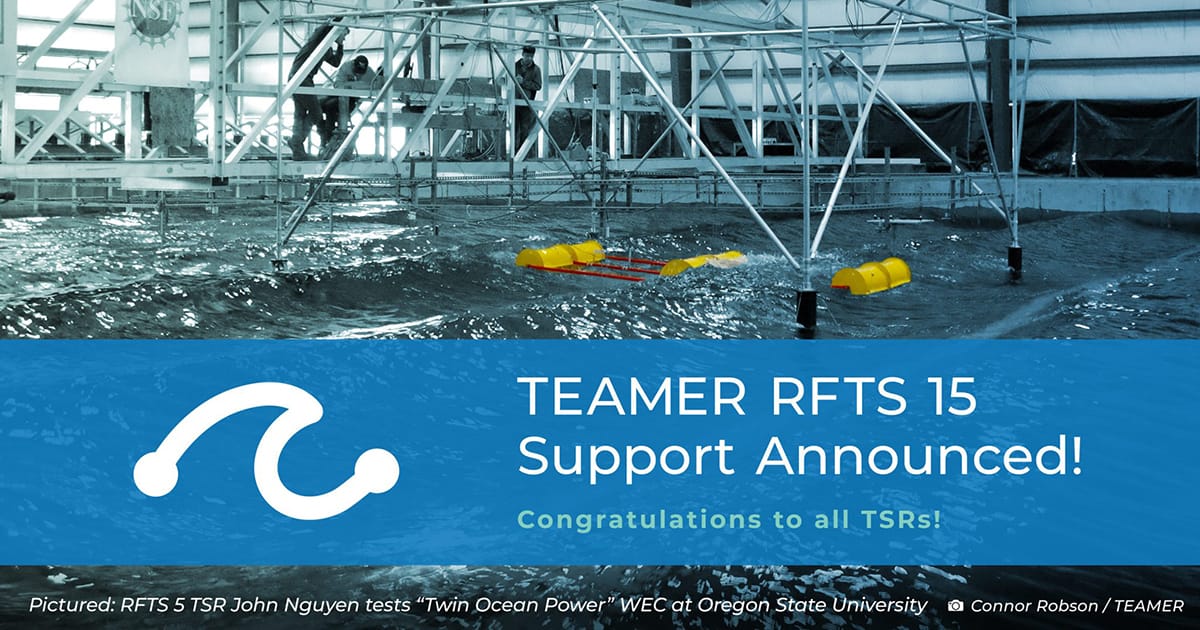
Supported by the US Department of Energy and directed by the Pacific Ocean Energy Trust, TEAMER accelerates the viability of marine renewables by providing access to the nation’s best facilities and expertise to solve critical challenges, build knowledge, foster innovation, and drive commercialization.
The following projects have been selected to proceed:
CalWave Inc.
Advanced Cost Modeling for Marine Energy Technologies
Facility: National Renewable Energy Laboratory
Economic viability is what separates research from commercial development. In order for companies like CalWave to evolve from foundational research to product development, defensible financial modeling and product economics are vital. The focus of this proposed TEAMER project is to obtain technical assistance from NREL to conduct a techno-economic analysis to estimate capital expenditures (CapEx) and operational expenditures (OpEx) for CalWave’s xWave deployment at PacWave. The results of this award would be a TEA model broadly supporting marine energy technologies.
Cetus Energy Inc.
Baseline Environmental Assessment of Preliminary Site for Current Energy Conversion Device off the Southeast Coast of Florida
Facility: Integral Consulting Inc.
Oceans are in constant motion, circulating nutrients and organisms worldwide while holding vast amounts of untapped kinetic energy. Because ocean currents are continuous, they represent a promising source of non-intermittent renewable energy. Cetus Energy has developed an ocean turbine that can reliably harness this energy. However, responsible marine energy (ME) development requires a thorough understanding of environmental conditions and potential impacts on marine animals and habitats through a comprehensive environmental assessment. The proposed study will advance global knowledge of how current energy conversion devices interact with high-energy ocean environments. Cetus Energy is seeking technical support from Integral Consulting Inc. to conduct a desktop environmental assessment to provide critical information to support an Environmental Impact Statement (EIS), which is required as part of the regulatory process.
Coastal Studies Institute
Met-ocean Characterization for Coastal Studies Institute’s Wave Energy Test Facility
Facility: Sandia National Laboratories
The Jennette’s Pier open-water wave test facility, operated by the Coastal Studies Institute and the Atlantic Marine Energy Center (CSI-AMEC), is one of the nation’s premier facilities for testing wave energy converters (WECs) at mid-level technology readiness levels (TRLs) between 4 and 6. This project will provide improved open-access met-ocean data and information compliant with international standards to enable technology developers to compare CSI’s test site with other sites and to facilitate test site selection, test article design, and test planning, including installation, operation, and maintenance (IO&M).
Instream Energy Systems
Technology Evaluation & Advisory for the Instream Energy CEC
Facilities: Sandia National Laboratories, National Renewable Energy Laboratory
Instream’s unique and groundbreaking technology harnesses the energy of free-flowing currents from tides, rivers, canals, etc., to produce renewably sourced distributed electricity, thereby addressing 1) the extensive use of fossil fuels and 2) energy independence. To help Instream achieve commercial viability, Sandia and NREL will provide a third-party technology evaluation and development advisory (TEDA) to critically review Instream’s technology performance drivers and improvement opportunities from an innovative and holistic perspective. The TEDA is a three-step, iterative process that includes (1) a detailed technology description, (2) technology evaluation with the technology performance level (TPL) assessment tool, and (3) technology development plan derived from TPL outcomes that identifies pathways for improving low performing technology areas and improves overall system knowledge.
iProTech
Hydraulic Power Measurement of Pitching Inertial Water Coil PTO on NREL’s LAMP
Facility: National Renewable Energy Laboratory
NREL will measure the hydraulic power available in IProTech’s novel inertial water coil power take-off unit when mounted to NREL’s Large Amplitude Motion Platform (LAMP). The water coil is part of IProTech’s Pitching Inertial Pump (PIP) wave energy converter (WEC), which captures the energy in ocean waves using its pitching motion. IProTech request use of NREL’s LAMP facility to subject the PIP PTO unit to the pitching motion it will experience in the ocean, using the output of a linear damping model made by NREL in WECSIM. IProTech request support from NREL to acquire the datastreams sent by the instrumentation installed on the PIP PTO, to find how much power can be captured by the PIP PTO by simulating different sea states on the LAMP.
Littoral Power Systems, Inc.
NeuralWEC: Scaling Validation & Open-Ocean Risk Mitigation for Next-Gen Wave Energy
Facilities: University of Maine, National Renewable Energy Laboratory, Kelson Marine
Through this project, Littoral Power Systems (LPS) aims to validate the scaling of a novel wave energy converter (WEC) and its control system by modifying a 1:20 tank-scale WEC model to closely resemble a 1:10 scale prototype intended for open-ocean testing at PacWave. Known as “NeuralWEC,” this project integrates machine learning and advanced control strategies with a lightweight, multi-axis point absorber to develop a cost-disruptive wave energy capture system.
Mirza Aliahmad
MirzaWEC and PTO Design Optimization using WecOptTool and WEC-Sim
Facility: The WEC-Sim Facility
The MirzaWEC is a TRL 2-3 wave energy converter concept that integrates multiple articulating floats deployed from a central platform. The concept is similar in general form to WaveStar, though Mirza has proposed a unique integrated power-take-off morphology to provide smooth power delivery and efficient mechanical power aggregation, decreasing the number of generator/electrical power take-off components to facilitate system modularity and scalability.
Mississippi State University
Reliability Analysis and New Technology Qualification of an Infinitely Variable Transmission for Tidal Energy Converters
Facilities: Idaho National Laboratory, American Bureau of Shipping (ABS)
This project advances tidal energy technology through comprehensive qualification and reliability assessment of an innovative Infinitely Variable Transmission (IVT) system. The IVT enables optimal energy harvesting by providing continuously variable speed ratios while maintaining 98% mechanical efficiency. The American Bureau of Shipping (ABS) will execute New Technology Qualification protocols to validate commercial viability, while Idaho National Laboratory (INL) will implement advanced reliability engineering frameworks for rigorous performance characterization. Key deliverables include quantified component-level reliability metrics through accelerated life testing, system-wide fault tree analysis with propagation pathways, and formal ABS certification documentation. This interdisciplinary collaboration between ABS’s certification expertise and INL’s reliability engineering capabilities establishes a robust analytical foundation for transitioning the IVT technology from prototype validation to commercial-scale deployment in maritime energy infrastructure.
Optical Waters Inc
Mitigating Marine Biofouling in Sensors Using UV Side-Emitting Fibers
Facility: Pacific Northwest National Laboratory
Biofilm accumulation is a critical issue for marine sensors, leading to reduced efficiency, inaccurate data, and increased maintenance costs. This project will explore the use of UV side-emitting optical fibers to mitigate biofilm formation using these technologies. For sensors, biofilm disrupts critical measurements by obstructing optical paths, clogging flow channels, and corroding components. Laboratory testing will validate the effectiveness of UV fibers in preventing biofilm growth for application in sensor channels to eliminate chemical management, enhance operational performance, reduce maintenance costs, and extend the lifespan of marine technologies.
Pacific Northwest National Laboratory
Techno-Economic Analysis for Marine Energy and Aquaculture Co-Location
Facility: National Renewable Energy Laboratory
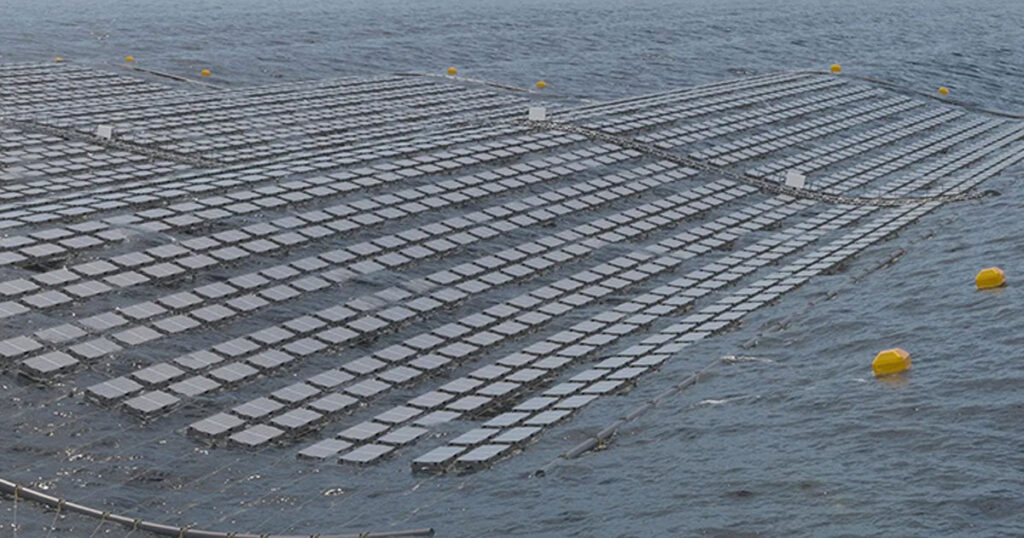
One of the ocean activities that can be powered by marine energy is offshore aquaculture. While aquaculture is not a new industry, it is developing offshore to reduce environmental effects, and competition for space and marine energy can help advance this growing sector. Pacific Northwest National Laboratory (PNNL) requests support to evaluate the technical and economic aspects of powering offshore aquaculture with wave energy. Prior research has investigated the feasibility of co-locating offshore aquaculture and wave energy in different regions of the United States through spatial analysis, energy needs assessment, and stakeholder engagement. The techno-economic analysis conducted by the National Renewable Energy Laboratory (NREL) will compare the cost and performance of different power supply systems, including wave energy and photovoltaic solar.
Pterofin, Inc.
Numerical Modeling of Pterofin’s Oscillating Hydrofoil
Facility: National Renewable Energy Laboratory
Pterofin, Inc. is developing the Pterofin Skimmer, a novel marine energy system. Utilizing an oscillating hydrofoil, the Skimmer harnesses energy in low-flow, shallow waters where traditional turbines are ineffective. This project, in partnership with the National Renewable Energy Laboratory (NREL), leverages multiple computational models—mid-fidelity Blade Element Momentum and high-fidelity Computational Fluid Dynamics—to optimize the design and efficiency of the Skimmer with assessment of the limitations of each model. Objectives include enhancing performance metrics like driveshaft torque and mechanical power and verifying and validating these improvements through comparisons of the two models and with experimental data. This research promises to deliver sustainable, efficient energy solutions for coastal communities, marking a significant advancement in renewable energy technology.
Sandia National Laboratories
Investigating Biofouling Effects on Wave Energy Converter Performance
Facility: University of Massachusetts
This project investigates the impact of biofouling on Wave Energy Converter performance. Sandia National Laboratories and the University of Massachusetts Amherst will conduct tank tests to gather data on biofouling effects. A knowledge gap has been identified, particularly regarding the effects of multi-layer biofouling, for which experimental data is lacking. While existing models account for surface roughness, surface coverage ratio, and fouling types, multi-layer biofouling remains underexplored. This project aims to collect tank test data to develop empirical formulas for drag and inertia coefficients, focusing on hard marine growth (mussels) common in the North Sea and the US Outer Continental Shelf. By integrating these formulas into optimization and simulation tools, we aim to reduce performance uncertainty, optimize WEC designs, and lower the Levelized Cost of Energy.
University of New Hampshire and Atlantic Marine Energy Center
OpenFAST Modeling Support for Integrated Numerical-Physical Turbine Tow Tank Experimental Program Capability
Facility: Sandia National Laboratories
This project’s goal is to develop the first phase of an integrated numerical-physical tow tank experimental program capability at the University of New Hampshire (UNH) and the Atlantic Marine Energy Center (AMEC) for the purpose of demonstrating improvements in the precision, accuracy, scope, and impact of marine turbine mechanical load and power performance testing. By coupling the strengths of numerical and physical experiments, UNH-AMEC can improve turbine performance assessments, ultimately leading to more efficient, reliable, and insightful de-risked turbine designs: the physical model enabling numerical model validation; the validated numerical model enabling design of physical model tests (saving time and resources), optimization of test conditions, e.g., rotor speed, hypothesis testing, parameter sensitivity studies, extrapolation to full scale, and augmentation of physical results like load distributions.
University of New Hampshire and Atlantic Marine Energy Center
UNH Open Water Testing Facility Data Acquisition System Development Support
Facility: National Renewable Energy Laboratory
MODAQ—a Modular Ocean Data Acquisition system—was created by NREL to support the advancement of marine renewable energy technologies by providing a comprehensive, verified, easily customizable data acquisition, processing, and storage solution. The newly founded Atlantic Marine Energy Center seeks to utilize MODAQ at its tidal energy test site, where a variety of environmental and performance monitoring instruments and sensors will be deployed. These sensors are used to monitor the performance and operation of marine energy devices under testing. Under this project, NREL scientists will provide training and technical support to AMEC staff and researchers using real-life examples. Training will focus on the software-side integration of instruments and sensors, using real-life examples as a basis for training and process documentation.
Water Bros Desalination, LLC
Technology Performance Level Assessment of Wave-Powered Desalination
Facilities: Sandia National Laboratories, National Renewable Energy Laboratory
WATERBROS’ unique and groundbreaking technology harnesses the energy of the ocean’s waves, etc., to produce desalinated water to coastal communities, thereby addressing 1) the energy resiliency of coastal communities and 2) energy independence. To help WATERBROS achieve commercial viability, Sandia and NREL will provide a third-party technology evaluation and development advisory (TEDA) to critically review WATERBROS’ technology performance drivers and improvement opportunities from an innovative and holistic perspective. The TEDA is a three-step, iterative process that includes (1) a detailed technology description, (2) technology evaluation with the technology performance level (TPL) assessment tool, and (3) a technology development plan derived from TPL outcomes, that identifies pathways for improving low performing technology areas and improves overall system knowledge.
Wave energy collective BV.
WECO Model Development and Analysis using WecOptTool
Facility: Sandia National Laboratories
In this project, Sandia trains WECO in using WecOptTool whilst applying the co-design process specifically to the Kaizen WEC. So far, The shape of Kaizen has been modeled successfully in Python using WecOptTool without PTO. The work on the PTO has started, and through this project, we aim to integrate a detailed representation of the PTO and mooring systems and complete a detailed analysis and optimization of Kaizen’s parameters, including the PTO mechanism. This project has the potential to reduce our current LCOE by 40% as it allows for optimization of the shape of our Kaizen increasing the capture width ratio, as well as enabling us to select a generator with a suitable efficiency map.
Wavewatts Inc.
Wave Energy Air Compression PTO Model in WEC-sim
Facility: The WEC-Sim Facility
The Wavewatts WEC harvests the power of waves to generate dispatchable energy in the form of compressed air. The stored energy can be used on demand for a variety of applications, from aquaculture to utility-scale power. WEC-Sim computations show that the revolutionary WEC is able to capture enormous energy with this simple and low-cost design. The WEC uses waves to power the air compression PTO and generate the large forces needed to compress air to high pressures. This makes the WEC cost competitive, comparable to other renewable energy plus storage systems. The next stage of development is to advance a numerical model of the PTO to integrate with the WEC-Sim analysis.