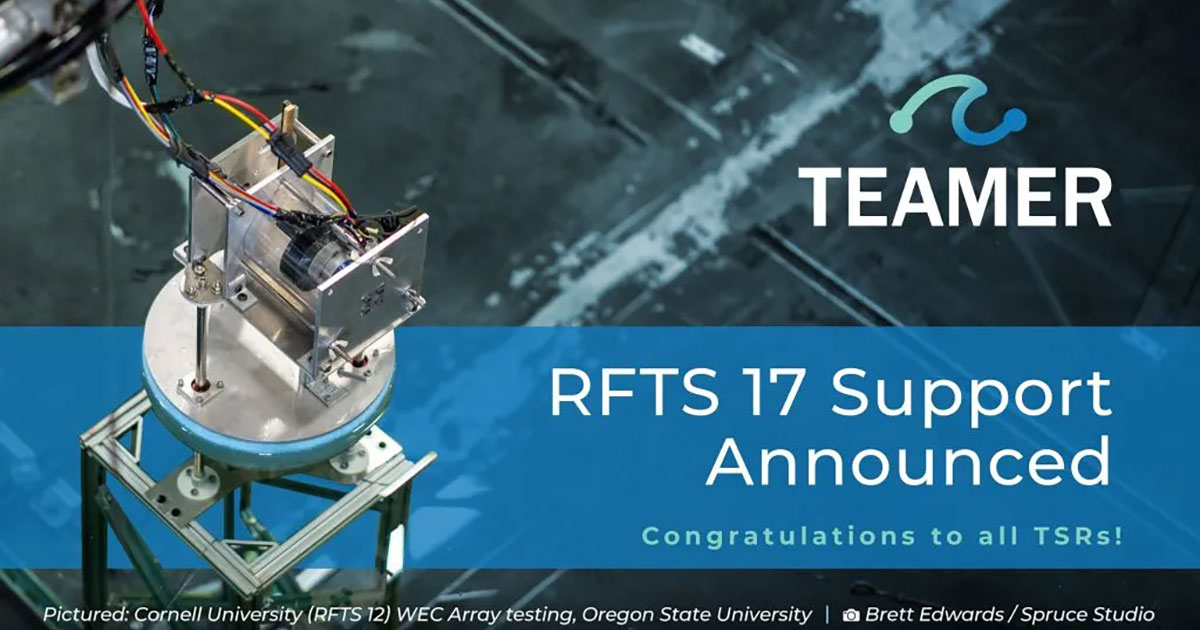
These numbers represent records for a round in terms of applications received, projects approved, and support amount. Thank you to all applicants and their selected facilities, our technical board, DOE partners, team leads, and external reviewers for their diligence in setting this new high-water mark!
The following projects have been selected to proceed:
Akselos Inc.
Demonstrating Risk Reduction of Marine Energy Support Structures through Integrated Design
Facility: National Laboratory of the Rockies
Akselos seeks the support of the National Laboratory of the Rockies (NLR) to address a core risk in Marine Energy (ME) design: the omission of detailed structural analysis for floating substructures. Internal structural details (scantlings) must be verified for ultimate strength and fatigue across all design conditions—tasks often simplified or ignored by the ME community, leading to risk of structural failure or over-design. This project addresses these risks via a case study to optimize NLR’s Reference Model 1 (RM1) marine hydrokinetic (MHK) turbine. It will provide an open-source demonstration showing how coupling NLR’s OpenFAST and WEIS toolsets with Akselos’ high-fidelity platform reduces failure risk, clarifies structural constraints, and optimizes system costs for the ME community.
Blue Lotus Energy Corporation
Commercialization Readiness, Market Entry, and Funding Strategy for Blue Lotus Energy
Facility: Braid Theory
Blue Lotus Energy is requesting commercialization support to accelerate the transition of its portable wave energy converter from prototype validation to early commercial deployment. The support will focus on aligning field testing and performance data with the practical needs of near-term customers, including offshore sensing, aquaculture, and other maritime applications that require reliable, low-maintenance power in challenging environments. This effort will translate technical performance into customer-relevant metrics such as reliability, survivability, deployment logistics, and maintenance intervals, while sharpening priority use cases and refining the go-to-market strategy. The outcome will be reduced market and adoption risk, stronger preparation for paid pilot projects, and a clearer, faster pathway to early revenue and scaled deployment.
C-Power
C-Power Critical Electrical System Accelerated Life Testing
Facility: The Wallace Energy Systems & Renewables Facility (WESRF) at Oregon State University
Power electronics used in wave energy applications are deployed in extreme and highly variable operating conditions that differ significantly from the steady state operating conditions seen in traditional applications. Prolonged operation under transient conditions, along with the high occurrence of over-voltage (OV) events, can accelerate degradation of the performance and reliability of power electronics and control systems, increasing the risk of premature system failure. This project will conduct accelerated life testing on updated SeaRAY power electronics with the goal to evaluate expected performance and reduce the overall risk of faults during long-term open-water deployments. The proposed Project will support two primary bench test campaigns—dynamometer-based testing and direct power testing. Key performance metrics include power conversion efficiency degradation, OV protection response time, and control network responsiveness.
C-Power
Integration of High Fidelity CFD into Structural Analysis Workflow to Improve Predictions of Wave Power System Subjected to Environmental and Operating Loads
Facility: Cardinal Engineering
This project investigates the integration of high-fidelity computational fluid dynamics (CFD) simulations into hydrodynamic modeling workflows for wave power system (WPS) design. Current methods rely on lower-fidelity models to estimate pressure gradient loads, which can lead to overly conservative structural requirements. By incorporating advanced CFD simulations, the project will provide more accurate predictions of external pressure forces acting on core structural components in wave power systems using the SeaRAY WPS as a case study. These improved load estimates will enable optimized structural designs that have the potential to reduce mass and manufacturing costs and increase power generation efficiency. The approach will be evaluated through metrics including mass reduction, cost savings, and improved power performance.
Carnegie Clean Energy Limited
Development of a Finfish Array with Distributed WEC Power Integration
Facility: Kelson Marine Co.
Kelson Marine will explore the feasibility of scaling down Carnegie’s existing WEC technology for use in a finfish aquaculture farm setting. Multiple WECs of different load and displacement capabilities will be modeled throughout a fish pen array, tuning control parameters to optimize power production as well as manage pen behavior and submergence.
Crown Estate Scotland
Investigating Wave Energy inter-array Impacts and Uncertainties (IWEIU)
Facility: Sandia National Laboratories
Understanding how deployment of a wave array may impact other wave arrays is critical for coordinated exploitation of the wave energy resource. Naturally, the assessment of inter-array impacts must be undertaken prior to the deployment of a wave array and so necessarily relies on numerical modeling. Currently, there is no universal agreement on how this modeling should be undertaken and the associated level of uncertainty in the model results. This project aims to investigate how different wave array representations may affect uncertainties in predicting inter-array impacts. The project outcomes will assist in planning the exploitation of the wave energy resource (for Scotland and globally), provide baseline numerical models to assess inter-array effects, estimate their uncertainty, and enhance understanding of SNL-SWAN capabilities.
Cymatix Solutions
Numerical Modeling of Water Pump-based Inflatable Wave Energy Converter
Facility: The WEC-Sim Facility
Cymatix Solutions is developing an inflatable wave energy converter (WEC) designed to provide reliable, low-cost offshore power in the 50–1,000W range, where solar and battery systems are often insufficient. The technology, originally developed and patented at the National Laboratory of the Rockies (NLR) to reduce mechanical complexity, improve survivability, and lower installation and maintenance costs in harsh marine environments. Cymatix Solutions is requesting numerical support from the WEC-Sim facility to advance this technology. The facility team will develop a WEC-Sim model to further refine a prediction of power production, structural loads, and anchoring requirements across selected deployment sites. These results will inform system sizing, power take-off optimization, and future prototype development, enabling Cymatix Solutions to de-risk commercialization and support investment in persistent offshore energy solutions.
Deep Anchor Solutions Inc.
Advancing DERA through ABS NTQ Prototype Validation
Facility: American Bureau of Shipping
This project requests TEAMER support to advance the Deeply Embedded Ring Anchor (DERA) through the Prototype Validation Stage of the American Bureau of Shipping (ABS) New Technology Qualification (NTQ) process. DERA is a compact, deeply embedded anchoring solution designed for floating marine renewable energy systems, offering high geotechnical performance with reduced material use and installation complexity. Building on prior TEAMER support, including completion of the NTQ Concept Verification Stage under RFTS 14, this effort focuses on design-specific qualification, verification, and residual risk closure. ABS will conduct independent engineering evaluations and risk assessments using existing analytical, numerical, laboratory, and field evidence. Successful completion will result in an ABS Statement of Maturity for Prototype Validation, supporting future certification and commercial deployment of anchoring technologies for marine energy.
Deep Anchor Solutions Inc.
Experimental Validation of Corrosion and Fatigue Models to Reduce Design Uncertainty in Marine Energy Anchors
Facility: Stress Engineering Services, Inc.
This project requests TEAMER support to advance Deeply Embedded Ring Anchors (DERA) by extending prior TEAMER desktop corrosion and fatigue analyses into focused laboratory validation conducted by Stress Engineering Services (SES) with Deep Anchor Solutions (DAS). DERA is a compact, deeply embedded anchoring solution for floating marine renewable energy systems, and long-term durability is critical for certification and commercialization. Building on RFTS 13, the project will generate controlled corrosion and cyclic loading data to calibrate corrosion-rate and fatigue-life models, enabling optimized corrosion allowance and fatigue-critical design details. Outcomes will reduce design uncertainty, overdesign, and lifecycle risk, supporting certification and lowering LCOE for marine energy systems—accelerating reliable offshore renewables, strengthening coastal energy resilience, creating skilled jobs, and reducing emissions and environmental impacts.
Drift Marine Systems
Drift-RMT
Facilities: VentureWell, Rare Innovation
Drift Marine is creating a sustainable and longer-lasting ocean surface drifter—designed to improve data accuracy and reduce battery failure through energy-harvesting technology. Drift Marine created a drifter that powers itself through its motion on waves, extending operational life and minimizing environmental impact. Now, with support from VentureWell and Rare Innovation, Drift Marine is seeking blue economy commercialization support through 1) financial modeling coaching and feedback, including scenario planning development; 2) price analysis, including pricing model assessments within leading industry technologies; and 3) product readiness coaching, developed specifically for ocean and marine ventures, which will aid in mapping product alignment between Drift Marine’s technical plans and customer requirements. Drift Marine will receive targeted customer discovery and beachhead market validation, with an explicit focus on pilot advancement.
Equinox Ocean Turbines BV
Full System Numerical Modeling of a Novel Semi-Floating Two-Stage Ocean Current Turbine
Facility: National Laboratory of the Rockies
The National Laboratory of the Rockies will simulate the Equinox Ocean Turbines semi-floating two-stage current turbine across a range of design load cases. The numerical model will include hydrodynamic rotor-to-rotor interactions informed by the detailed fluids modeling performed in a previous TEAMER collaboration. The coupled model will be expanded to include a full range of platform motions and mooring dynamics and incorporate platform controls. Design load cases will include shear and turbulence in the current and waves to test the performance, loads, and stability of the complete system.
Equinox Ocean Turbines BV
Roadmap Towards Large Scale Ocean Current Turbine Deployment in the Gulfstream
Facilities: Florida Atlantic University, Environmental Science Associates (ESA)
Equinox Ocean Turbines, Florida Atlantic University’s Southeast National Marine Renewable Energy Center, and Environmental Science Associates will collaborate to develop preliminary project planning assessments for ocean current turbine installations in the Florida Current. This partnership leverages the Gulf Stream’s potential as a clean baseload energy source. Equinox contributes innovative turbine technology, while FAU provides expertise related to southeast Florida ocean current development, and ESA offers environmental and regulatory expertise. Together, the team will address project development challenges through evaluation of Equinox technology compatibility, environmental impact assessment, and regulatory analysis. Two scenarios will be evaluated: a demonstration-scale single turbine and a commercial-scale turbine array. This will create pathways for ocean current energy development, providing clean baseload power and establishing a foundation for large-scale ocean current utilization.
IoT Bearings LLC
In-Water Validation of a Non-Invasive Vibration Sensor for Marine Energy Drivetrains
Facility: University of Washington
This project will experimentally validate a non-invasive vibration sensor for condition monitoring of rotating machinery in submerged and hostile environments. Bearings and shafts are critical failure points in tidal turbines, wave energy converters, and other marine and mining machinery, yet are difficult to instrument due to sealing, accessibility, and reliability constraints. The proposed testing will evaluate sensor performance in fresh and saltwater using a controlled laboratory test rig, with independent measurements of forces, torques, and shaft motion. Results will establish the sensor’s sensitivity to detect bearing damage and misalignment under submerged operation and quantify any changes in signal quality relative to in-air testing. This work will reduce technical risk and support the development of practical condition monitoring solutions for marine energy applications.
MARE
Seawater Conditioning and Testing of 3D Printed Materials Relevant to Marine Energy and Ocean Observing Systems
Facilities: Pacific Northwest National Laboratory, The University of Washington Applied Physics Lab
Additive manufacturing is of growing interest to the marine energy and ocean observing communities because it enables rapid design iteration, reduced fabrication cost, and mission-specific customization. However, 3D printed materials are known to degrade in seawater, and many remain uncharacterized under representative deployment conditions. The requested support will evaluate performance of FDM and SLA 3D printed test coupons and electronics enclosures before and after prolonged conditioning in seawater. Quantification of post-conditioning properties—water absorption, elastic modulus, ultimate tensile strength, and enclosure-level pressure survivability—will reduce uncertainty in designs utilizing these materials, enabling the broader use of additive manufacturing in subsea applications.
National Laboratory of the Rockies
Site Characterization for Floating Tidal Turbine Deployment in Sequim Bay
Facility: Marine and Coastal Research Laboratory at Pacific Northwest National Laboratory
PNNL will perform a site characterization study, using existing measurement and modeling data, for a potential future deployment of an NLR floating tidal turbine in Sequim Bay. To properly advance the conceptual design to a field test ready design, a formal siting investigation is required. To simplify the siting process, the team plans to deploy the prototype device in Sequim Bay under PNNL’s programmatic permits. PNNL will use existing measurement and modeling data to investigate and rank optimum locations to test the NLR-designed floating tidal turbine.
National Taiwan Ocean University
Shore-Moored Point Absorber WEC: Mechanical Integrity, Fatigue, and Survivability in Extreme Environment Conditions
Facility: American Bureau of Shipping
The applicant has developed a shore-moored point absorber WEC and demonstrated a 24kW unit at Badouzi Fishing Harbor in 2023. Initial trials showed reliable power generation under moderate seas (~3 kW at 0.5 m wave height). However, exposure to severe environment conditions like typhoon highlighted structural weaknesses and failures, underscoring the need for design refinement to enhance resilience and ensure compliance with safety standards. The objective of this technical assistance is to evaluate the design sea conditions and carry out structural analysis for assessing the WEC’s global and local structural integrity and evaluating the fatigue life of the critical components. This project will enhance the structural resilience and survivability of Taiwan’s first shore-moored point absorber WEC, enabling cost-effective operation in harsh environments.
Ocean Energy USA LLC
Numerical Simulation of the OE Buoy Oscillating Water Column Nozzle
Facility: Sandia National Laboratories
Recent Sandia OpenFOAM simulations of the OE35 oscillating water column device have indicated that the flow within the nozzle contracts and accelerates in the center of the nozzle, providing an opportunity to optimize power take off by concentrating the working surfaces of the power converter in this location. However, a typical power take-off device spins around a fixed rotor hub, which is located exactly where this accelerated flow was seen in previous analysis. This work will use numerical simulation to identify the trade-offs between the physical turbine blockage and the accelerating nozzle flow, and will study the effects of turbine blade location and hub geometry for optimal power capture.
Ocean Motion Technologies, Inc.
Testing the Ocean Motion Tech’s Surface Wave Energy Converter at Oregon State University’s Directional Wave Basin
Facility: Oregon State University – Directional Wave Basin
Ocean Motion Technologies (OMT) requests TEAMER technical support to test its Surface Wave Energy Converter add-on module (S-WEC) integrated with the Advanced Real-Time Control and Wave Analysis Module (ARCWAM) at Oregon State University’s Directional Wave Basin. TEAMER/OSU support is sought for facility access, test engineering, reference instrumentation, and data acquisition to benchmark ARCWAM’s near real-time wave estimation and quantify S-WEC power performance under repeatable regular and irregular, directional sea states. The campaign will map device response and control settings across a broader wave envelope than open-water trials and evaluate whether closed-loop kinematic control increases energy capture. Results will inform a higher-readiness prototype and generate a shareable validation dataset for the marine energy and ocean observing communities.
Ocean Power Technologies, Inc.
Experimental Investigation of Wave-Energy-Powered Floating Docking and Charging System for Autonomous Surface Vehicles
Facility: Stevens Institute of Technology – Davidson Lab
Ocean Power Technologies (OPT) requests TEAMER tank-test support at Stevens Institute of Technology’s Davidson Laboratory to evaluate a wave-energy-powered floating docking and charging system for autonomous surface vehicles (ASVs). The 1:10 scale test article includes: (1) a buoy representing a wave energy converter (WEC), (2) a floating docking/charging barge connected to the buoy via a hinged mechanical joint and bundled electrical/umbilical cable, and (3) a docked ASV surrogate. Testing will quantify coupled motions, and interface loads across scaled Sea States 1–5, validate OPT’s simulation model, and refine full-scale design loads for survivability and reliable docking/charging at sea.
Orbital Marine Power
Validation of Scalable Environmental Monitoring Strategies for Tidal Energy
Facility: MarineSitu
The marine energy industry currently lacks a comprehensive framework for determining monitoring mission parameters that considers available technological capacities, variable regulatory risk profiles, and operational effort requirements for implementation. To address this gap, Orbital Marine Power and MarineSitu will develop a scalable Monitoring Standard Operating Procedure (SOP). This SOP will be validated through a retrospective “Mock Deployment” using historical data from the O2 tidal turbine. By processing this high-volume dataset within MarineSitu’s SaltySuite platform, the project will benchmark automated strategies and quantify the specific labor and resources required for a variety of monitoring approaches. The outcomes will include a validated monitoring SOP and an Operational Feasibility Assessment, enabling the industry to define monitoring parameters that are both compliant and operationally viable.
Pacific Regional Institute for Marine Energy Discovery (PRIMED)
Environmental Monitoring Support for a Tidal Turbine Deployment in Blind Channel
Facility: MarineSitu
The Pacific Regional Institute for Marine Energy Discovery (PRIMED) is developing the Blind Channel Tidal Energy Demonstration Centre, in British Columbia. The primary objective is to develop and prove technical, economic, and environmental pathways for the integration of tidal energy into hybrid renewable energy systems. Environmental monitoring and data collection is a key focus to contribute to the state of science, make regulatory policy recommendations, and build community understanding and trust. Optical cameras, an imaging sonar, and a hydrophone will be used to monitor stressor and receptor interactions. TEAMER funding is requested to support the monitoring program through MarineSitu’s data management and analysis services. This includes the development of real-time detectors for monitoring instruments and builds on MarineSitu’s previous efforts to advance tidal energy monitoring.
PacWave (Oregon State University)
Requirements, Concept Design, and Business Case for PacWave Dynamic Cable System
Facility: 3U Technologies LLC
PacWave was commissioned to minimize costs of WEC prototype deployments and grid connectivity through supply of subsea transmission cables to accelerate open-water testing. Presently, deployment of WECs require the developer to supply a dynamic umbilical system to connect with the stationary subsea connector on the seafloor. This requirement represents a significant risk/cost to open-water testing for individual companies, which could be significantly reduced by this project. This effort analyzes the feasibility of PacWave providing a standard, ruggedized dynamic cable solution for repeated use by multiple WEC testers, which would significantly reduce the risk of future WEC deployments and accelerate open-water testing. Such an effort would have a positive impact on the entire marine energy industry with the potential to positively impact other marine test facilities.
Sandia National Laboratories
Pioneer WEC Version 2 Large Amplitude Motion Platform Testing
Facility: National Lab of the Rockies
The Pioneer WEC is a pitch resonator wave energy converter designed to provide additional electrical power to Coastal Surface Moorings (CSMs) within the NSF-funded Ocean Observatories Initiative (OOI) Pioneer Array. Pioneer WEC v2 builds upon the success of Pioneer WEC v1 by creating a more cost-effective, efficient, reliable, and easily manufacturable device. Testing v2 at the National Laboratory of the Rockies LAMP facility will greatly de-risk the next deployment, with the goal to again meet or exceed predicted power output; and to share lessons learned on how to design WECs to support power at sea endeavors and beyond.
Sitkana
Targeted Commercialization Support
Facilities: VentureWell, Rare Innovation
Sitkana is an Alaskan startup developing modular floating hydrokinetic energy systems for use in bidirectional oceanic tidal currents. Technological development includes power analysis of rotors in flume tanks, four full-size prototype iterations, and ongoing electrical power take-off assistance from Sandia National Laboratories. Now, with support from VentureWell and Rare Innovation, Sitkana is seeking blue economy commercialization support through 1) financial modeling coaching and feedback, including scenario planning development; 2) price analysis, including pricing model assessments within leading industry technologies; and 3) product readiness coaching, developed specifically for ocean and marine ventures, which will aid in mapping product alignment between Sitkana’s technical plans and customer requirements. Sitkana will receive targeted customer discovery and beachhead market validation, with an explicit focus on pilot advancement.
Stevens Institute of Technology
Experiment-Ready WEC-Sim Model Enabling Real-Time Hardware-in-the-Loop Control Implementation
Facilities: The WEC-Sim Facility, Sandia – Distributed Energy Technology Laboratory
The team at Stevens Institute of Technology led by Dr. Jia Mi requests TEAMER numerical modeling support from WEC-Sim and DETL teams to deliver an experiment-ready, real-time executable OSWEC numerical model to enable a dry-lab hardware-in-the-loop (HiL) platform. Stevens has validated a novel OSWEC and built a reconfigurable HiL system that applies programmable hinge-shaft excitation torque, enabling long-duration testing outside the wave tank. TEAMER support will (1) build and calibrate a WEC-Sim/Simulink OSWEC model using existing experimental characterization data, (2) develop the real-time cyber-physical interface (I/O definitions, timing, safety, logging) for deployment, and ensure the numerical model can instantly communicate with the instrument and hardware, and (3) demonstrate baseline closed-loop PTO control readiness, enabling future long-duration control and fatigue-relevant studies.
Triton Systems Inc
Power Take-off and Mooring System Model Development
Facility: Kelson Marine Co.
The collaboration between Triton Systems and Kelson Marine will center around practical wave energy converter (WEC) model development. Much of WEC model development has focused on theoretical precision and maximum numerical efficiency. However, industry priorities for commercialization of WEC technology revolve around applicability, experimental validation, and physical device power extraction efficiency. The model developed by these two entities will center these priorities through flexible modeling techniques in both the hydrodynamics and power take-off systems.
University of Connecticut
Assessing the Commercial Viability and Market Pathways of Piezoelectrochemical Energy Harvesting
Facility: OpenSeas Technology Innovation Hub at Old Dominion University
The applicant is requesting TEAMER Commercialization Support to accelerate the market readiness of our Piezoelectrochemical Energy Harvesting solution by systematically reducing commercialization and adoption risk. This effort will leverage OpenSeas’ proven commercialization frameworks, extensive marine energy networks, and direct experience supporting DOE Water Power Technologies Office (WPTO) programs, including SBIR/STTR, InDEEP, and Power at Sea challenges. This will help a business strategy and identify realistic market entry and funding pathways.
University of Massachusetts Amherst
Performance of Membrane Hydrofoils in Wave-Current Flows
Facility: University of Massachusetts Amherst – ORRE Wave-Current Flume
Tidal and river energy offer predictable renewable power, but current turbines face efficiency and performance challenges in variable conditions. This project advances an approach using compliant (stretchable) membrane hydrofoils that adapt their shape to flow conditions. Previous tests in uniform, low turbulence flows showed these membrane hydrofoils could extract up to 160% more energy than rigid blades in steady currents. This TEAMER project is an internal institutional support grant following on work completed under RFTS12, and will test membrane hydrofoils under realistic conditions at UMass Amherst’s Wave-Current Flume. We will measure performance when waves combine with currents, and the response of the energy harvesting system to changes in unsteadiness of the currents. Results will provide design guidelines for membrane-based tidal and fluvial hydro-kinetic energy extraction.
University of Washington
Characterizing WEC Hull Hydrodynamics
Facility: Oregon State University
UW is requesting support from OSU for experiments to characterize the hydrodynamics of point-absorber wave energy converter floats of various geometries in heave and surge motion. WEC design and modeling often rely on linearized hydrodynamic simulations, but these simulations have only been compared to experimental data for a limited number of float geometries. Therefore, UW is proposing hydrodynamics characterization experiments for contrasting geometries. UW will provide the actuator system, support structure, model floats, and DAQ. UW requests support from OSU to use and operate the Directional Wave Basin for these experiments.
University of Washington, Applied Physics Laboratory
Observing Animal Avoidance and Encounter Rates with a Small-Scale Tidal Turbine
Facilities: Pacific Northwest National Laboratory, MarineSitu
In 2023, APL-UW and project partners at PNNL and MarineSitu deployed a small-scale tidal turbine in Sequim Bay. The system was deployed for 141 days, and the turbine successfully operated and generated power. During that deployment, environmental monitoring was performed, and key findings have been published and made publicly available. While many animal interactions (birds, fish, and seals) with the turbine were observed, critical lessons were learned about how to improve sampling to more rigorously address key environmental questions. During a deployment of the 2nd generation turbine, we aim to apply these lessons learned to address data gaps needed to assess collision risk around operating turbines.
Voltage Vessels LLC
Accelerated Marine Aging and Characterization of Basalt Fiber Thermoplastic Composites for Wave-Energy Buoy Structures
Facility: Materials Aging and Detection (MAaD) Science Lab at Pacific Northwest National Laboratory
Eclipse is a basalt fiber-reinforced thermoplastic developed by Voltage Vessels using large-format additive manufacturing (LFAM) for marine structures. Prior work with the University of Maine and Oak Ridge National Laboratory has shown that Eclipse can be printed at hull scale and retains useful strength after seawater exposure. However, its long-term durability under demanding marine energy conditions remains uncertain. This TEAMER project will generate an accelerated aging and degradation dataset for LFAM-printed Eclipse coupons and subcomponents. Voltage Vessels will supply fabricated specimens to Materials Aging and Detection (MAaD) Science Lab at Pacific Northwest National Laboratory (PNNL), where combined saltwater immersion, temperature cycling, and UV exposure will be conducted. Mechanical testing and material characterization will support preliminary life-prediction models and design guidance for marine energy applications.
Vortex Hydro Power LLC
Commercialization of the VIVACE Converter
Facility: Rare Innovation
The VIVACE Converter is an environmentally compatible marine hydrokinetic energy system that harvests horizontal flow energy by leveraging fish-school dynamics without blades or rotors. The technology has been extensively validated through laboratory, river, and ocean testing, including recent third-party ocean trials, and has reached TRL 7. It is capable of operating in very slow flows—down to 0.5 m/s—where conventional technologies fail. This TEAMER engagement is focused exclusively on commercialization and market deployment. The project will advance VIVACE from successful technical demonstrations to early commercial adoption by validating priority Blue Economy markets, defining deployment and business models, engaging end users and partners, and establishing replicable pathways for scalable deployment across multiple marine and riverine applications requiring reliable, in-situ renewable power.
Wave Water Works
Markets and End User Focus for Ocillo-Drive Marine Energy Hybridization Applications
Facility: OpenSeas Technology Innovation Hub at Old Dominion University
Wave Water Works is seeking commercialization support from OpenSeas to refine Markets and End User Focus for Ocillo-Drive marine energy hybridization applications. After Open Seas independent review of previous technical work, discovery and stakeholder engagement, the facility will help refine our business strategy and model to identify realistic market entrance and funding pathways.
Supported by the US Department of Energy’s Hydropower and Hydrokinetic Office and directed by the Pacific Ocean Energy Trust, TEAMER accelerates the viability of marine energy by providing access to the nation’s best facilities and expertise to solve critical challenges, build knowledge, foster innovation, and drive commercialization.