
Autonomous landing is one of the most safety-critical phases of any drone mission and is particularly challenging when a device’s satellite navigation system is impaired due to signal obstruction, reflection, or interference. For example, when operating near tall buildings, in busy ports, or inside tunnels.
The DroneHome program has shown how terrestrial radio positioning can function as a complementary navigation layer within the overall navigation system, so a drone’s position remains stable and predictable even in GNSS-challenged environments where satellite signals are degraded or even absent. In practice, this means autonomous systems can maintain controlled behavior instead of experiencing sudden navigation failures.
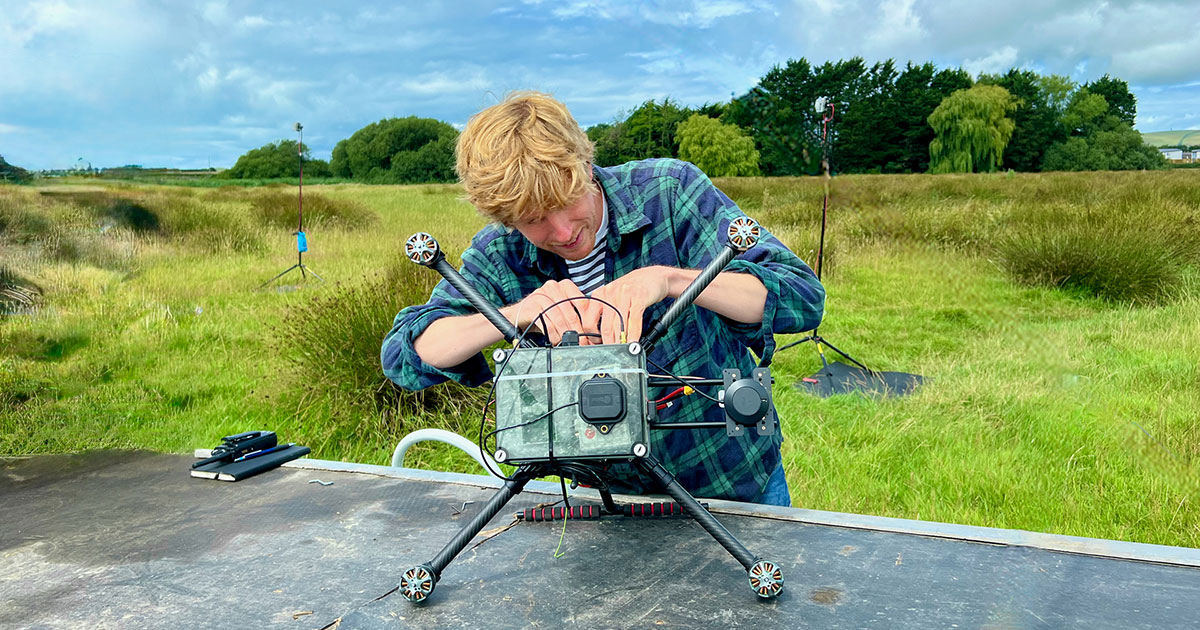
One of the key technical challenges was extending the operational range of UWB positioning to make it viable for autonomous landing. 42T worked closely with Omnisense to design and develop the extended-range RF hardware used in both the ground infrastructure and airborne elements of the system. The front-end design incorporates a UWB system-on-chip with low noise amplification, power amplification, switching, and antenna integration to deliver the required range and performance.
Field trials and simulation-based analysis confirmed that the system maintained stable positioning within a defined envelope during GNSS-degraded operation, enabling reliable autonomous approach and landing.
“We were delighted to support Omnisense in delivering its ground-breaking DroneHome project. GNSS underpins many of today’s critical systems, so developing a terrestrial positioning technology for more reliable autonomous operations in challenging environments is a major advance for drone safety,” said Paul Bearpark, Head of Electronics and Software of 42 Technology.
“DroneHome demonstrates that terrestrial radio positioning can provide a reliable and predictable navigation layer when GNSS signals cannot be relied upon,” said Andy Thurman, CEO of Omnisense. “This is an important milestone in building more resilient autonomous systems that can maintain safe operation in real-world conditions.”
The results from Omnisense’s DroneHome program are directly relevant across a wide range of applications, including airborne, terrestrial, and maritime operations, infrastructure inspection, and autonomous systems operating in GNSS-challenged environments.
Omnisense is now working with partners to explore the deployment of this capability within operational systems, with the aim of integrating it into next-generation navigation architectures and autonomous platforms.