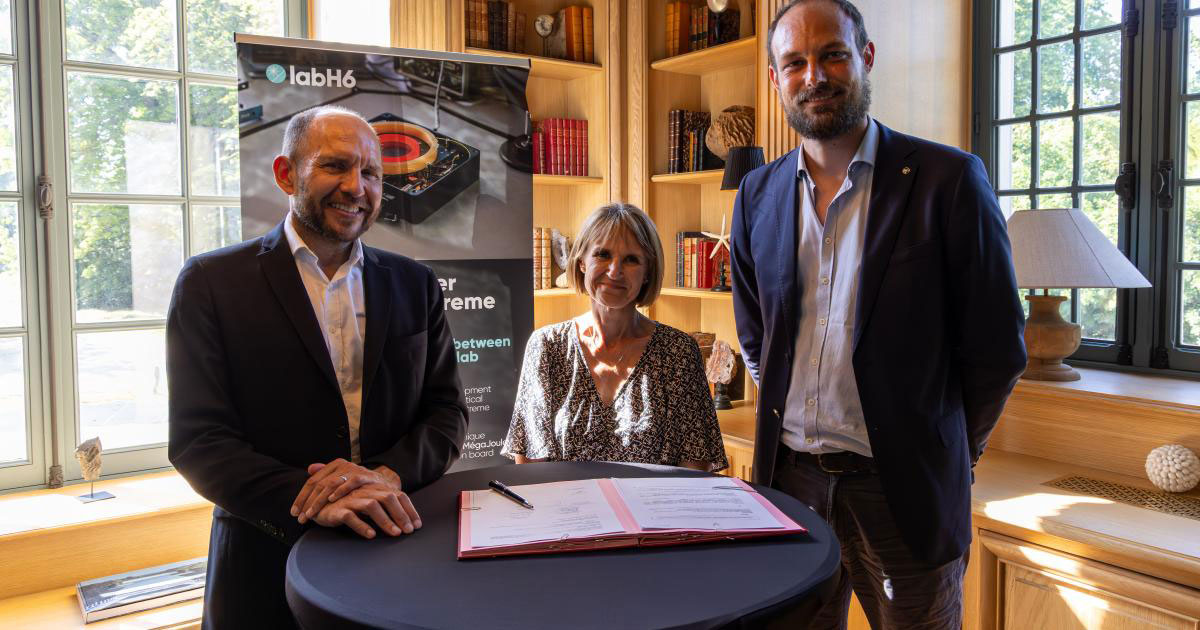
Exail, Jean Monnet University of Saint-Étienne (UJM), and CNRS announce the renewal of the LabH6 joint laboratory, bringing together Exail and the Hubert Curien Laboratory (UJM/CNRS/Institut d’Optique Graduate School). This new phase of collaboration aims to further advance the development of innovative optical fibers and sensors capable of operating in severe radiation environments, supporting strategic applications in space, nuclear energy, and high-energy physics.
Established in 2019, LabH6 combines scientific and industrial expertise to better understand the degradation mechanisms affecting materials exposed to radiation and to develop predictive simulation tools as well as next-generation technological solutions. Among its achievements, the joint laboratory has enabled the development of radiation-resistant optical fibers for ultraviolet and visible wavelengths, now used in laser diagnostics systems at inertial confinement fusion facilities, including the CEA Laser Mégajoule (France) and the LLNL National Ignition Facility (United States).
Research conducted within LabH6 has also led to the development of the LUMINA fiber-optic dosimeter. Designed in collaboration with CNES and calibrated at CERN, the instrument has been successfully deployed aboard the International Space Station (ISS) since 2021, where it has demonstrated its ability to detect the low radiation levels characteristic of the ISS orbit around Earth.
The renewal of the partnership will open new opportunities for the development of dosimeters increasingly tailored to the operational requirements of the space, nuclear, and nuclear medicine sectors. The partners also intend to expand their work to the design of new optical fibers and fiber-based sensors—both point and distributed sensing solutions—for data transmission and environmental monitoring in increasingly demanding environments. Future research will focus in particular on understanding radiation-induced degradation mechanisms in optical fibers operating under cryogenic conditions, a key challenge for magnetic confinement fusion applications.
Christelle Bahier-Porte, Vice President of Research at UJM, said: “Jean Monnet University is committed to working alongside its academic and industrial partners to foster cutting-edge collaborative research that combines expertise and generates new knowledge as well as major technological breakthroughs. The renewal of the LabH6 joint laboratory reinforces an ambitious scientific strategy shared by the Hubert Curien Laboratory and Exail, aimed at understanding and creating innovative technologies for harsh environments capable of addressing global challenges related to security and technological sovereignty.”
Mehdi Gmar, Deputy CEO for Innovation at CNRS, said: “Since 2019, the LabH6 joint laboratory has demonstrated that public research and industry can innovate together quickly and effectively. The space and nuclear applications resulting from this partnership show that combining our expertise delivers far more than each organization could achieve alone. This renewal marks a new milestone: deepening our understanding of materials under irradiation to address tomorrow’s challenges.”
Bruno Desruelle, CEO of Exail’s photonics business line, added: “Through its joint laboratories, Exail continues to pursue a strategy of close cooperation with academic institutions to accelerate the emergence of breakthrough technologies in strategic fields. This approach helps strengthen national and European capabilities in sectors where mastery of critical technologies, system resilience, and technological sovereignty are key priorities.”