
This subject-focused Science Plan is the first of its kind within NOAA Research, outlining and prioritizing scientific goals related to ocean carbon observation and providing coordination across NOAA Research and with intra-agency, interagency, and international partners. With extensive review and contributions by over 40 subject matter experts, this document represents what NOAA Research ocean carbon experts deem the most important ocean carbon scientific questions to answer over the next 10 years. This plan provides a framework and strategic direction for addressing these pressing scientific questions with regard to ocean carbon.
Some of the topics addressed in the plan include ocean carbon uptake and storage, ocean acidification, air-sea flux, data management, model and product development, and communication to end users, policymakers, and the general public. Parts of this plan were also informed by a landscape analysis of federal carbon observing efforts.
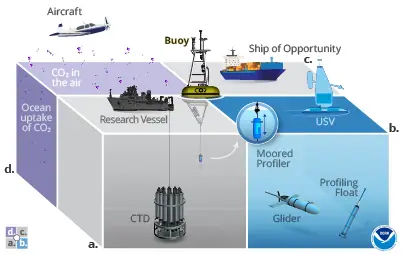
While this Science Plan focuses on NOAA Research’s ocean carbon activities, we envision it serving as an actionable guide for intra- and interagency partners (such as NSF, NASA, USGS, DOE, EPA, etc.) to identify potential areas of collaboration.
Strategic Scientific Goals
Subject matter experts have identified three goals to achieve over the next 10 years:
- Goal 1: Observe Changes in the Ocean Carbon Cycle
- Goal 2: Enhance Ocean Carbon Data Management, Models, and Services for Society
- Goal 3: Expand Ocean Carbon Opportunities and Community Engagement
Each goal includes prioritized research questions, actionable objectives, and a roadmap of suggested actions that NOAA Research can use to work towards achieving these goals. These efforts support NOAA’s mission and will enable NOAA Research to deliver trusted ocean carbon observations and services for the nation and the world.
By better-coordinating ocean carbon efforts, aligned with NOAA and US government priorities, this plan aims to improve the efficiency and effectiveness of carbon observing, enhancing the nation’s ability to address environmental and ecosystem change. With a clear scientific direction, actionable objectives towards accomplishing ocean carbon observing goals, and enhanced coordination and communication provided by this plan, NOAA Research labs and programs will work towards advancing this 10-year vision for ocean, coastal, and Great Lake observing networks.
This Science Plan was developed and made possible by ocean, coast, and Great Lake carbon experts. The Executive Writing Team includes GOMO Ocean Carbon Knauss Fellow and Program Managers Kyla Kelly, Alyse Larkin, and Kathy Tedesco, as well as David Munro (GML), Erica Ombres (OAP), Liza Wright-Fairbanks (OAP), Richard Feely (PMEL), Samantha Clevenger (OAP), and Elise Keister (OAP). Contributing authors included (in alphabetical order) Simone Alin (PMEL), Leticia Barbero (CIMAS), Chris Beaverson (OER), Eugene Burger (PMEL) Brendan Carter (PMEL), Sarah Cooley (OAP), John Dunne (GFDL), Reagan Errera (GLERL), Andrea Fassbender (PMEL), Dwight Gledhill (OAP), Liqing Jiang (CISESS), John Kochendorfer (ARL), David Legler (GOMO), Abby Letts (OER), Xiao Liu (GFDL), Sarah Nickford (IOOS), Kevin O’Brien (CICOES), Denis Pierot (AOML), Aaron Ramus (National Weather Service), Jonathan Sharp (CICOES), Adrienne Sutton (PMEL), Colm Sweeney (GML), and Samantha Wills (CPO). Feedback and review were provided by: Maciej Telszewski (IOCCP), Amanda Fay (Columbia University), Tim DeVries (U. of California, Santa Barbara), Annika Jersild (U. of Maryland), Britton Stephens (NCAR), Heather Heenehan (GOMO), Melissa Smuck (GOMO), Shelby Brunner (GLOS), Daniel Sandborn (U. of Minnesota/CICOES), Ralph Keeling (Scripps Institute of Oceanography), NOAA Research lab and program directors, the USGCRP Carbon Cycle Interagency Working Group, the Interagency Working Group on Ocean Acidification, the NOAA Carbon Dioxide Removal Task Force, the NOAA Greenhouse Gas Monitoring Technical Team, and the Ocean Carbon and Biogeochemistry program Scientific Steering Committee.