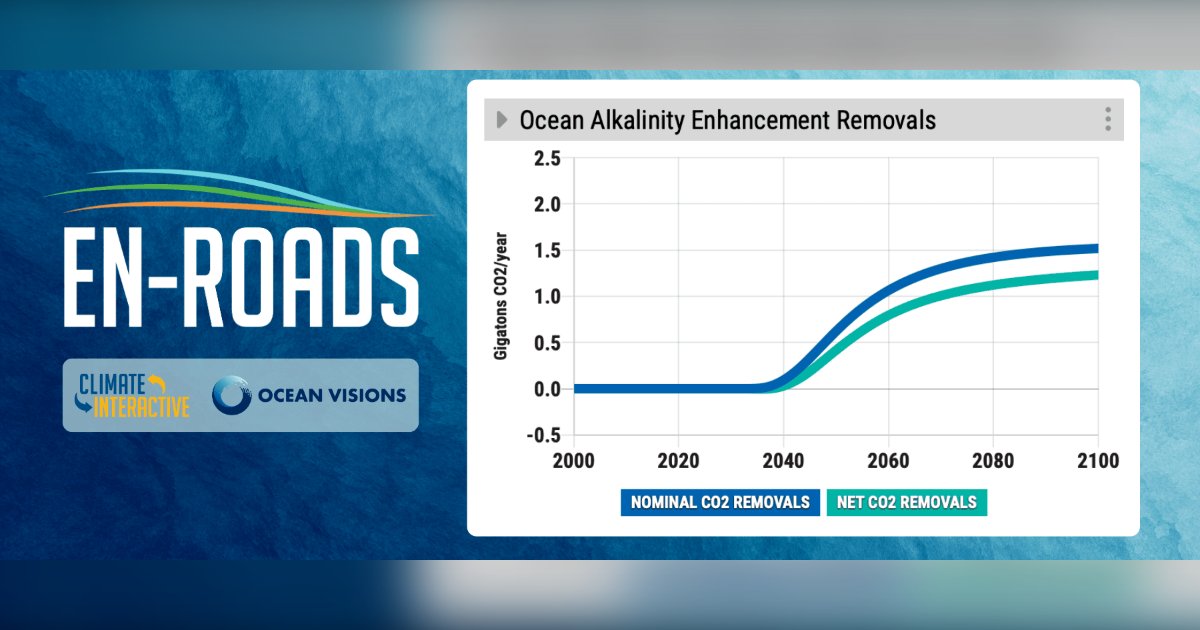
As knowledge of marine carbon dioxide removal (mCDR) grows, there is an increasing need to help decision-makers understand how its various approaches fit together within overall climate strategies. The new feature brings one of the most actively researched mCDR pathways, OAE, to a popular decision-support tool for climate strategy, allowing users to test scenarios, compare outcomes, and explore tradeoffs. The feature, based on rigorous climate models, was developed by Climate Interactive in close partnership with Ocean Visions and its deep network of experts.
“Marine carbon dioxide removal is still largely unknown to most climate policy decision-makers in terms of its potential role in meeting global carbon removal targets,” said Ocean Visions CEO Brad Ack. “This new tool will introduce millions of users of the simulator to Ocean Alkalinity Enhancement and enable them to assess how it may fit within climate mitigation portfolios in combination with and relative to other approaches.”
Unlike highly specialized technical models, the En-ROADS Simulator was designed to engage diverse users across sectors without requiring modeling expertise. The En-ROADS Simulator is one of the world’s most widely used climate decision-support tools. En-ROADS has been used by more than 1.5 million people worldwide, supported by a network of more than 960 Climate Ambassadors in 91 countries. Between 2022 and 2025, simulators from Climate Interactive and MIT Sloan informed 58 government, investment, corporate strategy, philanthropic, and higher-education policies and initiatives.
The new feature represents both mineral-based and electrochemical OAE approaches and allows users to:
- Explore potential climate outcomes associated with scaling OAE
- Examine and consider deployment constraints, costs, and uncertainties
- Compare OAE with other potential approaches to carbon dioxide removal
- Test policy, investment, and technology assumptions
- Visualize results instantly through interactive scenarios
“En-ROADS exists to help people better understand the consequences of different climate policies and investments,” said Andrew Jones, Climate Interactive Executive Director. “Partnering with Ocean Visions enabled us to build a feature that reflects current scientific understanding of both the opportunities and limitations of Ocean Alkalinity Enhancement in a transparent and evidence-based way.”
Climate disruption is the top threat to ocean health. Stabilizing the climate and restoring the ocean will require both dramatically reducing greenhouse gas emissions and removing greenhouse gases, especially carbon dioxide, already in the atmosphere. Recent scientific assessments indicate that carbon dioxide removal will need to scale significantly to reach global climate goals.
As governments, investors, and other stakeholders evaluate potential climate actions and pathways forward, accessible decision-support tools are increasingly important. The new OAE feature in En-ROADS contributes to those discussions and helps users explore OAE within the broader set of climate solutions.
To explore the tool, visit the En-ROADS Climate Solutions Simulator.