Researchers Find Argentinian Deep Sea More Biodiverse Than Originally Thought

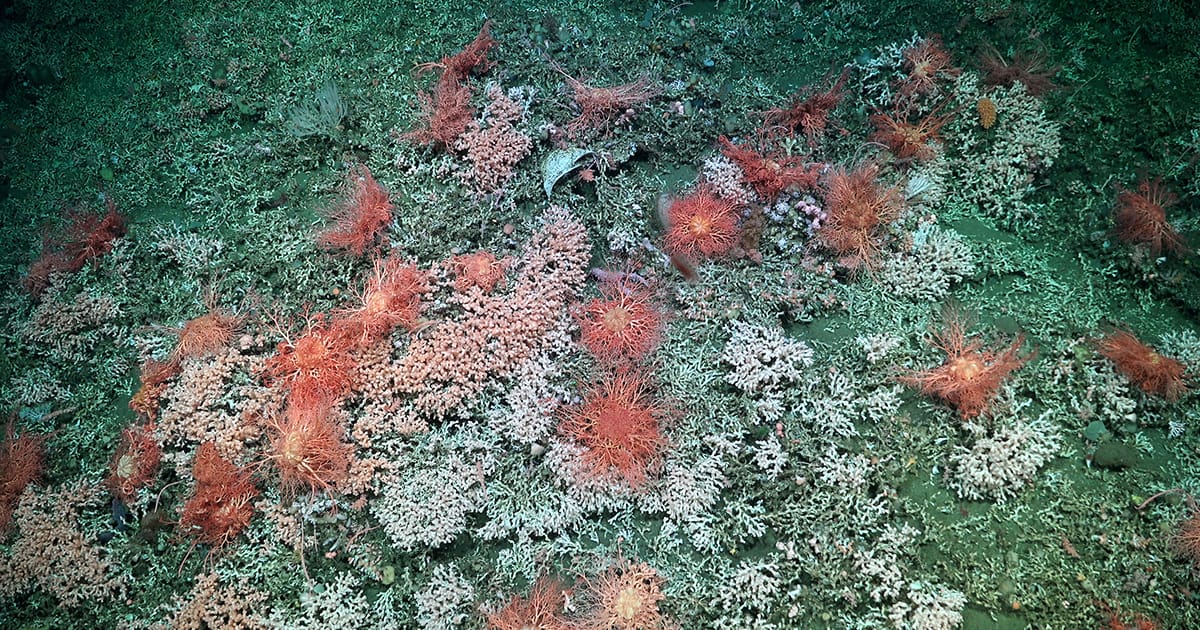
Deep-sea corals are slow-growing and long-lived. They are often classified as Vulnerable Marine Ecosystems, or VMEs, because they support high biodiversity and are threatened by human activities such as bottom trawling. In this image, red and pink basket stars (Gorgonocephalus chilensis) perch on top of white hard corals (primarily Bathelia candida and Solenosmilia sp.). The sea stars and corals actively feed by capturing particles and small organisms from the water. (Image credit: Schmidt Ocean Institute)
On an Argentinian-led science expedition aboard Schmidt Ocean Institute’s R/V Falkor (too), a science team observed stunning biodiversity along the country’s continental shelf. Traveling along the entire length of the coastline, from Buenos Aires in the north to an area offshore from Tierra del Fuego, the team documented the largest known Bathelia candida coral reef in the global ocean, several other rich reef complexes, and 28 suspected new species, including worms, corals, sea urchins, sea snails, and sea anemones.

“We were not expecting to see this level of biodiversity in the Argentine deep sea, and are so excited to see it teeming with life,” said the expedition’s chief scientist, Dr. María Emilia Bravo of the University of Buenos Aires and CONICET. “Seeing all the biodiversity, ecosystem functions, and connectivity unfolding together was incredible. We opened a window into our country’s biodiversity only to find there are so many more windows left to be opened.”

Expedition Chief Scientist Dr. María Emilia Bravo, a researcher at IGeBA – CONICET – UBA, directs an ROV SuBastian dive from the mission control room on the Research Vessel Falkor (too). (Image credit: Misha Vallejo Prut, Schmidt Ocean Institute)

Covering at least 0.4 square kilometers, the Bathelia reef is nearly the size of Vatican City. This stony cold-water coral provides habitat for other organisms, such as fish, crustaceans, and octopuses. Recognized as a Vulnerable Marine Ecosystem (VME) indicator species, Bathelia candida has been documented throughout the Southwestern Atlantic Ocean, with the largest patches off the coast of Argentina, but scientists hadn’t understood its extent until this expedition. The team found Bathelia reefs 600 kilometers (373 miles) further south than its known range, at 43.5° latitude.

ROV pilots filmed the remains of a deceased whale that had dropped to the seafloor, called a whalefall, at about 3,890 meters deep during a dive on the Salado-Colorado Kilometer scarp in the Argentine Basin. Whale falls offer up thousands of years of nourishment to a place accustomed to scarcity. From large scavengers to invisible microbes and bone-eating Osedax worms, there is something for all creatures that happen upon a whale fall. Once organic matter has been consumed, the succession stage is named ‘reef phase,’ and it is mostly used by the animals as a hard substrate, as in the case of this whale carcass, which presumably has spent decades on the seafloor. (Image credit: Schmidt Ocean Institute)

The team also documented Argentina’s first deep-water whale fall at 3,890-meters-depth and a rare phantom jellyfish—a deep-sea jelly that can grow as long as a school bus. Whale falls—places on the seafloor where a whale’s body lands after the animal dies—serve as temporary ecosystems, providing food for animals, including octopuses, sharks, and crabs. In addition, the scientists observed ancient Bubblegum coral gardens (Paragorgia arborea) nestled among large sponges in the 3,000-meter-deep Malvinas Trough near Tierra del Fuego.

Juvenile fish (Centrolophus sp.) swim around the bell of a Stygiomedusa gigantea, commonly known as the giant phantom jelly, which ROV pilots filmed at 250 meters. Their bell can grow up to 1 m (3.3 ft) in diameter, and their four arms can reach up to 10 m (33 ft) long. They do not have any stinging tentacles, but use their arms to catch prey, including plankton and small fish. (Image credit: Schmidt Ocean Institute)

“We collected an unprecedented number of chemical, physical, and biological samples that will be used to understand connections in our waters for years to come,” said Dr. Melisa Fernández Severini of Instituto Argentino de Oceanografía and CONICET. “These samples represent a unique opportunity to understand not only how extraordinary these extreme ecosystems are, but also how vulnerable they can be.”

(L-R) Fabrizio Scarabino (Universidad de la República – Udelar), Dr. Juliana Giménez (CONICET-UBA), and Dr. Leonel Pacheco (CONICET) look at biological samples in the main lab on board R/V Falkor (too). (Image credit:  Vallejo Prut, Schmidt Ocean Institute)

The team’s primary goal was to locate cold seeps, deep-sea environments where methane and other chemicals released from the seafloor serve as energy for microbes, which provide sustenance for animals like clams, mussels, and tube worms. They found one active seep measuring 1 square kilometer—twice the size of the Bathelia reef—which included a large patch of chemosynthetic clams.

Scientists observed this squat lobster in a bed of chemosynthetic clam shells of the genus Archivesica sp. and Calyptogena sp. at 619 meters while exploring chemosynthetic habitat patches associated with a methane-derived carbonate mound. In Argentine waters, the biodiversity and environmental context of these chemosynthetic ecosystems remain poorly understood. (Image credit: Schmidt Ocean Institute)

Scientific understanding of how cold seeps and deep-sea coral reefs interact is still in its adolescence, said Bravo.

The team observed trash in some areas, including fishing nets, garbage bags, and a VHS tape in near-pristine condition, owing to the durability of plastics. The sticker on the side of the tape is in Korean, but the team is not sure how it arrived off the Argentinian coast or how old it is.

“With every expedition to the deep sea, we find the Ocean is full of life—as much as we see on land, and perhaps more because the Ocean contains 98% of the living space on this planet,” said Schmidt Ocean Institute’s executive director, Dr. Jyotika Virmani. “We have been privileged to work with outstanding scientists across three expeditions in Argentinian waters, and look forward to seeing their research continue to unfold, unlocking new understanding and inspiration.”

Research Vessel Falkor (too) with ROV SuBastian deployed in the South Atlantic Ocean during the expedition. (Image credit: Schmidt Ocean Institute)

More in Science & Tech

Latest News

Latest Issue:

Advances in ocean tech—hardware and software—continue to fuel the appetite for deep-sea exploration. But Exploring the…

Your cON&Tent matters. Make it count.

Send us your latest corporate news, blogs or press releases.

Search