
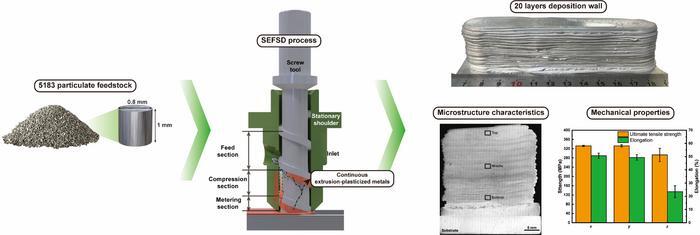
In a study published in the KeAi journal China Welding, a research team from Shanghai Jiao Tong University reported a solution: a novel solid-state 3D printing process termed screw extrusion-plasticizing friction stir deposition (SEFSD). Utilizing a specially designed three-stage tapered screw tool, the team continuously extruded and plasticized 5183 aluminum particulate feedstock via the tool itself, fabricating a 20-layer deposition wall without melting the metal.
“By keeping the metal in the solid state and utilizing the intense frictional heat and severe plastic deformation of the SEFSD process, we bypass the melting phase entirely,” said first author Licheng Sun. “This not only suppresses defect formation but also triggers dynamic recrystallization, yielding a homogeneous, finely grained structure with exceptional strength and ductility in the deposition components.”
The team’s research highlighted that the printed components maintained remarkable microstructural stability despite repeated thermal cycles during the layer-by-layer deposition because of the alloy’s low stacking fault energy. “In addition, since SEFSD relies on particulate feedstock, it allows for continuous feeding and easy customization of alloy compositions, overcoming the limitations of previous wire- or rod-based solid-state printing methods,” adds Sun.
Most importantly, this new method enables ‘self-plasticization’ without relying on a substrate constraint; it could therefore significantly reduce the thermal and mechanical forces applied onto the substrate or previously deposited layers, hence improving the processing flexibility.