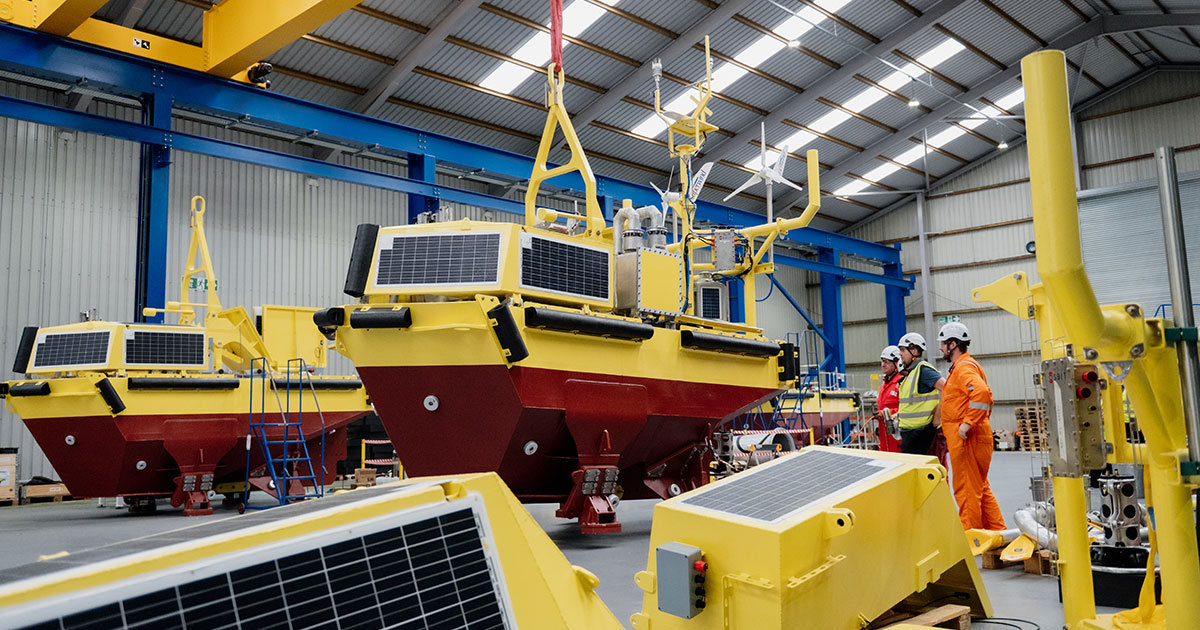
Developed by Partrac in close collaboration with fellow Venterra company Osbit, V‑LiDAR is the world’s most advanced floating LiDAR buoy system, designed to address the safety, reliability, and operational challenges seen in legacy designs. The innovative system combines an ergonomic lifting arm to reduce offshore handling risk, secure real‑time high frequency data transfer, and an extended deployment capability of up to 20 months—among the longest on the market—reducing service frequency and offshore interventions.
The fleet’s growth is underpinned by demonstrable delivery milestones and reflects increasing market adoption of this technology. Partrac has recently completed a comprehensive pre‑validation campaign for three V‑LiDAR systems at the NOAH met mast facility in Blyth, UK. The campaign represents a key early milestone for a client project scheduled for offshore deployment this summer, with each system undergoing rigorous testing to verify performance, data quality, and operational readiness ahead of mobilization.
Sam Athey, Managing Director of Partrac, said: “We’re seeing strong demand for V‑LiDAR and metocean measurements as developers look for safer, validated, deployment‑ready solutions that can perform reliably in challenging offshore environments. We’ve recently commenced another pre-validation for three systems for an upcoming wind measurement campaign scheduled for deployment this summer. This demonstrates the depth of metocean, offshore engineering, and operational experience brought together by Partrac and Osbit, and Venterra’s ability to support us in scaling the V‑LiDAR fleet while maintaining the highest standards of data quality, safety, and delivery.”
Floating LiDAR has become a critical tool for offshore wind development, but the industry has faced ongoing challenges around safety, reliability, and operational risk. In particular, the G+ Global Offshore Wind Health and Safety Organisation’s Floating LiDAR Safety Working Group has highlighted issues in operating floating LiDARs, including manual handling risks, complex lifting operations, in‑field maintenance requirements, and repeated offshore interventions. Developed through a risk‑led engineering approach, V‑LiDAR has been designed specifically to address these challenges, combining high‑integrity wind measurement with robust offshore engineering to reduce offshore interventions, improve deck‑handling ergonomics, and enhance overall system reliability
This approach has already received industry recognition. V‑LiDAR was recently named a finalist in the IIRSM Risk Excellence Awards 2026—Technological Breakthrough of the Year, in recognition of its potential to meaningfully reduce offshore risk and improve safety outcomes across floating wind measurement programs
The continued expansion of the V‑LiDAR fleet reflects Venterra’s role in supporting Partrac to scale delivery of floating LiDAR solutions, underpinned by group-wide engineering, safety, and governance standards that provide assurance to offshore wind developers, lenders, and investors.