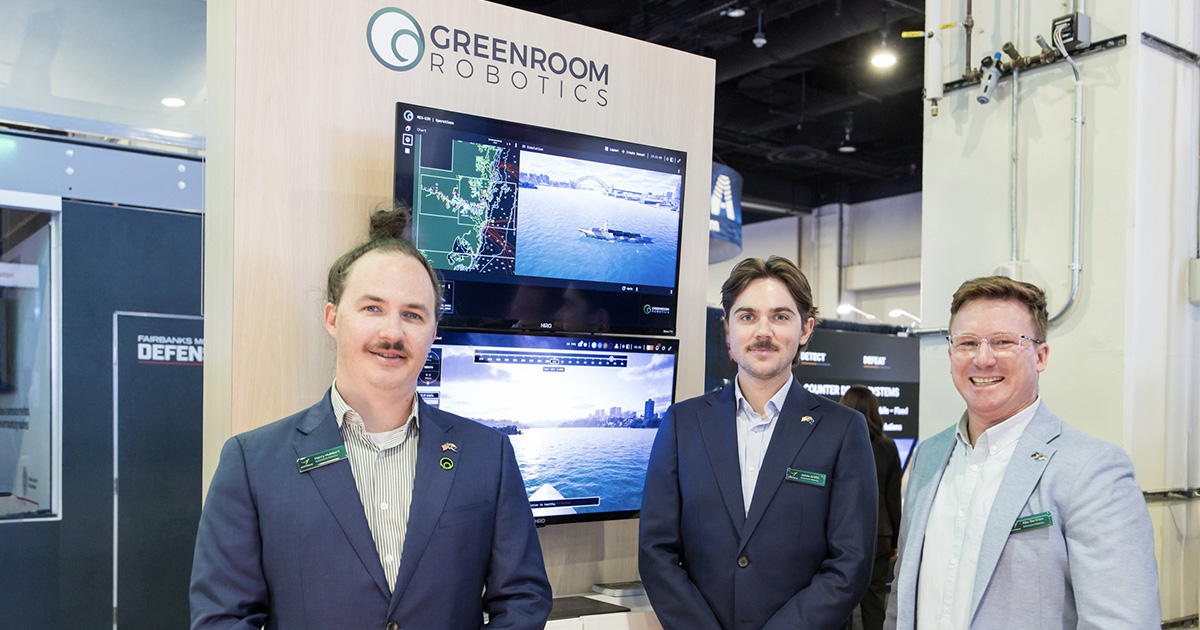
The company showcased a live, interactive simulation of its autonomy stack, designed to enable vessels to navigate, make decisions, and carry out missions with minimal human input.
“We’re not talking about future concepts. This is mission-ready autonomy that is already deployed today,” said Greenroom Co-Founder and COO Harry Hubbert. “The focus is on how quickly capability can be integrated and scaled across a range of vessels.”
As the Navy looks to field more rapidly deployable, multi-mission MUSVs, Greenroom is positioning its software as a way to shorten the path from platform to operations. The system is already deployed on commercial and defense vessels and has been successfully trialed with the US, UK, and Australian navies.
The maritime environment presents a uniquely complex challenge for autonomy, with constantly changing conditions driven by waves, currents, weather, marine life, and vessel traffic. These factors affect navigation, sensing, and communications. As a result, many companies developing unmanned surface vessels initially attempt to build autonomy software in-house, but often turn to specialist, operationally proven providers as these challenges become harder to manage at scale.
At the core is Greenroom’s GAMA, an autonomy module that integrates with onboard systems, including rudder, propulsion, and radar, to enable COLREGS-compliant operations in complex environments. GAMA has received Approval in Principle from Bureau Veritas, placing it among a small number of autonomy systems recognized by a major classification society.
The system is paired with Lookout+, an AI-enabled optical radar designed to provide passive situational awareness without emitting signals. The capability has undergone formal testing and evaluation, demonstrating collision avoidance in denied and emissions-controlled conditions.
Greenroom’s hardware-agnostic approach allows autonomy to be deployed in as little as five days, either by retrofitting existing vessels or integrating into new builds.
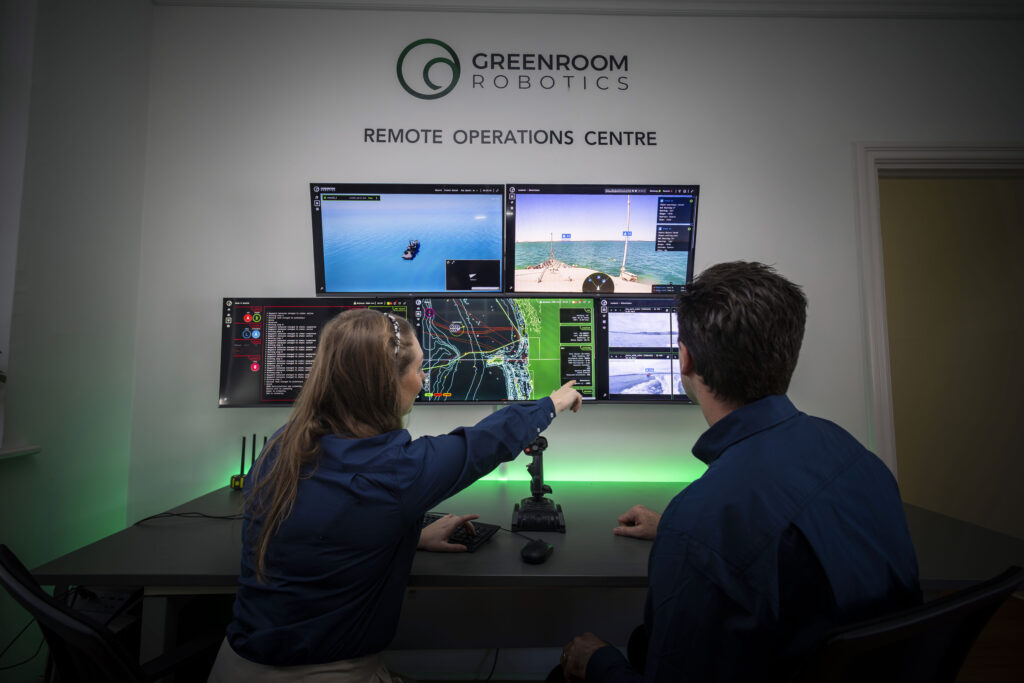
Greenroom’s remote operations center. (Image credit: Greenroom Robotics)
“We’ve designed thsoftware to work with the systems vessels already have onboard,” Hubbert said. “That removes a lot of the friction typically associated with bringing autonomy into service.”
The approach also allows navies to convert commercial craft, workboats, and decommissioned ships into autonomous platforms, rather than waiting for purpose-built fleets.
The retrofit model has already been tested. In an Australian Navy Patrol Boat Autonomy Trial, the system executed 148 autonomous collision avoidance maneuvers over a 705-nautical-mile mission on a 187-foot (57-meter) Armidale-class patrol boat that had been retrofitted for autonomous operations.
Greenroom’s software is also being integrated into new platforms, including SubSea Craft’s MARS unmanned surface vessel, a modular system developed for distributed maritime operations and brought from concept to water in 100 days.
“As MUSV programs evolve, the ability to rapidly adapt and deploy capability is becoming more important,” Hubbert said. “Our focus is enabling that flexibility.”