As governments, research institutions, and commercial organizations seek improved methods for monitoring the world’s oceans and critical subsea infrastructure, Nauticus believes autonomous robotic systems can significantly reduce the cost and complexity of deploying, inspecting, maintaining, and monitoring persistent subsea sensing networks. These networks have the potential to provide continuous streams of environmental and geophysical data while enabling greater visibility into changing ocean conditions and critical subsea assets.
The world’s oceans remain significantly under-sensored despite their increasing importance to environmental stewardship, offshore energy, subsea communications, scientific research, national security, and critical infrastructure protection. Nauticus believes this presents an emerging opportunity for autonomous subsea robotics to support the deployment and long-term operation of continuous ocean sensing infrastructure, creating a new class of persistent underwater monitoring capabilities. Recent advances in distributed fiber optic sensing, autonomous robotics, artificial intelligence, and subsea communications are enabling continuous ocean monitoring at a scale and cost that was previously impractical.
The Company is currently participating in multiple collaborative proposal efforts with government agencies, commercial organizations, and academic institutions to evaluate future autonomous subsea sensing solutions. These opportunities include government- and commercially-sponsored feasibility studies focused on the deployment, monitoring, and long-term operation of continuous ocean sensing infrastructure. The proposal efforts span multiple geographic regions and are intended to support persistent monitoring of critical subsea infrastructure, environmental conditions, and other emerging ocean intelligence applications.
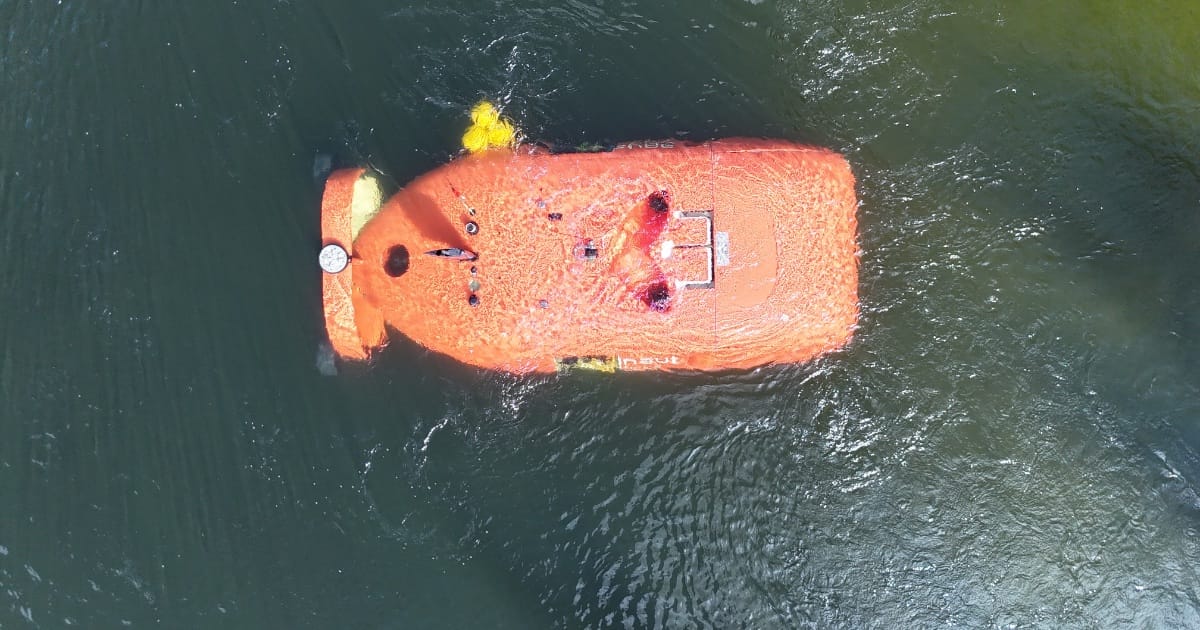
Nauticus believes the Aquanaut platform is uniquely positioned to support these emerging applications through its ability to autonomously perform complex subsea operations while minimizing reliance on traditional surface vessel-intensive activities. The Company is collaborating with prospective industry participants possessing expertise in fiber optic technologies, deployment systems, offshore operations, geophysical analysis, and data acquisition to evaluate integrated solutions capable of enabling persistent subsea monitoring. By bringing together specialists across multiple disciplines, Nauticus believes autonomous robotics can serve as a foundational component of a scalable ocean sensing ecosystem that delivers continuous, high-quality subsea data while reducing operational costs and vessel dependence.
“We believe autonomous robotics will play a transformative role in the next generation of ocean intelligence,” said John Gibson, President and CEO of Nauticus. “The world’s oceans remain one of our least continuously observed environments, yet they are becoming increasingly important to global infrastructure, environmental monitoring, scientific research, resource management, and national security. We are encouraged by the collaborative discussions currently underway and believe Aquanaut is uniquely positioned to help enable a new generation of persistent, cost-effective ocean sensing solutions. The breadth of engagement we are seeing from government, commercial, and academic organizations reinforces our confidence that autonomous subsea operations will become an increasingly important part of future ocean infrastructure. We believe this represents the beginning of a significant long-term market opportunity for autonomous subsea robotics, and we intend for Nauticus to be at the forefront of enabling persistent ocean sensing infrastructure around the world.”
While these activities are currently in the proposal and evaluation stage, and there can be no assurance they will result in awarded projects or commercial agreements, Nauticus believes its differentiated autonomous technology, growing industry engagement, and expanding ecosystem of collaborators position the Company to participate in this emerging market as it develops.