A multidisciplinary team has successfully tested a novel autonomous monitoring system designed to improve how environmental evidence is generated for decision-makers managing the sustainable future expansion of floating offshore wind.
As the UK accelerates its transition to renewable energy, floating offshore wind, which sees floating turbines mounted on buoyant platforms tethered to the seafloor, is expected to play a vital role in achieving national net zero ambitions.
However, while there is a growing body of scientific evidence on the environmental effects of fixed offshore wind farms, much less is known about how floating developments may interact with deeper seas, seasonal changes and the wider marine ecosystem.
Researchers on the EQUIFy project, which brings together experts from Plymouth Marine Laboratory (PML), the University of Plymouth, Centre for Environment, Fisheries and Aquaculture Science (Cefas) and a wider network of academic, public-sector, and industry partners, are looking to address this.
The research team is developing an evidence-based framework that can quantify ecosystem changes associated with floating offshore wind developments and support regulators and decision-makers.
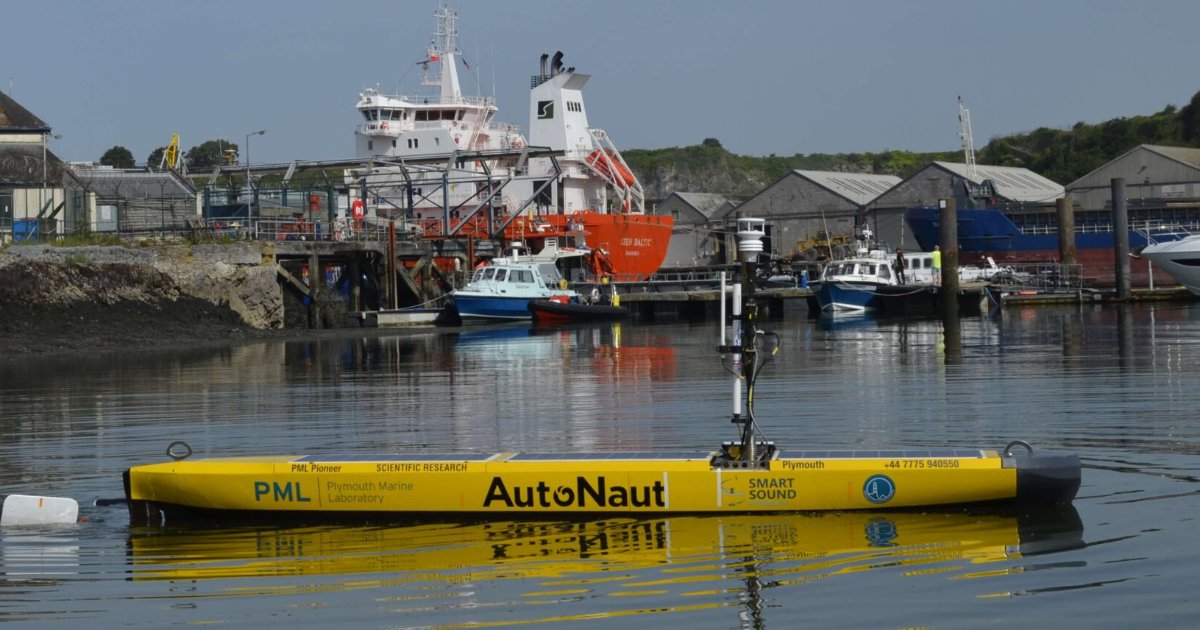
They recently conducted a trial in Smart Sound Plymouth using the PML Pioneer (Autonaut, pictured above), a five-meter wave-propelled, uncrewed surface vehicle (USV), to test its novel integrated sensor payload.
The trial combined meteorological and oceanographic observations, scientific echosounders, and autonomous environmental DNA (eDNA) sampling, ensuring monitoring capabilities from physics to fish.
Dr. Juliane Wihsgott, Physical Oceanographer at PML and observational lead for EQUIFy, explained: “This was the first successful field deployment of our integrated marine autonomy demonstrator, and it is an important step towards the autonomous ecosystem monitoring needed to support the sustainable expansion of offshore wind. This integrated approach allows us to build a more complete picture of dynamic and complex marine ecosystems, by combining information about physical ocean conditions with data describing fish populations and the genetic signatures of marine life present in the surrounding waters. The shift is not simply to generate more data but to provide robust information to support decision makers. This trial gives us a practical testbed for that shift, helping us understand how autonomous systems can contribute to future monitoring, adaptive sampling and environmental evidence for floating offshore wind.”
Data collected during the trial will now be used to evaluate how autonomous technologies can support integrated ecosystem assessment and turn individual data streams into information that improves confidence in model predictions, environmental assessment and decision-support tools.
All of that is essential for the floating offshore wind sector as, with rapid expansion planned, environmental monitoring will need to keep pace with increasingly complex questions around cumulative impacts, climate change and multiple human uses of the sea.
This creates a need for monitoring approaches that are scientifically robust, operationally safe and scalable, whilst also capable of characterizing the physical, biogeochemical and biological processes that shape marine ecosystems.
Professor Matthew Palmer, Professor of Marine Autonomy and Environmental Intelligence at the University of Plymouth and EQUIFy project lead, said: “This demonstration represents an extremely valuable step forward in showing what’s possible when marine autonomy, environmental science and engineering come together.
“The team overcame genuine real-world challenges to deliver a state-of-the-art capability that will benefit not only EQUIFy but also future collaborations with industry, government and research partners.
“As offshore wind expands and moves further offshore into deeper waters, autonomous technologies will become increasingly important for collecting the environmental evidence needed by regulators, industry and policymakers.”
Funded by the Natural Environment Research Council (NERC) and The Crown Estate through the ECOFlow program, the four-year EQUIFy project is helping to address knowledge gaps in the environmental effects of floating offshore wind systems. This includes developing a transferable, evidence-based framework to assess ecosystem change throughout the lifecycle of floating offshore wind developments, from local turbine-scale processes to regional effects across wider shelf sea systems.
Rather than examining individual species or isolated environmental pressures, the project takes a whole-ecosystem approach, combining ocean physics, marine ecology, autonomous monitoring, advanced modeling and decision-support tools. This allows EQUIFy to assess potential effects from local mixing and productivity through to wider ecological receptors, while considering cumulative pressures, climate change and changing use of marine space.
Ultimately, EQUIFy aims to provide government, regulators and industry with the robust scientific evidence to support faster, more informed consenting and spatial management decisions whilst ensuring the sustainable growth of floating offshore wind.
The Plymouth marine autonomy demonstrator builds on EQUIFy’s wider program of field observations and modeling. Earlier this year, project scientists joined the Royal Research Ship Discovery at Scotland’s Kincardine floating offshore wind farm, to investigate the physical and ecological processes around operational floating turbines.
Combined with advanced computer modeling and artificial intelligence, data collected through EQUIFy fieldwork campaigns will help improve understanding of ecosystem change across scales, from local processes to wider shelf-sea responses.
The findings will feed into new decision-support tools capable of translating complex environmental science into practical evidence for policymakers, regulators and industry.