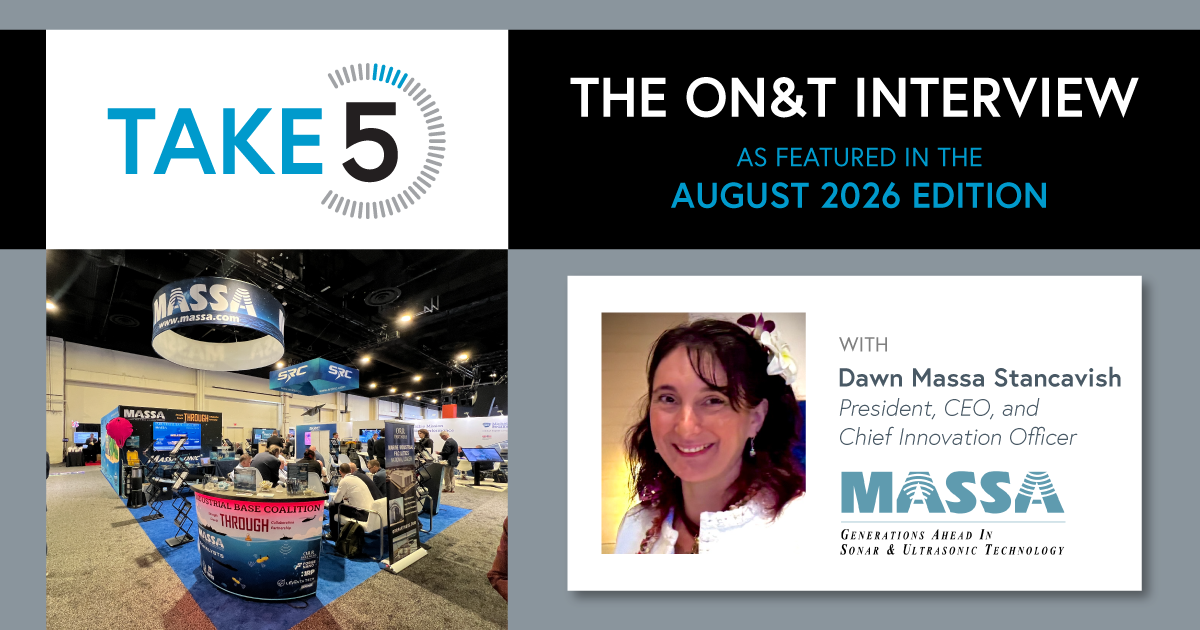
Massa has been sharing a message of “Strength Through Collaboration; Growth Through Partnership.” Can you explain how you put it into practice?
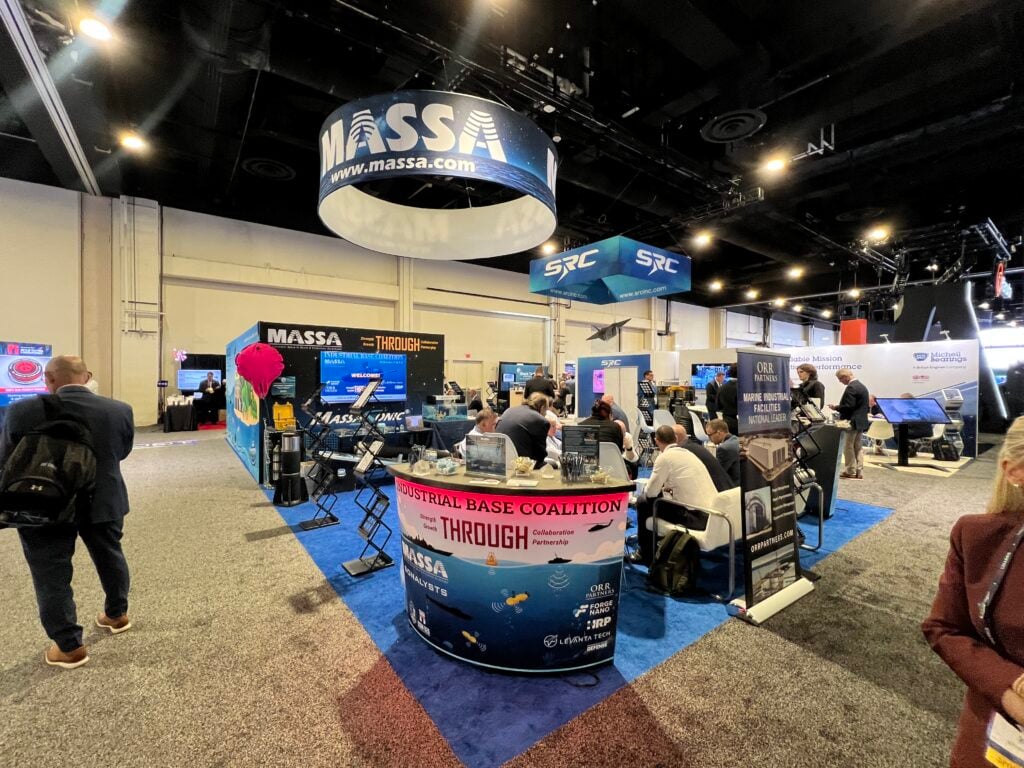
Strength Through Partnership; Growth Through Collaboration can be read any way or direction and still read true. It’s a concept I came up with when I chose to showcase some other businesses we are working with at the Massa booth during a prominent maritime tradeshow. Massa has been both a prime and a subcontractor. Years prior (before we had a booth of our own) I had tried to rent a little space from larger primes we had worked with hoping to demonstrate our partnership—but no one would support this.
Management at Massa decided that, as we grew, we would view our subcontractors as partners and team members rather than replicating the power struggle we experienced too often as a subcontractor. Also, by coalescing synergistic teams amongst various sized businesses together, a collaborative group of companies can provide faster, more cost-effective solutions to governments than traditional large primes. What’s more, it’s a much more enjoyable and rewarding working experience.
What challenges have you faced with Navy restructure for Submarine Procurement, Defense Contracting/Acquisition Reform, and the Defense Industrial Base (DIB)?
As a business, we never stop learning. This is how strategy and capability can be of service to fill any market need. Perception and communication are key.
Despite delivering ahead of schedule over 60% of the sonars to US Submarines of all classes, small businesses like Massa can often struggle to be heard. Submarine sensors are only a small portion of what Massa does. Companies like ours need to resist being “pigeonholed” by the government.

The US administration recently reallocated submarine procurement from the Department of Navy (DON) to the Department of War (DOW). This is a major structural shift in reporting and procurement and, one can only assume, that its intent is to send a clear message to the Navy. The problem remains, however, until the Navy sheds its bureaucratic peacetime inertia, we will remain behind schedule and over budget. This is concerning due to the current military and technical advancements and threats we face from the Chinese Communist Party (CCP).
Regardless of perception, truth and reality have a funny way of standing out on their own. Massa knows how we differ from our competition in terms of strategy, capability, and approach to playing with others. We may be a Small Business, but Massa will always stand apart as an innovative producer of sophisticated acoustic products and underwater systems of all sizes.
What are your concerns regarding America’s “Readiness” and how can Massa help solve issues that the DOW is faced with presently?
I am concerned about the mounting geopolitical threats
America and her allies face. This is exacerbated by what is going on today with respect to the greater health of the DIB as a cohesive ecosystem. There is a growing consolidation of large companies—and this could trigger a serious degradation in our combined technical capabilities, not to mention drive up prices and lead times significantly.
If the government does not move faster and smarter, we as a nation, will become stuck in one very consequential bottleneck. The Government needs to collaborate with industry and use some common sense to qualify more vendors. They also must act faster to grant the demand signals to those who can compete & scale as alternate suppliers and innovative partners. We’re facing increasingly aggressive threats from our adversaries. America has a track record of deliberating for too long—the time to act is now!
How has Massa been able to maintain its status among the Large Primes, Neo-Primes, and other businesses and University Affiliated Research Centers (UARCs)?
The DIB consists of large, medium, and small businesses, and various universities and government research centers. To maintain a healthy ecosystem, the DIB requires traditional Primes, Neo-Primes (the fast-moving startups), and technical Subject Matter Experts (SMEs) in everything from complex sensors and systems to precision manufacturing and technical trades. Unlike the larger government contractors who adopt an administration-to-administration approach, and the startups that channel their efforts more quarter to quarter, many small and medium private businesses are focused on longevity and are in the DIB because they are passionate about using their craft to secure our freedom.
Traditionally the US government works with a large Prime and a University Affiliated Research Center (UARC) to design certain systems and products. They then separate different aspects of the product or system and sometimes hold different parts of the whole at different clearance levels. Then the segregated packages are held out to industry with very vague description to bid on separately, much like Lego kits.
Massa’s philosophy integrates production engineering into the design process for both commercial and military programs. Our early prototypes are closer to First Article units than what the UARCs can produce. This ethos stems from our early roots and how we rapidly advanced sonar in WWII. Designing with production in mind from the outset allows for fast scalability, yet this is a nuanced skillset. This is what must happen today if we are serious about widespread deterrence.
Massa produces products for both defense and commercial markets. How does Massa manage its unique business model, and how does that play into a design and scale approach?
At Massa we continue to challenge people to reenvision the possible with acoustics and scalability. Anything is possible with clarity, capability, and capital. Massa benefits from being in our own category. We have a strong and inspirational story. We maintain and grow our diverse catalog of products and capabilities, many patents, ongoing contracts, and a specialized practice of integrating production and design engineering specifically for acoustics.
We are not bound by any one market. We serve many customers, and because we are free to decide what we do as a business, we focus our capabilities in areas we are passionate about—and that ultimately benefits our country’s national defense. We heard the call to action and are in the DIB by choice. We deliver certain products at a rate of 1,440/month and have had commercial production rates of 8,000 sensors per day. We are currently expanding our facility to add an additional 10,000 sq. ft.
Massa scales new and existing products in months—not years. At Massa, we unapologetically continue our legacy of doing the impossible.
This feature appeared in ON&T Magazine’s 2026 August Edition, Defending Critical Underwater Infrastructure, to read more access the magazine here.