
These dimensions define their suitable applications and payload capacity in the field, but this rapid diversification shows little sign of slowing. As defense and commercial markets look to better explore and secure remote stretches of the marine domain, we can expect a growing ecosystem of cooperative drones—surface, subsurface, and aerial—to deliver tactical advantage by providing actionable intelligence quickly and accurately.
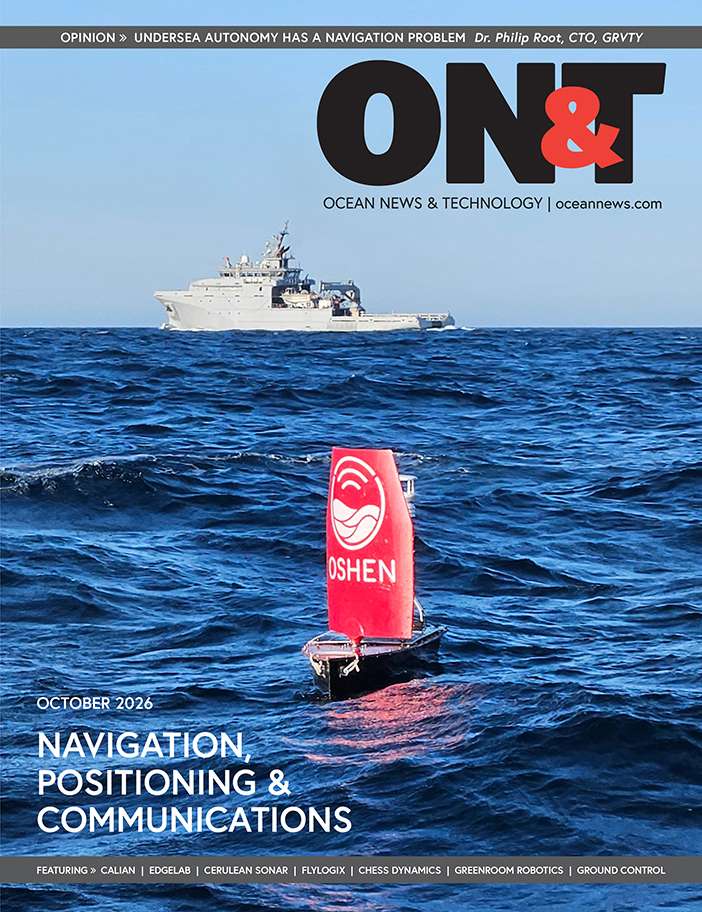
This month we sat down with Anahita Laverack, CEO of Oshen, a Plymouth (UK)-based company that’s squarely focused on building and fielding constellations of small, rugged surface robots designed to handle some of the toughest ocean data collection assignments, including Category 5 hurricanes. Fresh back from REPMUS in Portugal, where Oshen robots participated in several Anti-Submarine Warfare demonstrations, we consider how a relatively new startup is already showing how cost-effective, quick-to-deploy surface robots can play an increasingly tactical role in force multiplication.
Give us a little background on Oshen and how the company got started…
Oshen grew out of an engineering effort—we wanted to be the first in the world to complete the fully autonomous microtransat, a challenge for small autonomous sailboats to cross the Atlantic Ocean. During this, we started engaging with industry and saw the potential of what large constellations comprising these small robo-sailboats could do. It was a very different take to industry consensus at the time, which was shifting to larger USVs with ever more sensors packed into one platform. But it’s great years later to not only complete the microtransat challenge we set out to do at the start but also have growing operational evidence and documentation about the use cases of swarms of small micro-USVs.
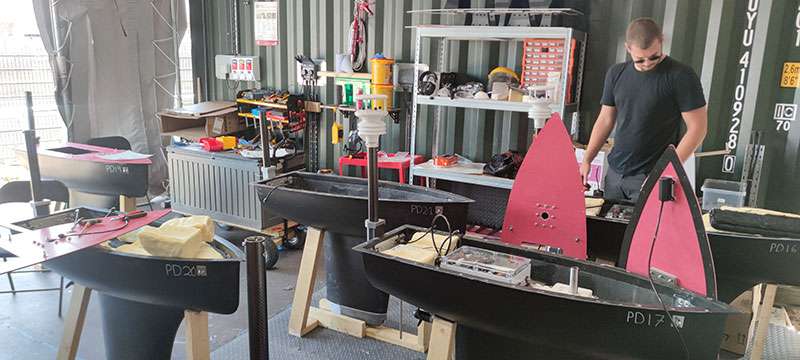
Tell us about the development cycle of the C-Stars…
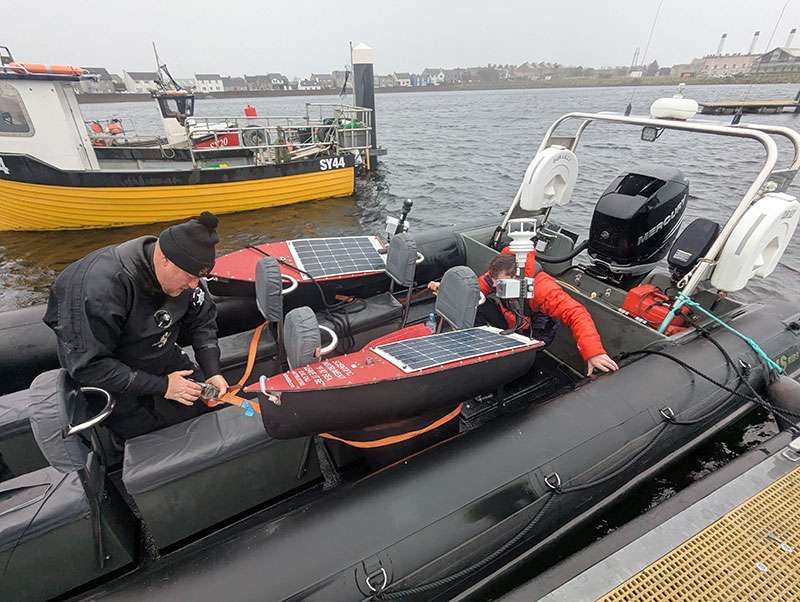
Put it in the water, test it until it’s broken, rinse and repeat. An advantage of the small size and low-cost nature of C-Stars is that they’re easy to deploy (lift them overboard by hand) and, should something go wrong, losing one isn’t a major issue. That said, the C-Stars themselves have survived major hurricanes and completed missions over 200 days in duration; for Oshen right now it’s less about developing the platform and more on pushing the constellation level control, the individual sensors, data fusion, etc.
Much of the USV development work right now concerns the integration of larger platforms into naval forces. What role can Oshen play in this space?
These larger platforms are impressive—extremely effective and reliable, packed with sensors, and offer payload adaptation. However, it’s a big ocean and even with the potential cost savings of autonomy they can’t be everywhere at once. This is where C-Stars come in—think of us as the CCTV network whose intelligence picture cues in the security guards (the larger USVs) to chase down and get to the right place at the right time when a threat is in the area. Fundamentally, that’s the defense use case—a persistent network of eyes and ears, always at sea, always providing a first tripwire effect should anything of interest pass through. This is what we recently demonstrated at REPMUS, with 6 C-Stars taking part as a constellation, and detections coming from them being used to cue in other assets as part of the broader picture.
What, in your opinion, are the most significant technical challenges to the expansion of unmanned systems?
Different systems naturally face different challenges but the most fundamental operational challenge of any USV is one of absolute reliability. Getting enough hours at sea over and over to get something to work, in any and all sea states, without anyone to fix issues is a significant undertaking. We have it easy on this—our ethos is: simple is beautiful. C-Stars are painstakingly engineered to be simple to build, integrate, and deploy, which is why we’ve been able to have so many C-Stars each complete missions over 100 days in duration as an example. Data fusion and adaptive sampling I think will be key challenges for platforms such as C-Stars. Nobody wants to individually control a 1,000 C-Star constellation or look at the data from 1,000 platforms that are covering a wide area. You need the adaptive sampling to self-organize the constellation to be in the right place at the right time and the data fusion to turn 1,000 data points into one intelligence picture (simply put, imagine a heatmap of detections with evidence when requested instead of live audio streams).
Well, it depends on your specific definition. We’d frustrate those with a background in the field if we called C-Star constellations a swarm… following the “proper” definition of a swarm which is focused on a decentralized and self-organizing system, you’d need individual C-Stars to communicate to each other, and for them to be intelligent enough to work out between them the optimum mission. We don’t do this for power, comms, many reasons—it’s better to do the ‘smart’ stuff in one intelligent orchestrator rather than have 1,000 small robots lying around that could have the ability to glean the bigger picture from a security perspective. More loosely, in terms of how I view the future of large numbers of small USVs for wide area monitoring, I think the critical moment will be when there’s the first seriously large (50+) C-Star constellation out there, persistently, and the positive impacts of this to the customer are visible. If it’s as good as we think it’ll be, this will be a tipping point that starts wider adoption beyond our initial successes.
This feature appeared in ON&T Magazine’s 2026 October Edition, Navigation, Positioning & Communications, to read more access the magazine here.