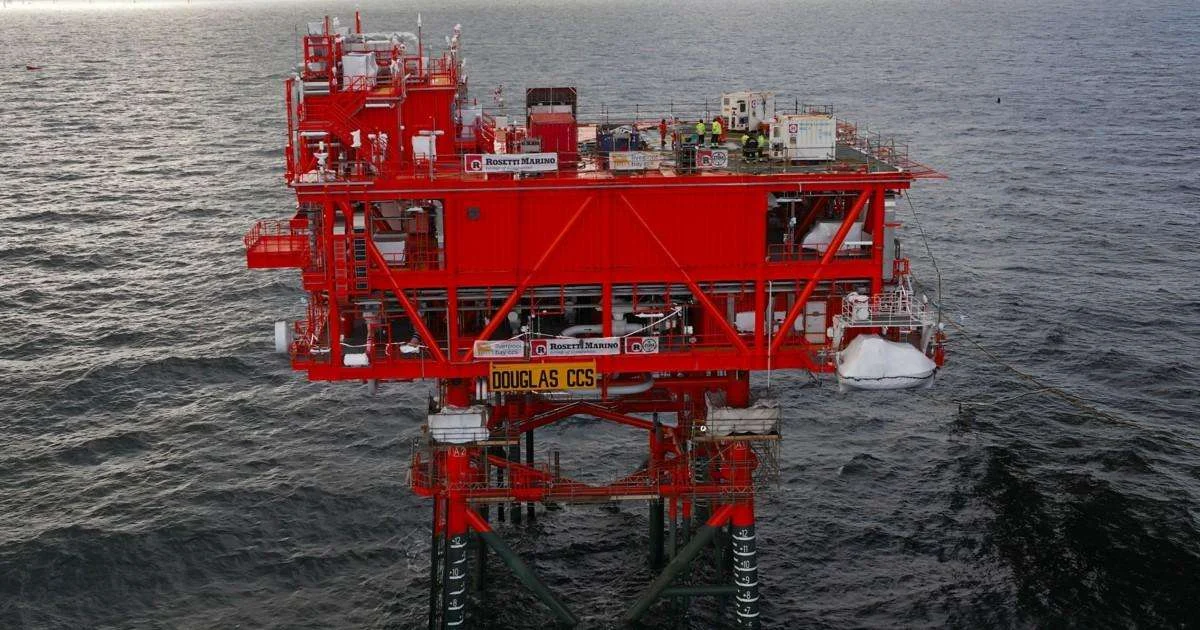
The new Douglas CCS is the first purpose-built offshore platform dedicated to Carbon Capture and Storage (CCS) for industrial decarbonization in the world. Designed to operate as the offshore hub of the Liverpool Bay T&S system, the platform will receive CO₂ captured from industrial facilities across North West England and North Wales before distributing it through a network of existing offshore pipelines, which will be repurposed for CO2 transport to depleted natural gas reservoirs for subsequent permanent storage.
The platform was delivered in less than 18 months from contract award following an accelerated program integrating engineering, procurement, construction, and commissioning. The new facility comprises 1,885-tonne topside facilities, a supporting jacket structure weighing 1,755 tonnes, and eight foundation piles with a combined weight of 730 tonnes, which secure the structure to the seabed.
The combination of purpose-built and repurposed infrastructure is a defining feature of Liverpool Bay CCS, enabling the project to efficiently draw on existing offshore assets, as well as on the extensive knowledge of the depleted reservoirs.
The installation of Douglas CCS forms part of a wider construction program that is progressing across the entire Liverpool Bay CCS network, which is now approximately 50% complete. Around 60% of the overall project expenditure from the investment is delivered through UK-based supply chains, supporting more than 2,000 jobs during construction and approximately 200 to 300 long-term roles over more than 25 years of operation.
Liverpool Bay CCS forms part of Eni CCUS Holding’s portfolio of CCS initiatives and represents a key project in the company’s strategy to develop CO2 transportation and storage infrastructure to support industrial decarbonization at scale.
CCS is a mature and safe technological process, and it is one of the key levers for the energy transition, being currently the most efficient and effective tool for decarbonization to support hard-to-abate industries in reducing their emissions.