The JIWG, chaired by BIMCO, was established under the Tripartite, a forum bringing together shipowners and operators, shipbuilders, and classification societies. As part of its work to develop a common approach for Maritime Emissions Reporting, the JIWG has released version 1.0 of the Operational Vessel Data (OVD) and Vessel Emissions Reporting (VER) frameworks. The two frameworks complement each other and can help establish a common foundation for a more efficient exchange of data.
Both OVD and VER are voluntary industry frameworks. They do not create new reporting obligations but provide a common approach that organizations may adopt to support more efficient and consistent data exchange.
The JIWG’s development of the OVD and VER frameworks complements and builds on earlier work by BIMCO and IACS (International Association of Classification Societies) to add emissions-reporting data elements to the IMO Compendium on Facilitation and Electronic Business. While the IMO Compendium provides common definitions and formats for maritime information, the latest work adds a practical implementation framework for exchanging operational vessel data and verified emissions-reporting results between industry systems.
The initiative also forms part of a broader move towards using the IMO Compendium as a common foundation for maritime data exchange. Emerging use cases covering port-call optimization, electronic seafarer certificates, and maritime emissions reporting demonstrate how common data definitions can support interoperability across different parts of the maritime sector.
The work of the group addresses the common industry challenge of stakeholders facing different reporting systems and data formats which often result in the same information being mapped, entered, and checked multiple times.
The OVD and VER can support a more consistent, efficient, and traceable exchange of data between ships, shipping companies, software providers, verification bodies, and other authorized users. The approach will also make it easier to reuse data more consistently across the industry and connected value chains.
Two complementary parts of the data flow
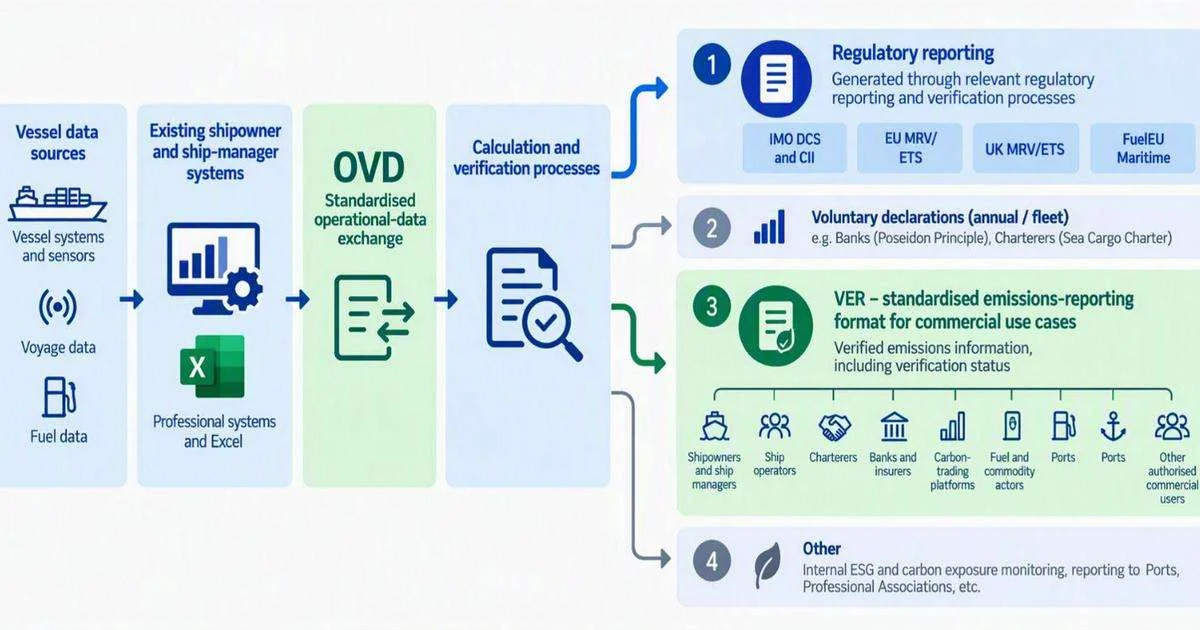
The OVD provides a structured format for exchanging operational vessel and fuel-consumption data. It defines common data elements, names, units, and structures, allowing the information to be interpreted consistently by different systems and organizations. It does not prescribe how data must be collected onboard, which software must be used, or where data must be stored, but instead provides a common approach for sharing such data across the maritime industry.
The VER complements the OVD by providing standardized formats for emissions reporting in cases when commercial reporting practices and needs vary considerably. This could include charter-party performance, Emission Trading Schemes (ETS) cost allocation, FuelEU pooling, and other commercial arrangements. The VER provides a common way to exchange emissions information, including its verification status for reporting periods that are defined by the user.
In practical terms, the OVD provides the underlying operational data layer while the VER provides a structured output solution for emissions information. In combination, the two solutions can help support the maritime industry’s objective of capturing data only once and reusing it for all relevant reporting, verification, and other purposes.
Responding to a growing reporting burden
The need for accurate and trusted maritime emissions reporting has increased due to the IMO Data Collection System (IMO DCS) and the EU Monitoring, Reporting and Verification system (EU MRV). Although these requirements serve different purposes, the use of different datasets and system formats can create inconsistencies, repeated data mapping, and manual work across the reporting chain.
The Tripartite JIWG has therefore worked to develop a common approach that allows data to move between different systems, regardless of the technology or service provider used. The OVD builds on a framework initially developed by DNV and subsequently considered through the wider JIWG process. The VER builds on an initial draft prepared by ClassNK and was further developed collaboratively by the participating organizations.
Industry collaboration and practical implementation
As voluntary industry frameworks, OVD and VER version 1.0 provides a baseline for practical use and further development. Organizations can now consider how the formats may be applied within existing systems and processes. Experience from implementation and real-world use will help identify where definitions, guidance, tools, or data structures may need further refinement.
As part of the next phase, the Tripartite Joint Industry Working Group will also assess options for transitioning OVD and VER towards independent and broadly representative governance. The objective is to establish clear ownership, open participation, transparent decision-making, and predictable change management, providing confidence that the frameworks can be maintained as neutral and accessible industry resources.
The Joint Industry Working Group will continue to oversee the work while the governance alternatives are assessed and until an appropriate structure is ready to receive the frameworks. No final governance model has yet been selected.
Yasuhiro Ikeda, Director, Digital Solutions Division, ClassNK, said: “VER is the result of a truly collaborative effort across all participating organizations, and I would like to thank everyone who contributed to this achievement. By establishing a common foundation for trusted and interoperable emissions data exchange, VER will help improve efficiency, transparency, and digital collaboration across the maritime industry. Version 1.0 marks an important beginning, and we look forward to expanding its value through practical use and continued industry cooperation.”
Bjarte Walaker, Head of Maritime Deliveries, Veracity by DNV, said: “After several years of developing OVD, DNV is very pleased to see its broad adoption and grateful to the shipping companies, solution providers, and other contributors who have helped turn it into a formal industry standard. This shared commitment is essential to enabling more efficient, consistent, and interoperable exchange of vessel data, helping to reduce friction and support innovation across the maritime industry and connected value chains.”
Vincent Joly, Smartship Manager – Bureau Veritas Marine & Offshore, said: “As reporting requirements continue to evolve, greater alignment in operational and emissions data is becoming increasingly important. Bureau Veritas has already adopted OVD for emissions data collection and supports this industry-led effort to establish common approaches for data exchange. These frameworks provide an important foundation for greater consistency across reporting and verification activities, enabling information to be shared and used more effectively across the maritime ecosystem.”
Michela Schenone, Marine Digital and Class Solutions Operations Director – RINA, said: “RINA believes that common industry standards are essential to make maritime emissions reporting more efficient, consistent, and interoperable. RINA is taking practical steps to adopt OVD within its emissions reporting processes, supporting a common approach to data exchange across the industry. Continued industry collaboration will be key to achieving broad adoption and ensuring that these common frameworks deliver long-lasting value across the maritime sector.”
Jeppe Skovbakke Juhl, Chief Naval Architect, Regulatory Affairs, BIMCO – Chair of the JIWG, said: “The maritime industry does not need more ways of exchanging the same information. It needs a common approach that allows data to move efficiently between organizations and systems. OVD and VER are an important step in that direction, reducing duplication and creating a stronger foundation for efficient and interoperable reporting.”
Availability and next steps
OVD and VER version 1.0, together with supporting material, are available on the BIMCO website: Emission reporting
The JIWG will continue to collect experience from practical use, consider the findings from the industry consultation, and identify priorities for further development. An update on the work will be presented at the Tripartite meeting in Tokyo on October 28, 2026.