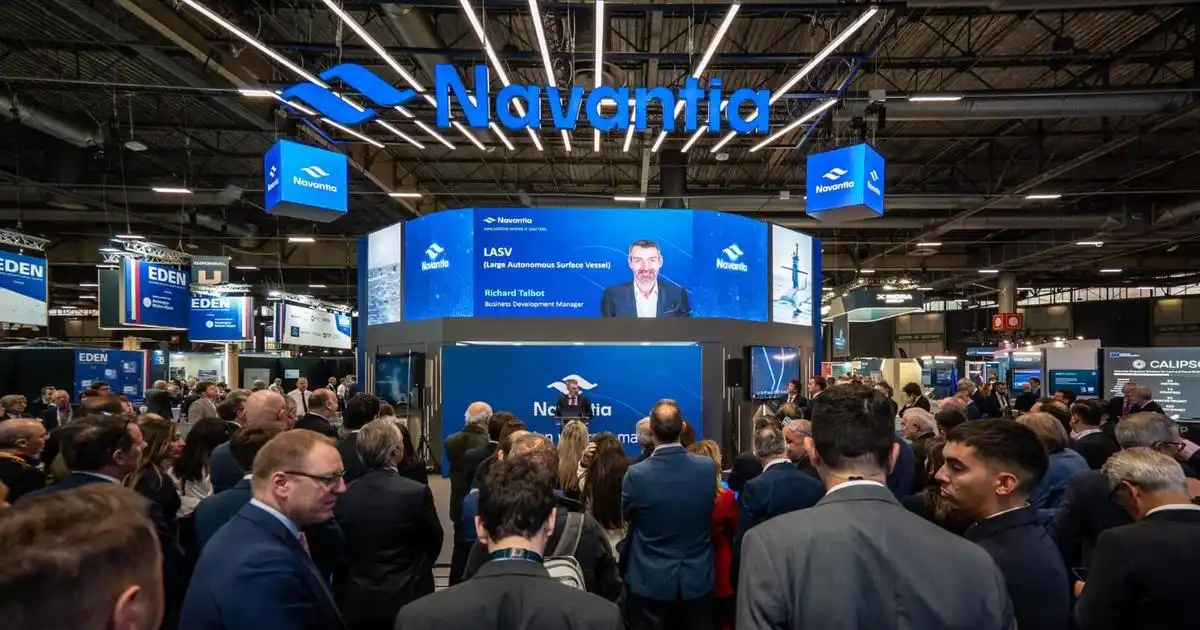
Naval combat cloud, F110 Integrated Air and Missile Defense (IAMD) frigate and LASV-75 autonomous surface vessel have been the focal points of a proposal that combines the company’s capabilities in platform design, combat system integration and the development of digital solutions.
The value proposition addresses three drivers that are transforming naval operations: the ability to share and exploit information in a distributed manner, the enhancement of platforms’ combat capabilities to meet the demands of high-intensity scenarios, and the introduction of autonomous systems that operate in coordination with crewed units.
“Value goes beyond the platform,” said Navantia’s Chairman, Ricardo Domínguez, at the presentation held in Euronaval. “It lies in the technology we develop and integrate—from digital twins to advanced onboard systems—and in designing ships that can evolve as operational needs change. This is how we put innovation at the service of the Spanish Navy and other navies.”
The naval combat cloud represents the capability objective towards which Navantia is directing this new generation of products. Future combat superiority will depend not only on the individual capabilities of each platform, but also on the ability of the force as a whole to process data, share information, accelerate decision-making and act in a coordinated manner. Navantia therefore envisages the naval combat cloud as a multi-system, multi-domain capability that will enable progress towards a naval force integrated as a system of systems.
The evolution of the combat system developed for the Spanish Navy (SCOMBA NG) shows the growth of Navantia’s mission systems towards this new model. Its new NASOS open architecture will enable the deployment of a common digital platform on which the Spanish Navy, Navantia and third parties will be able to progressively incorporate new services and capabilities. This approach, intended both for next-generation platforms and for the fleet already in service (through extension modules), enables more agile and continuous technology insertion. Within this framework, the Spanish Navy and Navantia have worked together since 2024 in the REPMUS exercises on the early validation of services for the control and management of uncrewed systems (NAIAD) in accordance with STANAG 4187, one of the key elements in the evolution towards the Naval Combat Cloud.
Navantia has also showcased its F110 IAMD (Integrated Air and Missile Defense), an evolution of the F110 family designed to strengthen integrated air and missile defense while retaining its existing capabilities. The proposal builds on the program for five frigates currently under construction for the Spanish Navy and its growth potential, preserving the multi-role character and digital architecture of this new generation of ships.
The Spanish Navy and Navantia are already working together to define this evolution, known as F110 IAMD, in accordance with the requirements established by the Spanish Navy as part of its Armada 2050 vision.
The aim is to provide a platform capable of responding to a wide range of air threats, maintaining the anti-submarine and anti-surface warfare capabilities that characterize the F110 frigate.
This evolution envisages increased vertical launch capacity, designed to accommodate different missile types and tailor the weapons load to the requirements of each mission. It also includes the transition towards SCOMBA NG, incorporating technologies such as the SPY-7 radar and the International Aegis Fire Control Loop, combining the sovereign capability of Navantia’s combat system with AEGIS-related technologies.
Navantia also presented LASV-75 (Large Autonomous Surface Vessel), a 75-meter Autonomous Surface Platform developed by Navantia UK. Designed from the outset to operate without a crew, it responds to the hybrid fleet concept, in which crewed and un-crewed platforms complement one another to extend naval presence and effect.
The design incorporates a modular approach to adapt the vessel to different missions and is intended to offer high availability and endurance at sea, including in the demanding conditions of the North Atlantic.