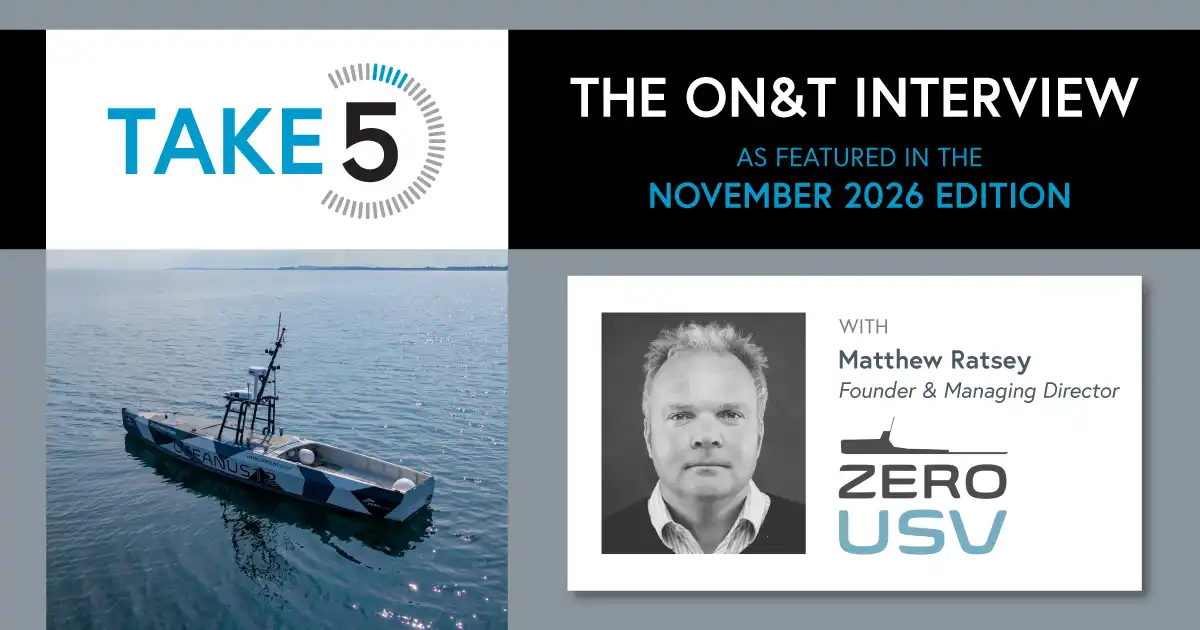
ZeroUSV is a relatively new company, give us the background on how the company was founded…
ZeroUSV was founded in Plymouth (UK) in 2024, but its roots go back to the Mayflower Autonomous Ship (MAS400). When MAS400 crossed the Atlantic without a crew in 2022, the project brought together MSubs, our parent company, and our sister company MarineAI. The experience revealed an opportunity to turn proven maritime autonomy into a practical, commercially available service. Together, the three companies bring more than 50 years of combined marine engineering experience.
MSubs designs, builds, and operates crewed and uncrewed marine vehicles, including XV Excalibur, the Royal Navy’s extra-large uncrewed underwater test platform. MarineAI develops GuardianAI, the autonomy software used across our Oceanus vessels. ZeroUSV brings these capabilities together to design, build and operate autonomous uncrewed surface vessels for defense, survey, and scientific offshore operations.
Our aim is to provide navies, survey companies, and researchers with autonomous vessels built for long endurance, which they can charter or procure and deploy quickly, keeping sensors at sea for weeks without putting crews offshore. Ultimately, we want to make maritime operations safer, smarter, and more efficient, with a lower environmental impact.
Your Oceanus12 ASV went from concept to water at breakneck speed. Tell us more about the development process…
The first Oceanus12 entered the water at Manor Marine in Portland in February 2025, around 18 months after design work began. We could move at that pace because the same team had already taken MAS400 across the Atlantic. That experience shaped what we asked of Oceanus12 from the outset.
We designed her for long range operations beyond the horizon. Twin electric drives and a hybrid powertrain provide redundancy and efficiency, while her fuel capacity supports a range of more than 2,500 nautical miles. A Navtech millimeter wave radar feeds MarineAI’s GuardianAI autonomy system in real time, supporting navigation in accordance with COLREGs. Her interchangeable sensor keel and adaptable payload area allow the same platform to undertake survey, monitoring, and defense missions.
She arrived at Plymouth’s Turnchapel Wharf in March 2025 for commissioning and integration trials. Six months later she was selected by the Royal Navy for NATO’s REPMUS exercise in Portugal, where she became the first USV to autonomously launch and recover a thin line towed acoustic array without personnel handling it. During the exercise she logged more than 40 operational hours in the first week with 100 percent availability, operating around 800 miles from her control center.
In March 2026, she launched a Teledyne Slocum glider in a demonstration supporting the Royal Navy’s Atlantic Bastion program. Later, a trial backed by UK Defence Innovation saw Oceanus12 autonomously deploy two Oshen C Star surface drones, with four planned for the next phase. These activities also showed us how demand is evolving. Customers need longer endurance, more payload capacity and the ability to deploy other systems. These requirements helped shape Oceanus17.
How does the 17-m USV model differ from the 12-m platform in terms of capabilities?
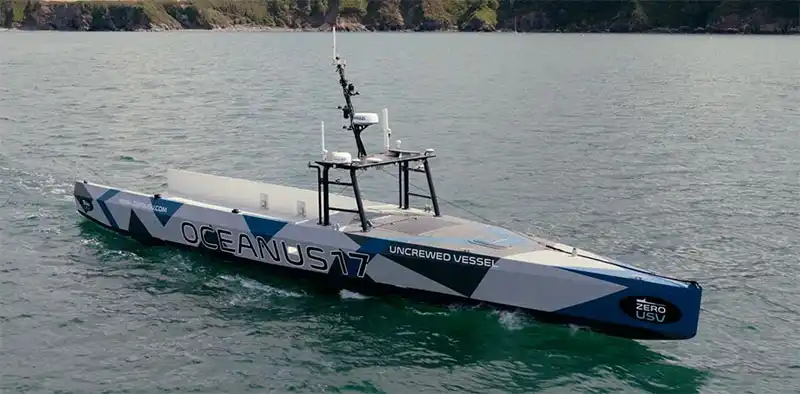
Oceanus17 grows directly out of Oceanus12. She retains the same modular Oceanus design philosophy and uses MarineAI’s GuardianAI autonomy software, while remaining capable of rapid mobilization. The most obvious difference is scale. At 17 meters, Oceanus17 has a full load displacement of 17.7 tonnes and can carry up to 4,000 kg of payload. Her more than 6-meter ISO compatible payload bay, 30kW of dedicated mission power, and an extensive aft deck accommodate larger sonar systems and launch and recovery equipment that would be beyond Oceanus12’s capacity.
Endurance is another major step forward. She can stay at sea for more than 50 days, with a range exceeding 5,000 nautical miles at six knots and a top speed approaching 15 knots. Her aluminum hull is designed for survey operations in Sea State 4 and survival in Sea State 8, while duplicated critical systems provide additional resilience.
Built in just over six months through an iterative development process, the first Oceanus17 went to NATO’s REPMUS 2026 exercise shortly after her naming. There, she autonomously launched and recovered Kongsberg’s ST2400 Variable Depth Sonar, with mission data processed onboard and relayed to the Remote Operations Center in real time. Carrying a sonobuoy receiver, she also took part in live antisubmarine scenarios alongside the Royal Navy.
For defense customers, that means a heavier sensor fit that can stay on station for weeks. That is exactly what the Oceanus12 trials told us they needed. REPMUS 2026 demonstrated why the larger platform matters. She can integrate substantial payloads and deliver operationally relevant capability over extended periods.
What does the accelerated scaling and integration of USVs look like over the next five to ten years?
The pace of change in maritime autonomy is so rapid that I think it is more useful to focus on the next 12 to 24 months than to make firm predictions five or ten years out. The real question is how quickly we can move from successful demonstrations to delivering integrated USV capability at scale.
At ZeroUSV, we are in a position to do that now. Our equity stake in Manor Marine gives us access to established UK shipbuilding expertise and capacity, including an 8,000 square meter facility in Portland. Together, we have the people, skills, and infrastructure to build Oceanus vessels at pace as orders are secured. The autonomy software from MarineAI is already integrated, we have addressed the relevant regulatory requirements for our existing platforms, and we provide the training and operational support customers need.
For us, the primary barrier is therefore not the technology, the training, or the ability to build. It is turning demand into funded programs and signed contracts. That is particularly important in defense, where investment and procurement decisions determine the speed of adoption. The capability exists today; what matters next is putting it to work at scale.
If Oceanus12 was the proof of concept, what do you want Oceanus17, and whatever comes after it, to prove?
I would challenge the premise slightly. Oceanus12 was never intended to be merely a proof of concept. MAS400 helped establish what was possible. With Oceanus12, our objective was to deliver a complete, usable product, with autonomy, sensors, regulatory compliance, remote operations, and support integrated into a turnkey package that a customer could put to work.
Oceanus17 is not a replacement for Oceanus12. It is a different tool for a different job. Oceanus12 is particularly well suited to applications such as shallow water hydrographic and geophysical survey, where a smaller vessel is an advantage. Oceanus17 can accommodate the larger sensors, heavier launch and recovery equipment, and extended endurance required for deep water and demanding defense missions. Her work with Kongsberg’s ST2400 at REPMUS 2026 is a practical example of that distinction.
What comes next is not necessarily an ever-bigger vessel. We see a family of USVs ready for different missions, with sizes and payload capacities matched to specific tasks. What we want to demonstrate is that customers can choose the right autonomous platform, integrate the equipment they need and deploy it reliably, repeatedly and cost effectively, without having to start from scratch each time.
This feature appeared in ON&T Magazine’s 2026 November Edition, The Drone Revolution, to read more access the magazine here.