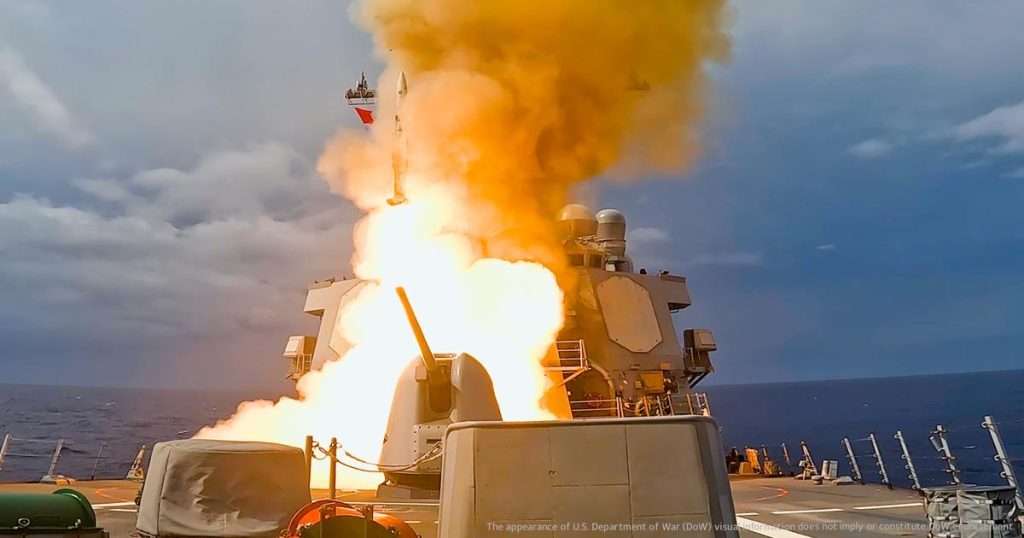

The exercise took place across international waters and airspace south and east of the Republic of Korea, as well as at military installations and command posts in Japan.
“Freedom Edge 26 built on the foundation of previous iterations through increasingly complex trilateral training. What began as a maritime-focused effort in the first iteration of Freedom Edge, now integrates air, maritime, missile defense, cyber, and medical capabilities in a more connected training environment,” said Lt. Col. Matthew McNeal, Exercise Control Group Director, US Pacific Command.
Throughout the exercise, participating forces trained across a series of events that tested how quickly and effectively the three nations could communicate and operate together. Ships operated in formation and practiced replenishment-at-sea while maritime and aviation crews rehearsed conducting multilateral medical evacuation and search and rescue operations. Air crews flew in multinational formations, while command-and-control teams synchronized actions across multiple domains.
“Freedom Edge was a valuable opportunity for Japan, the US, and the Republic of Korea to enhance our defensive capabilities, which contribute to a security environment that does not tolerate unilateral changes to the status quo,” said Capt. Takenori Koga, Exercise Control Group Director, Japan Joint Staff.
Teams also expanded trilateral air defense communication and refined real-time data-sharing procedures during the exercise. Cyber planners and command post personnel worked through coordination drills that helped connect information flows between the three countries and support faster decision-making across the battlespace.
“Built on mutual understanding and trust, Freedom Edge served to further elevate the level of security cooperation among the ROK, US, and Japan,” said Capt. Daeik Kim, Exercise Control Group Director, Republic of Korea Joint Chiefs of Staff.
This year’s iteration concluded with gift exchanges of coins, patches, and other souvenirs as well as a group photo of all exercise control group planners in front of the US Forces Japan Headquarters at Yokota Air Base, Japan.