As interest in autonomous technologies and remotely operated systems grows across commercial, government, and defense sectors, developers and operators face increasing pressure to demonstrate that new systems can operate safely, reliably, and in line with evolving regulatory requirements.
LR and Sagar Defence will work together to bridge the gap between technological innovation and operational deployment, helping move autonomous maritime systems from concept to approved operation.
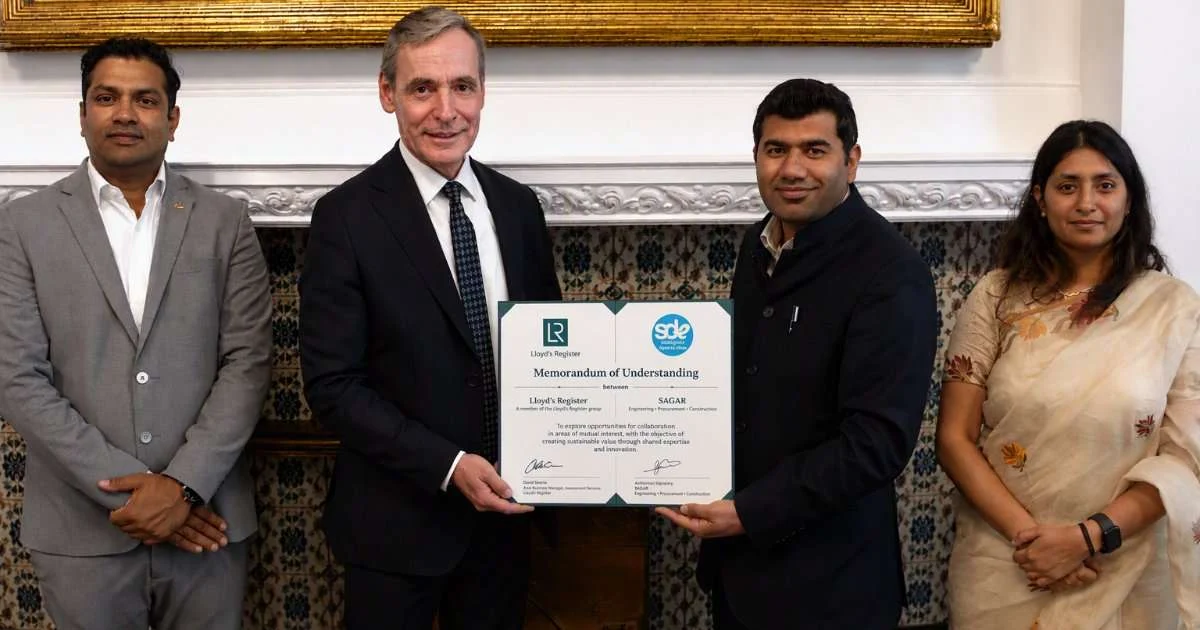
The MoU combines LR’s global expertise in classification, assurance, and regulatory compliance with Sagar Defence’s experience developing autonomous and remotely operated platforms. The partnership will focus on supporting the classification, certification, and operational acceptance of autonomous systems while helping shape the rules, guidance, and assurance frameworks needed for wider industry adoption.
The two organizations will work together to develop practical approaches to verification, validation, and testing, alongside classification readiness assessments and assurance methodologies.
The collaboration will also support the development of operational concepts, mission profiles, and safety cases, while enabling closer engagement with regulators, government agencies, and industry stakeholders to support the evolution of certification pathways for autonomous technologies.
David Lloyd, Vice President, Naval and Government Business, Lloyd’s Register, said: “Autonomous maritime capability is moving rapidly from experimentation to operational deployment. For the world’s leading navies, the decisive question is no longer whether autonomy is technically possible, but whether it can be trusted to perform safely, securely, and consistently under demanding mission conditions.
“Through this collaboration, Lloyd’s Register will work with Sagar Defence to establish credible, evidence-based pathways from concept development and system integration through trials, certification readiness, operational acceptance, and in-service assurance. By combining independent assurance, naval engineering, cyber-resilience, and regulatory expertise, we aim to support the development of autonomous systems that are safe, resilient, interoperable, and mission-ready, giving operators, acquisition authorities, and regulators the confidence to deploy maritime autonomy at pace and scale.”
Mridul Babbar, Director of Sagar Defence Engineering Limited, said: “Autonomous and remotely operated systems are set to play an increasingly important role across maritime and defense applications. Working with Lloyd’s Register will help us strengthen the assurance, certification, and regulatory foundations that support these technologies.
“Together, we aim to accelerate the journey to operational deployment and support wider industry confidence in autonomous systems.”
Dipali Kuchekar, Global Director, Naval Autonomous Systems, Lloyd’s Register, said: “Maritime autonomy cannot be assured by looking at the platform, software, or mission in isolation. Confidence must be built at system level, considering how the vessel, autonomous functions, sensors, communications, remote operators, and supporting infrastructure work together under normal, degraded, and failure conditions.
“Our collaboration with Sagar Defence will bring assurance into the development process from the outset. This will help translate operational needs into clear engineering requirements, define proportionate test and evaluation evidence, and support a traceable pathway towards certification, operational acceptance, and assurance throughout the system lifecycle.”