The vessel of the future will need to combine combat power, enhanced adaptability, and a greater capacity to integrate new systems throughout its life cycle. This is the thinking behind Naval Group’s new concept ship, the SCX 26.
What is a concept ship?
A concept ship is a forward-looking exercise that explores technologies, architectures, and operational approaches most likely to meet the future needs of naval forces, at the level of an individual ship and its surrounding fleet. While it is not necessarily tied to a future program, it reflects our thinking about the future and opens up new possibilities.
“A concept ship makes it possible to test future technologies and new combinations of naval architecture, combat systems, drones, effectors, digital infrastructure, and human factors. When shared with crews, partners, and suppliers, it provides guidelines for future whole warships.”
What does our concept ship look like?
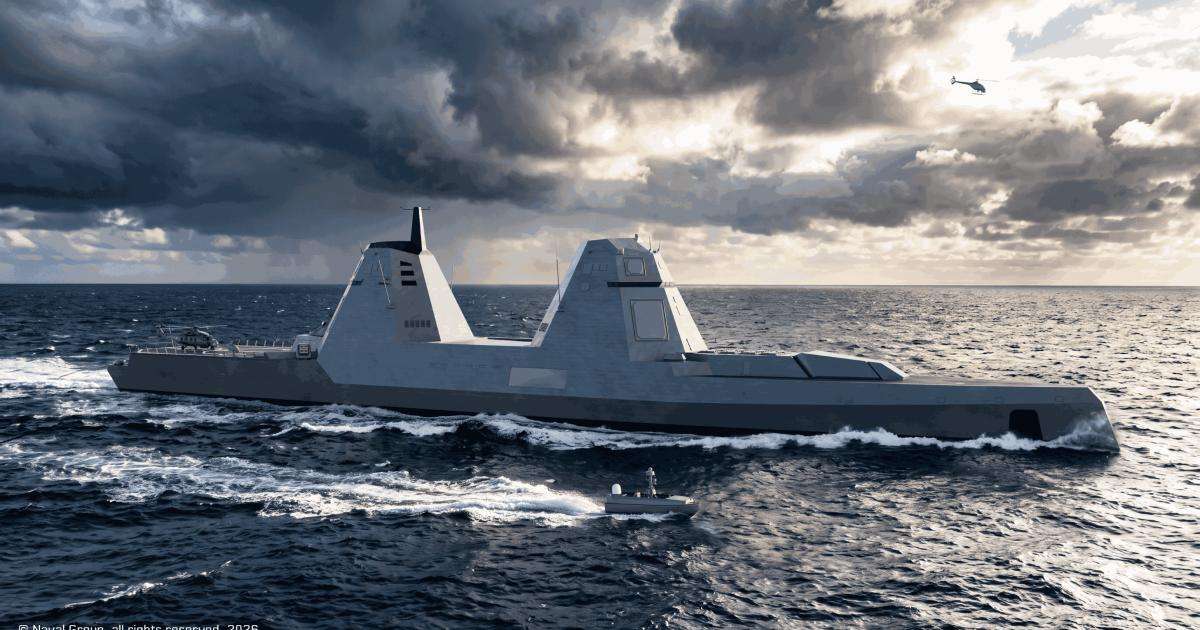
Measuring 170 meters in length, this 8,000-tonne concept ship, designed to reach 30 knots and cover more than 8,000 nautical miles, combines power, adaptability, and resilience.
Its architecture is based, in particular, on two integrated modules, separated by a flex zone designed to incorporate new operational capabilities in a modular format. The aft section is designed around a spacious mission bay, which provides a centralized facility for deploying, recovering, and updating drones. Fitted with integrated lifting systems and a large-capacity elevator, it makes it possible to load, maintain, deploy, and recover various types of drones and helicopters, depending on the mission.
In order to dominate in high-intensity engagements, the concept ship combines state-of-the-art sensors such as a UHF radar designed for ballistic missile defense, a comprehensive sonar suite for anti-submarine warfare, and advanced electronic warfare capabilities.
Onboard weapons are designed to counter multiple and overwhelming threats, whilst ensuring cost-effectiveness. The main missile capability comprises more than 100 vertical launching system (VLS) silos of various classes and an electromagnetic gun capable of rapid fire. This density ensures that threats are dealt with at optimal cost and on a long-term basis.
The close-range protection combines two Rampart multipurpose modular launching systems and a 100 kW laser. The concept ship SCX 26 is also equipped with remotely operated munitions and 360° remotely operated secondary artillery.
Resilience is ensured by a high degree of segregation and redundancy in key systems, particularly the weapon systems, with their two masts and launchers distributed between the bow and stern.
How does it address the needs of future naval combat?
Naval combat is characterized by constant movement and a focus on the offensive. The vessel is therefore designed as an open platform for combat and the deployment of systems, capable of adapting its configuration to each mission throughout its service life. Its mission bay enables it to rapidly adapt the configuration of its onboard drones: intelligence, surveillance, electronic warfare, anti-submarine warfare, force protection, or other specialized missions. Combined with its own sensors and effectors, this capability contributes to a more distributed approach to combat, in which the vessel operates as part of a force comprising ships, aircraft, drones, and future naval combat systems.
What role do people play?
Technology is not a substitute for the crew but provides them with new capabilities.
Designed for an optimized crew of 150 sailors, the vessel offers an additional capacity of 100 places to accommodate senior officers and specialist personnel.
In this highly digitized and automated environment, the challenge is to enable operators to assess the situation, coordinate systems, and make decisions more rapidly. While artificial intelligence and autonomy enhance the crew’s capabilities, operational decision-making and responsibility remain at the heart of human action. This concept ship thus offers a vision of the combat vessel as an evolving system of systems, capable of utilizing both its own capabilities and those it deploys around it, always with a view to collaborative combat.