During a recent US Navy exercise, the UUV completed a series of at-sea missions on a Navy undersea test range, successfully demonstrating its undersea launch capabilities while submerged. This marks the first time the US Navy has seen this integrated capability in the water and points toward a future where a single unmanned undersea platform can perform detect, reacquire, and engage functions within one mission.
“This demonstration is an important step in a broader roadmap to deliver autonomous, end-to-end undersea capabilities that are far less detectable than surface platforms,” said Jen Gauthier, vice president of Naval Systems & Sustainment at Raytheon. “By tightly coupling design, integration and at-sea experimentation, we’ve proven we can bring new autonomous solutions to the fleet quickly and cost-effectively.”
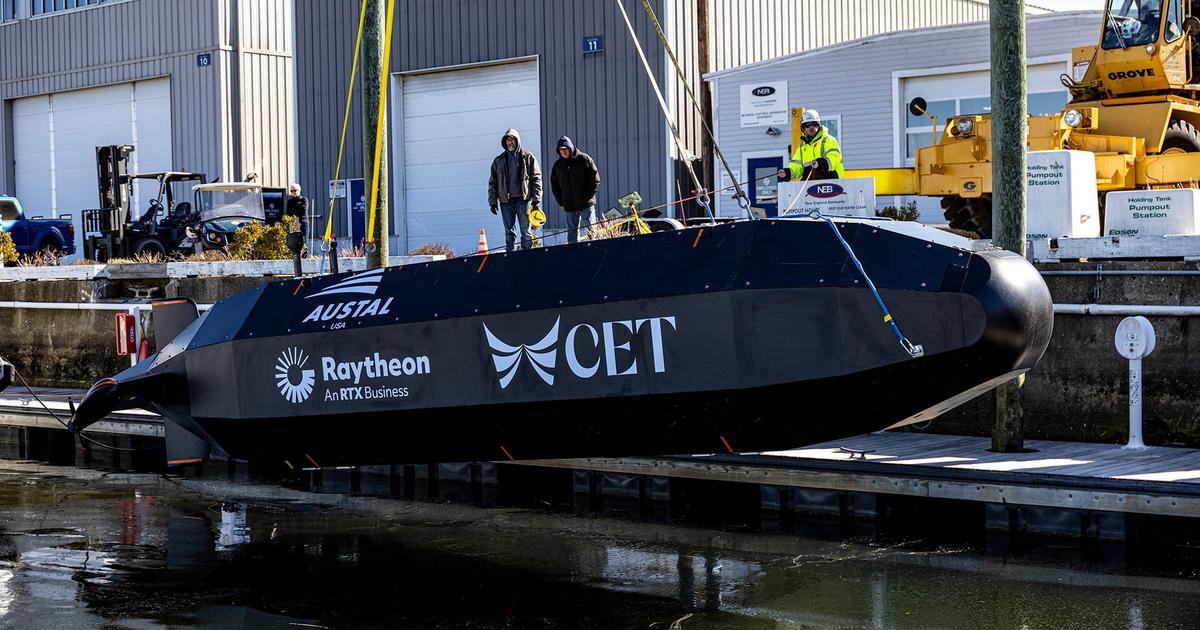
HADALUS is a 34-foot UUV with a six-foot cross section and more than 2,000 nautical miles of endurance. Its free-flooded, all-carbon-fiber exoskeleton delivers exceptional strength and payload capacity while enabling a significantly lower-cost architecture. Designed to cost roughly one-third to one-fifth of comparable long-endurance vehicles, HADALUS offers a scalable path to fielding affordable undersea capabilities.
In less than 18 months, Raytheon and CET progressed from a conceptual sketch to a complete prototype successfully demonstrated in water. This was driven by investment from both companies in the design and build of the vehicle, integration of the launcher, sonar and electronics, and full system testing leading up to the exercise.
“HADALUS demonstrates that the undersea industrial base can move with greater speed and dynamism than traditional development cycles allow,” said Chase Hogoboom, CEO and President of CET. “By combining CET’s advanced composite vehicle architecture with Raytheon’s mission systems, sensors and integration expertise, we have created a highly capable platform that can be produced at a fraction of the cost of conventional alternatives.”