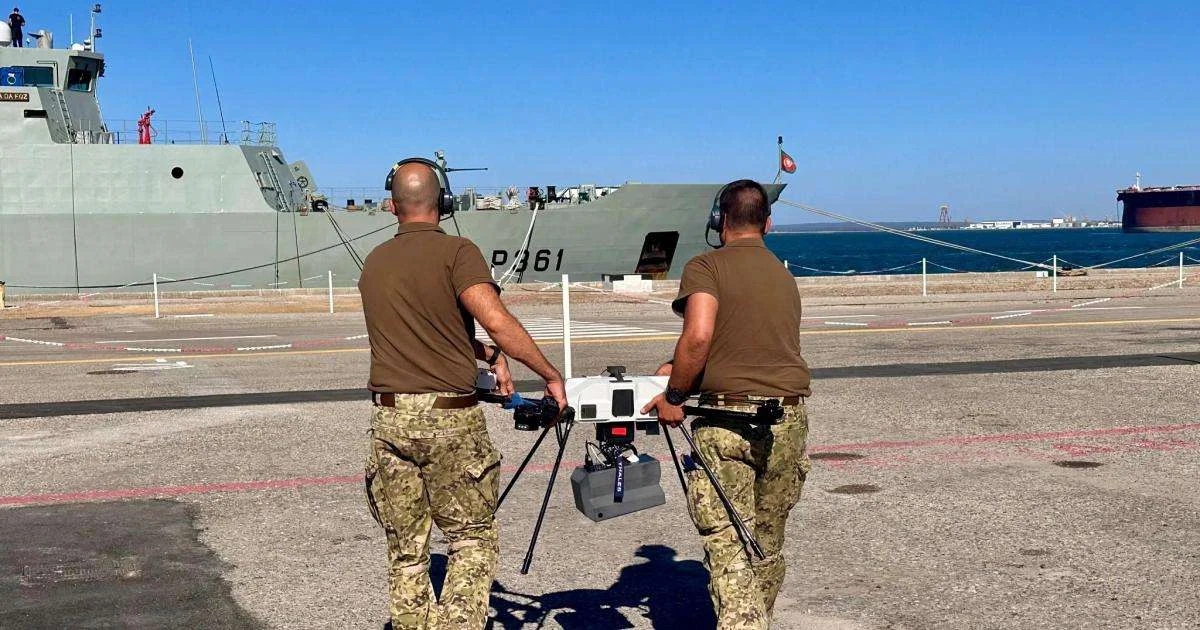
In complex operational environments, having relevant information at the right time is essential to enhance situational awareness and support decision-making. The ability to collect and analyze information as close as possible to the operational environment is particularly important in the maritime domain, where distances, the scale of areas to be monitored, and the exposure of operational teams can all present significant challenges.
As part of this year’s REPMUS exercise, Thales demonstrated how VORTEX can detect and analyze signals from cellular networks in an operational environment.
For the demonstration, VORTEX was integrated onto a Beyond Vision BVQ418 drone, operated by the Portuguese Navy.
A Solution Designed to Adapt to Mission Requirements
One of VORTEX’s key features is its modular and platform-agnostic design. The solution can therefore be integrated onto different drones depending on mission requirements.
This flexibility opens the way to different operational concepts, combining Thales’ tactical intelligence capabilities with the mobility provided by unmanned systems.
The demonstration at REPMUS26 provided an opportunity to explore the potential of this combination in a maritime environment and alongside an operational user.
Experimenting with Users and Partners
Beyond the technology demonstration itself, REPMUS26 provided Thales with an opportunity to work alongside the Portuguese Navy and its partner Beyond Vision, and to explore with them new ways of combining unmanned systems with intelligence capabilities.
This collaborative approach is fully aligned with the spirit of REPMUS, which brings together armed forces, industry, and the scientific community each year to experiment with new technologies and explore their integration into operational environments.
REPMUS (Robotic Experimentation and Prototyping with Maritime Unmanned Systems) is an international exercise dedicated to the experimentation and integration of unmanned systems. Held in Portugal from August 31–September 25, 2026, REPMUS26 brought together armed forces, industry, academia, and international organizations to test new capabilities in operational conditions.