Maritime activity beyond AIS visibility
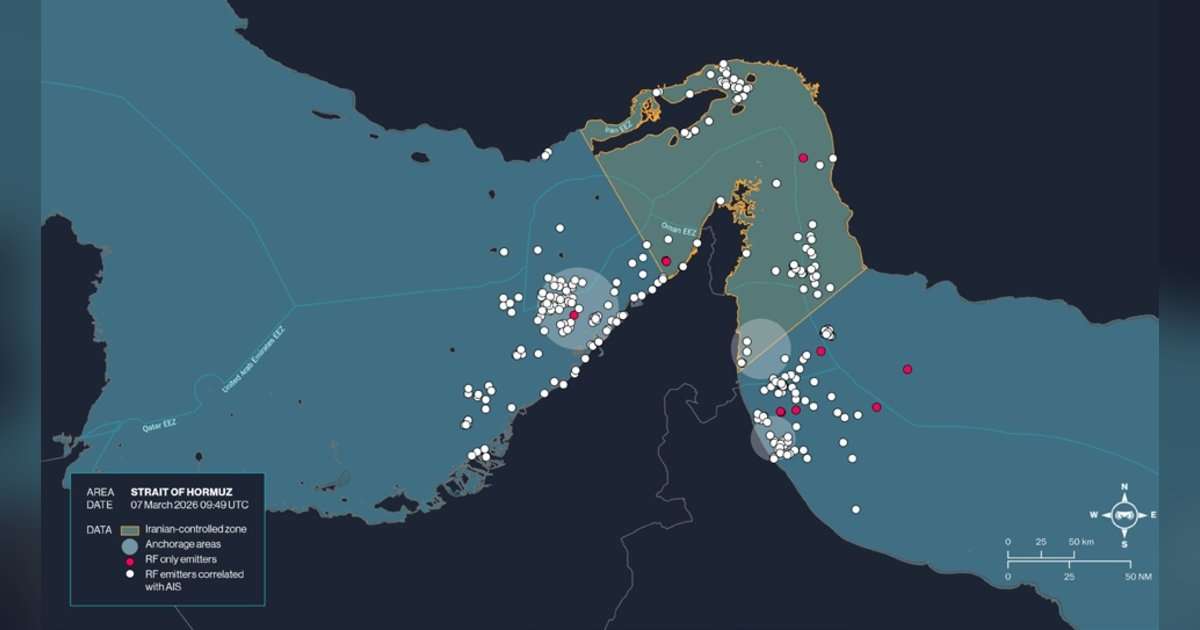
A strategic passage for global trade, the Strait of Hormuz has experienced major disruptions since the conflict escalated in late February 2026. Attacks on vessels, restrictions on passage, and changing shipping routes have made maritime monitoring increasingly challenging.
On March 7, Unseenlabs recorded 555 correlations between RF detections and vessel AIS positions. By the following morning, that number had fallen to 228, while the number of RF emitters without matching AIS positions had roughly tripled. These observations show that maritime activity detectable from space did not necessarily follow the same pattern as reported vessel traffic.
A Russian shadow fleet tanker located during an AIS gap
On May 12 and 13, Unseenlabs observed a sanctions-listed tanker linked to Russia’s shadow fleet. Its journey was interrupted by three AIS gaps lasting 4 hours and 35 minutes, more than 13 hours, and another eight hours.
During the final gap, near an anchorage off the United Arab Emirates coast, Unseenlabs detected an RF emission associated with the tanker, helping confirm its location despite the absence of AIS positions.
Observations near critical infrastructure
On March 31, Unseenlabs also detected 65 RF-emitting vessels without matching AIS positions, representing 9.13% of the activity observed. Many were concentrated off the UAE coast, near mapped subsea telecommunications cable corridors.
These observations help locate maritime activity and identify areas requiring further investigation. However, they do not establish vessel intent or any connection to damage to subsea infrastructure.
This campaign illustrates how space-based RF detection can complement AIS data and maintain maritime situational awareness when cooperative tracking information becomes incomplete.
Explore the full case study, including maps and detailed findings