For a long time, the central question around ocean energy was whether this future technology could work at all: whether machines could survive at sea, generate power reliably, and turn an abundant but difficult resource into usable electricity. Many of those questions have since been answered, and the industry has moved far enough for another set of questions to become the main focus going forward: How can we scale up production of these systems? How do you make them easier to maintain, monitor, and service, improve cost competitiveness, and move from promising projects to an industrial model that can support volume production and large-scale wave parks?
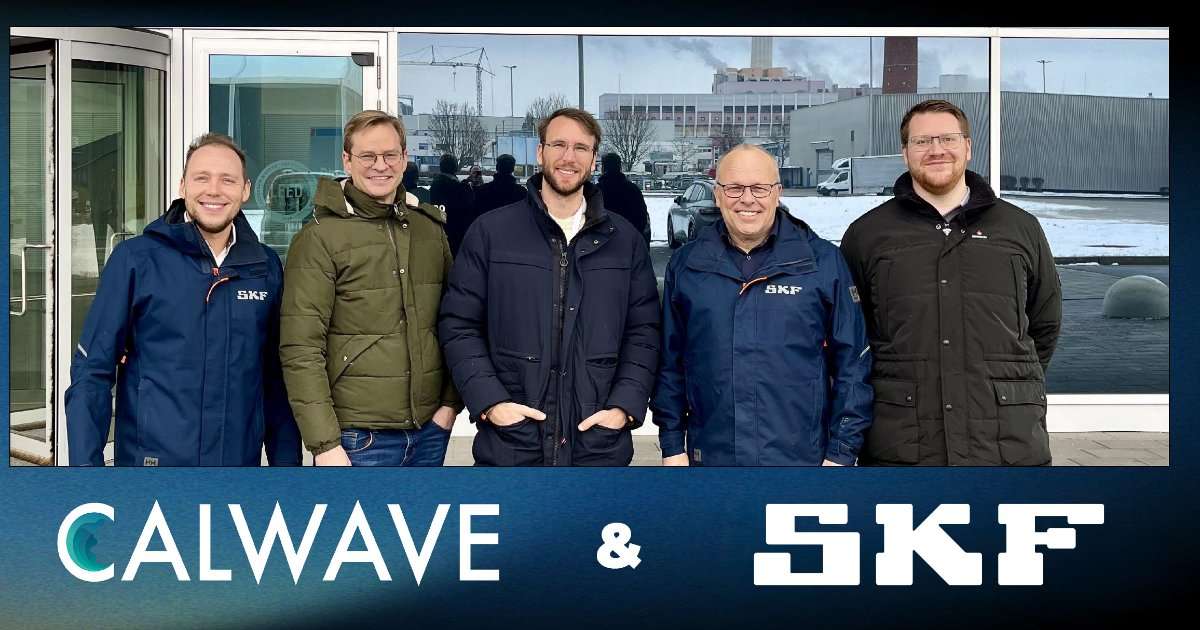
At this point, CalWave and SKF are now bringing their respective experiences together. During the International Conference on Ocean Energy (ICOE OEE 2026) in The Hague, Netherlands, CalWave announced that the two companies have signed a Memorandum of Understanding to explore a commercial supplier relationship for CalWave’s fully submerged wave energy systems.
CalWave, based in California, develops its proprietary xWave™ solution operating fully submerged. A central element of the concept is its ability to manage wave loads while continuing to capture energy across changing sea states, combining the need for energy production with one of the fundamental challenges of operating machinery in the open ocean: survivability.
Over the years, CalWave has progressed from foundational research and demonstrations toward a larger-scale deployment. The collaboration between SKF and CalWave started during the development of CalWave’s first open ocean system, the x1. CalWave validated its technology by deploying the x1 during a long-duration, in situ demonstration in San Diego, CA, that led to two Statements of Maturity from the American Bureau of Shipping (ABS). CalWave has now completed its utility-scale design and started fabrication of the x2. The company is preparing for its next deployment at PacWave South, the first grid-connected wave energy test site in the United States, where it is slated to deliver electricity directly to the grid.
SKF bearings have been part of CalWave’s x1 open-ocean pilot, and for the x2, they have already completed testing at CalWave’s in-house drivetrain test center. This led to a selection of bearings and additional SKF components for the x2 deployment at PacWave. The next step is to explore how that cooperation can grow as CalWave moves toward larger-scale deployment. The MOU provides a framework for examining where SKF components, subsystems, and engineering capabilities can support this growth phase. The areas of collaboration range across bearings and bearing units, sealing and lubrication solutions, condition monitoring, fully integrated rotating equipment solutions, as well as design and application engineering.
The interesting part of the collaboration is less about the individual list of components than the combination of expertise behind them. SKF has been working with machinery at sea for decades. Much of that equipment operates in places that are difficult to reach, exposed to salt water, changing loads, and long service intervals, where reliability is a prerequisite for operation. SKF’s maritime expertise is complemented by a long history in wind, hydropower, and work that is similar to the ocean-energy sector itself. SKF has been supplying components for tidal turbines for around 15 years, including well-known ocean energy installations in the Faroe Islands. Wave energy systems are a different technology, but many of the engineering solutions and learnings can be directly transferred.
As ocean energy matures, those questions increasingly extend beyond individual machines. Building, deploying, and operating dozens and hundreds of systems requires stable processes, defined interfaces, predictable quality, and production capacity that meet the same quality and certification requirements for bankable infrastructure projects. This is where the transition from developing a technology to building an industry becomes visible.
SKF’s role therefore extends beyond supplying components. In Hamburg, SKF designs and manufactures complete systems, power take-off modules, and holistic powertrains, bringing mechanical components, engineering, and production together in equipment that can be assembled, tested, and delivered as a fully assembled, commissioned, and factory-accepted subsystem. For an emerging industry, that capability is crucial because industrialization begins well before production volumes become large: it begins when the product, its interfaces, and its manufacturing strategy are developed with repetition and the full 20-plus-year lifecycle in mind.
The partnership brings CalWave and SKF together around a shared objective: turning proven wave-energy technology into systems that can be manufactured, deployed, and supported at commercial scale. Building on CalWave’s expertise in developing and validating the xWave™ technology and SKF’s industrial, marine, and manufacturing expertise, the two companies will work together on the next step of that journey—translating a successful technology into a reliable and scalable product as the basis of a viable business model.
“Our x1 pilot answered the survivability question—ten months at sea, more than 7,000 operating hours, 99 percent uptime and zero unplanned interventions,” said Marcus Lehmann, Co-Founder and CEO of CalWave. “The next challenge is industrialization: building these systems in series, at cost, on a supply chain that scales. Partnering with a Tier 1 supplier like SKF—proven components today, with the depth to grow toward integrated subsystems—is critical to our move from pilot to serial production.”
“Ocean energy is entering a new phase where success will be defined not only by technology performance, but by the ability to manufacture, deploy, and operate systems at scale,” explained Michael Baumann, Global Application Account Manager Ocean at SKF Marine GmbH. “By combining CalWave’s innovative wave energy technology with SKF’s industrial and marine engineering expertise, we can help accelerate the path toward commercial wave energy deployment.”