Assets worth around $6.7 billion changed hands under this new intent in 2025, a departure from 2020–2024, which was dominated by majors trimming late-life positions and production sharing contract (PSC) expirations. Transaction metrics have risen alongside the competition: recent deals have reached $9.8 per barrel of oil equivalent (boe) for development assets and over $3 per boe for pre-final investment decision (FID) resources, against six-year averages of $6–7 per boe and $1.5 per boe, respectively.
The $9.6 billion is split almost evenly between energy majors ($3.6 billion) and independents ($3.7 billion), with national oil companies (NOCs) accounting for $1.4 billion and a handful of smaller sellers making up the rest. What separates the groups is the growth ambition behind each sale. Majors are selling assets in countries with limited upside to focus on a few core basins, while entering frontier acreage instead through partnerships rather than carrying the risk alone. Independents, sitting on recent pre-FID discoveries such as Harbor Energy’s Andaman portfolio, need capital beyond a single balance sheet to reach FID. NOCs are the most selective of the three, having built up domestic portfolios (such as Petronas through its Searah joint venture with Eni) which now gives them room to rationalize late-life assets at home while eyeing entry elsewhere.
“Growth is the common theme across nearly every portfolio in the region right now. The next 18 months will be shaped by three things: the conversion of pre-FID opportunities into mega M&A deals, the trajectory of premiums on producing assets, and the continued evolution of deal structures into strategic partnerships. For buyers, capital alone won’t win the next round. The premium a bidder can justify will come down to the value creation plan behind the offer.”
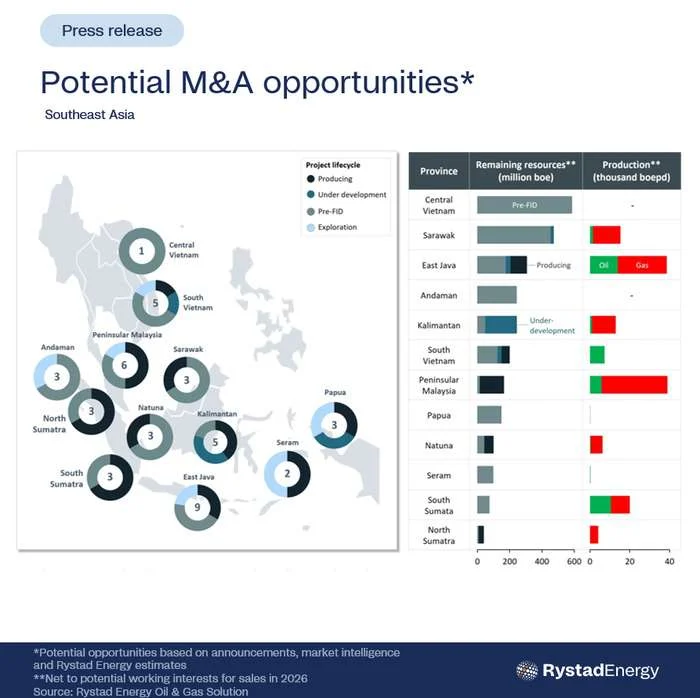
That growth ambition is concentrated in a narrow set of basins. The opportunities span nearly 45 PSCs across 12 provinces, holding 2.8 billion boe of net resources and about 145,000 barrels of oil equivalent per day (boepd) of production. However, 72% of the resources are in the pre-FID stage, while only 18% are producing. Sarawak, the Andaman Sea, and the Kutei Basin hold the region’s largest pre-FID gas positions: Lang Lebah, Harbour’s Andaman II and South Andaman, and Eni’s Kutei hub, where a minority stake is currently on the market. Vietnam’s Ken Bau, which holds 3.7 trillion cubic feet (Tcf) of recoverable resources, is the single largest resource on offer. The field has remained between the appraisal and development stages for years, making a farm-down more plausible than a direct sale as a route to advancing the project.
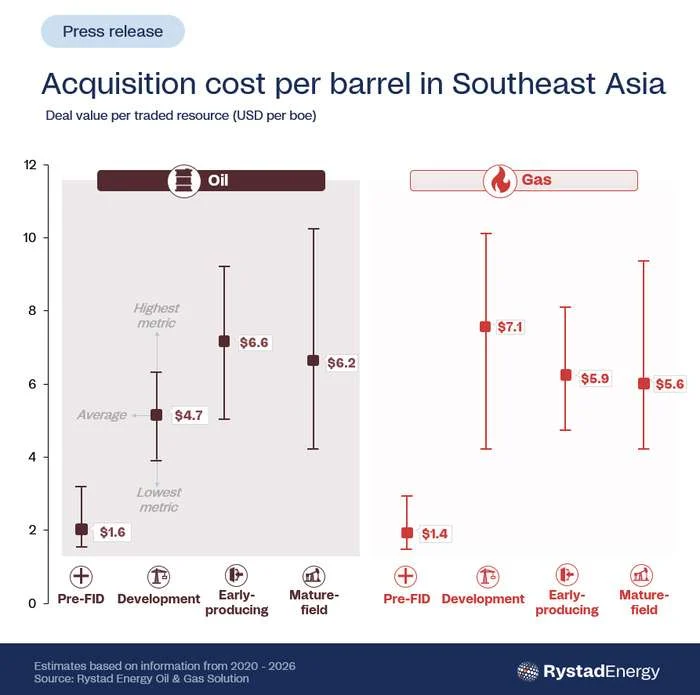
The producing slice is smaller in barrels but the most contested, with just 17 PSCs competing for buyer attention and a track record of commanding a premium near $8 per boe. Chevron’s stake in the North Malay Basin, the second-largest producing gas block in Peninsular Malaysia, is the standout opportunity on offer and a marker of broader retreat: Chevron’s Southeast Asian resource base has fallen from nearly 3 billion boe in 2020 to around 300 million boe today. That contraction is creating opportunities for NOCs. Petronas is expected to lead the next wave of domestic divestments, followed by Pertamina, with state-linked players such as Petros in Sarawak, SMJ Energy in Sabah, and Terengganu Petroleum in Peninsular Malaysia emerging as the natural buyers in their respective home basins. Some upward revision to 2025 totals is expected as additional information becomes available.
While optimism is building across the region, not all assets in the region are progressing the way their owners originally planned. Two consecutive dry wells in Eni’s Vietnamese portfolio have added commercial pressure on Ken Bau, making a farm-out with partner Essar more likely than a direct sale. Abadi LNG could follow a similar path: after its FID announcement, Inpex may look to farm down part of its interest to spread development capital, adding another entrant to the region’s already crowded buyer list.