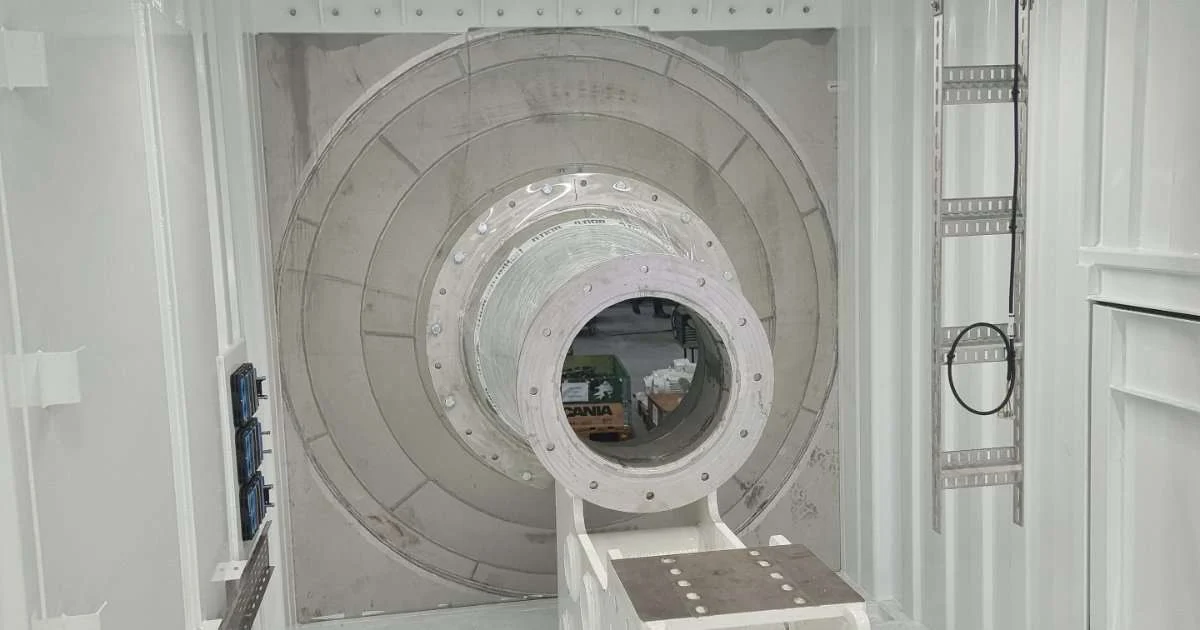
The milestone, witnessed by DNV, marks the moment offshore vessel power and charging move from drawings and simulations to tested hardware.
The containerized VCU houses the 11 kV connector package. Its modular construction allows bow, stern, or under-deck connection and is designed to provide a seamless charging and control interface with the vessel. Housed in its own container, the unit can be integrated on newbuild and retrofitted vessels alike and moved from one vessel to another where onboard cabling permits. Once connected, the VCU integrated funnel enables the vessel to charge at an optimum heading, providing the dynamic positioning operator with total control over charging and disconnection operations.
Graeme Wood, Stillstrom UK MD, said: “For vessel operators, charging at sea is no longer a concept. In simple terms, the VCU has been built and tested, and we are good to go.
“High-voltage power has never been transferred to a vessel offshore in this way, and the connector package inside our VCU represents several years of careful development and testing. The control system and integrated safety interlocks significantly de-risk offshore charging for both vessel owners and wind farm operators.
“Getting from design to reality meant solving challenges unique to offshore charging, including marinized connectors that withstand daily connection and disconnection, all with DNV witnessing critical steps throughout. Work on the wind farm topsides interface is progressing at pace, and by the middle of next year we’ll have the full end-to-end system ready to go to work at sea.”
The company’s complete charging system is expected to be ready for extended offshore trials by summer next year.
Lessons from the prototype are already shaping a Mark 2 design, which will move the current semi-automatic alignment towards full automation.